The pivot is planned to be done through locally developed technology and renewable-energy integration.
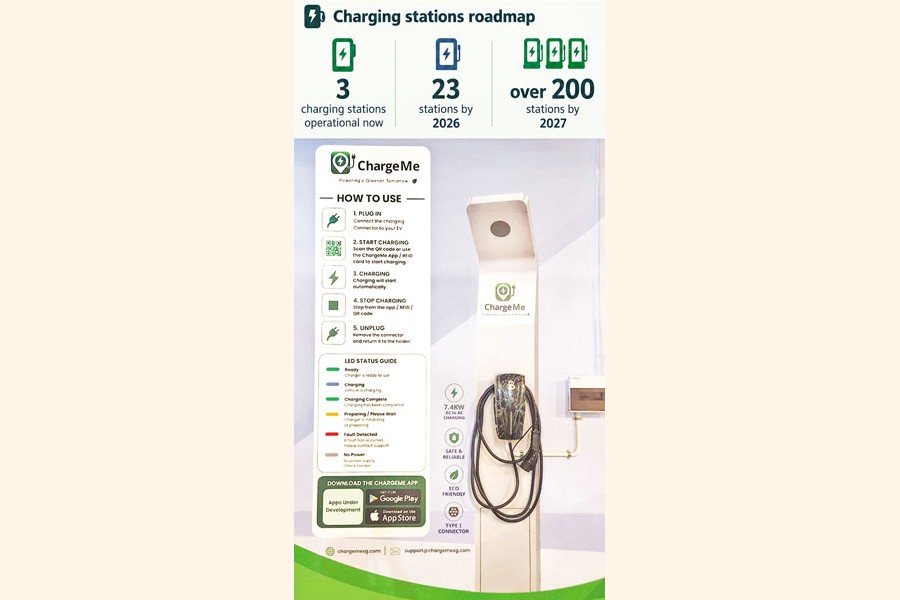
The company has already installed three AC-charging facilities at United International University (UIU), FARS Hotel, and Casablanca in Gulshan, Dhaka. A DC fast-charging facility is currently under implementation at Clean Fuel in Mohakhali in the capital.
ChargeMe aims to expand its network to 23 charging stations by December 2026, followed by more than 200 by the end of 2027.
In the recent months, investors have started showing increased interest in setting up of EV- charging stations. This August, the government asked millions of battery-powered auto-rickshaws to use solar-powered charging stations to get registration.
Also, the selling of electric cars has started rising in the recent months.
These have created opportunity for businesses to make investment in charging stations.
Ezaz Al Qudrat A Mazid, managing director of Solar EPC Development Ltd, has said in the recent weeks he has received dozens of calls from investors expressing interest in setting up solar-powered charging stations.
Unlike conventional infrastructure projects that primarily focus on installing charging equipment, ChargeMe is developing an integrated ecosystem combining EV-charging infrastructure, locally developed software, digital payment systems and renewable-energy solutions.
A key feature of ChargeMe’s initiative is its formal collaboration with the Department of Computer Science and Engineering at the United International University.
Under the partnership, young Bangladeshi engineering graduates are working on the development of charging-management software, equipment-communication systems and digital platforms to support the company’s expanding network.
The collaboration aims to develop local technical expertise, reduce dependence on foreign software, and create opportunities for young engineers in Bangladesh’s emerging electric-mobility industry.
ChargeMe is developing a technology platform intended to accommodate different categories of battery-powered vehicles, including passenger cars, commercial vehicles and electric three-wheelers.
The company plans to prioritise renewable energy, particularly solar power, for its future charging facilities wherever technically and economically feasible.
ChargeMe is exploring charging solutions that can combine grid electricity with solar generation and battery-energy storage where appropriate.
The company also sees considerable potential in developing organised charging infrastructure for Bangladesh’s battery-powered rickshaws and other electric three-wheelers.
Such facilities could help improve electrical safety, enable transparent electricity metering and support more accountable charging operations.
ChargeMe also plans to incorporate carbon-emissions monitoring and reporting capabilities into its charging-management platform.
The company is examining internationally recognised frameworks, including Verra’s Verified Carbon Standard methodology VM0038 for Electric Vehicle Charging Systems, to evaluate whether eligible charging projects could eventually participate in voluntary carbon markets.
The approach would involve maintaining reliable operational records and electricity-consumption data from the outset, although any future carbon-credit registration would depend on applicable eligibility requirements and independent verification.
ChargeMe founder Md Akhtar Hamid Khan says the company wants to demonstrate that Bangladesh can develop its own technology for the emerging electric-mobility industry.
“Our target is to build a fully Bangladesh-developed technology platform capable of supporting all types of battery-powered vehicles. We want to create not only charging infrastructure but also the software, technical expertise and operating systems required to support electric mobility,” he told the FE.
He emphasised that the company’s approach would combine technological innovation with transparency in electricity consumption and financial transactions.
“EV charging should operate through a transparent digital system where electricity consumption and customer payments are properly recorded. Our objective is to ensure that the government’s legitimate revenue is protected while making charging services convenient and reliable for users,” Mr Khan said.
The founder added that ChargeMe eventually aims to introduce its Bangladesh-developed technology and operating model in other South Asian and African markets.
The company also plans to work with EV manufacturers, vehicle importers, property owners, renewable-energy developers and other stakeholders to expand charging availability.
[email protected]