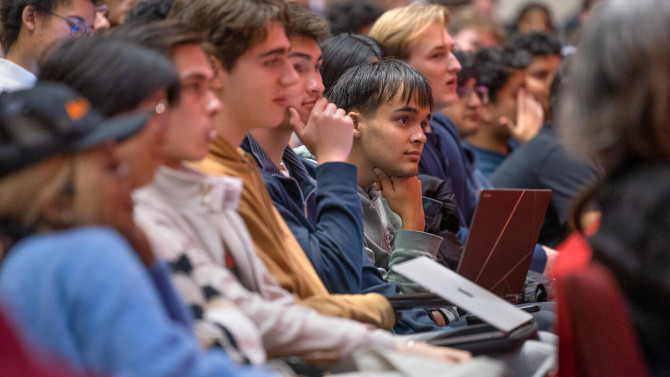
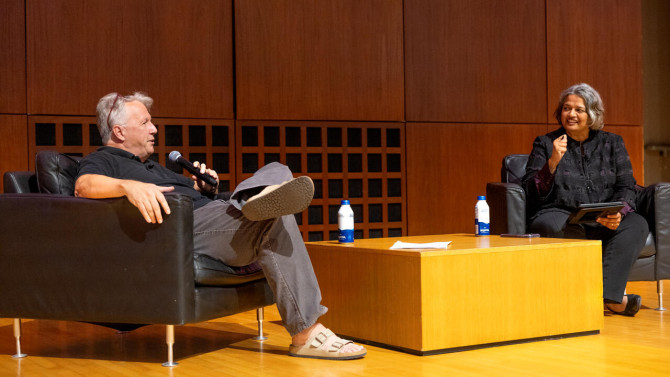
Taking advantage of the opportunities a college education affords and doing what you love are important in a successful startup journey, according to Paul Graham ’86, founder of Y Combinator, one of the world’s most influential startup accelerators.
“You can do a kind of learning in college that most people never get to do again … The kind that makes you rich,” Graham said in a talk, “How to Turn Yourself Into a Startup Founder,” on Oct. 28 at sold-out Call Auditorium. Graham is the inaugural Distinguished Visitor of the Humanities, Social Sciences + AI Initiative, which is led by the College of Arts and Sciences.
Graham emphasized that the path to a successful startup begins with curiosity and learning.
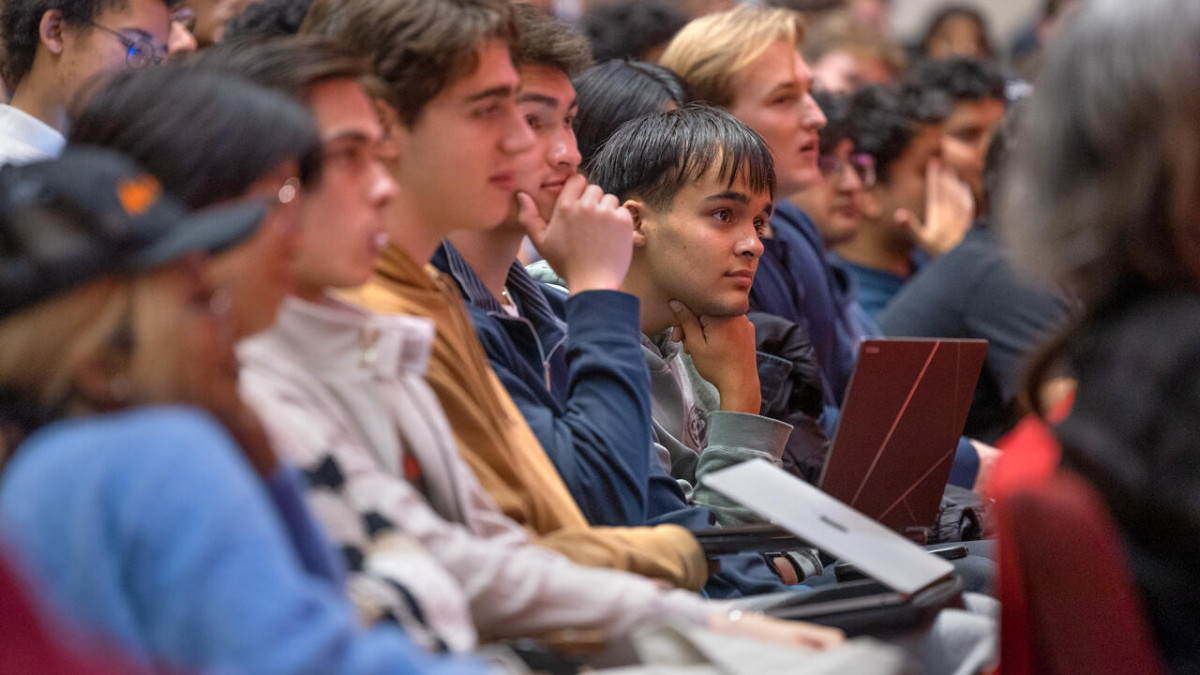
Credit: Ryan Young/Cornell University
Students attend Graham’s discussion on startups.
“Doing things just because you’re curious is the way to get the best ideas,” he said, noting that universities, where one can follow their curiosity wherever it leads, are uniquely suited to generating ideas. He urged students not to drop out to launch a startup, but to take advantage of a once-in-a-lifetime opportunity in college to follow their interests and experiment with building things.
Graham co-founded Y Combinator with Jessica Livingston in 2005; it has since funded more than 6,000 companies, including Airbnb, DoorDash, Dropbox and Reddit. In introductory remarks, Provost Kavita Bala called Y Combinator “legendary” and “a dream launching pad for any startup that wanted to succeed.”
Graham has shared his insights in writing, as well, on topics he touched on during his talk, such as “Making Startups Powerful” and “Is There Such a Thing as Good Taste?“
“The most powerful motivation of all, at least for smart people, is not money or fame or power, but being genuinely interested in what you’re working on,” Graham said. “It’s the same with startup founders as it is with physicists or writers. Nothing can make you work more intensely on something than being interested in it, because if you’re interested, it’s not work. It’s what you’d do anyway.
“The best startup ideas don’t come from sitting around talking about startup ideas,” Graham said. “They come from building stuff you’re genuinely interested in, and only later realizing it could lead to a startup. This is how Apple and Google and Meta got started. They grew out of projects.”
The traditional ideal of a liberal education, Graham said, is the best way to turn yourself into a startup founder. “That is pretty cool when you think about it,” he said, “that curiosity is the way to get rich.”
In a Q&A moderated by Bala after his talk, Graham fielded numerous questions submitted in advance from the attendees, who filled the 600-seat auditorium.
“The biggest pitfall in early startups is indifference: Make something you yourself would use,” he said. He also encouraged the students to “work on your own projects. That’s where startup ideas come from. It’s also fun.”
“How to Turn Yourself Into a Startup Founder” was sponsored by the College of Arts and Sciences; the Cornell Ann S. Bowers College of Computing and Information Science; and the Cornell Duffield College of Engineering.
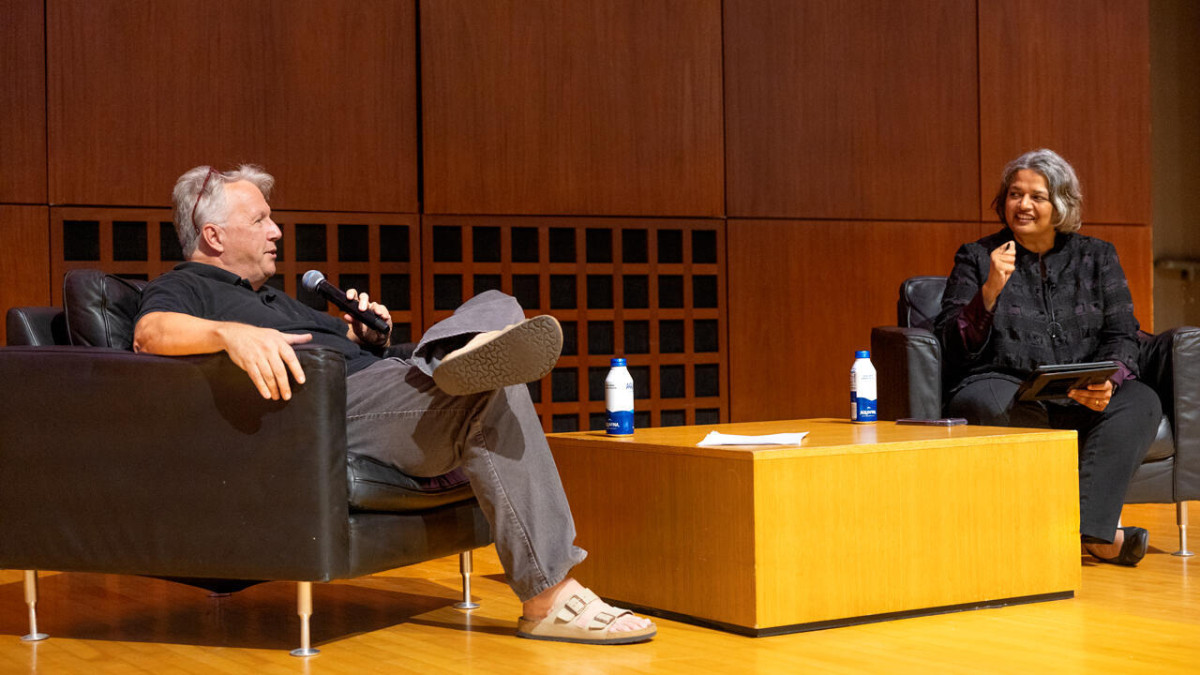
Credit: Ryan Young/Cornell University
Graham and Provost Kavita Bala hold a Q&A session following the speech.
In his role as Distinguished Visitor, Graham also led a roundtable on Oct. 28 with a select group of Cornell faculty and academic leaders that explored the implications of artificial intelligence for the humanities and social sciences. Moderated by Shaun Nichols, Distinguished Professor of Arts & Sciences in Philosophy (A&S), the roundtable gave participants a unique opportunity to engage directly with Graham
Roundtable participants included Sorin Lerner, dean of Cornell Bowers; Thorsten Joachims, Jacob Gould Schurman Professor of Computer Science and Information Science (Cornell Bowers), Vice Provost for AI Strategy and director of the Cornell AI Initiative; and faculty from the departments of Comparative Literature, Science and Technology Studies, Government, Psychology, Music and Economics (A&S).
“The roundtable was an exciting opportunity for in-depth conversation with one of the foremost voices in technology and entrepreneurship,” Joachims said. “Getting Paul’s views on the opportunities and challenges of AI brings an important perspective to our scholarship, and these exchanges strengthen Cornell’s ability to thoughtfully engage with AI.”
Linda B. Glaser is news and media relations manager for the College of Arts and Sciences.
Source link

