Uber is now Lucid’s biggest outside backer after Saudi Arabia’s Public Investment Fund affiliate, and its stake is tied to a robotaxi fleet that hasn’t been built.
About 37.75 million shares of Lucid Class A stock now sit in Uber’s hands, roughly 11.5% of the company. Uber added $200 million to its stake, pushing its total investment in Lucid to $500 million. The move comes with an expanded robotaxi partnership, which Lucid Group disclosed alongside $750 million in fresh investment commitments, according to an 8-K filing with the SEC and a joint press release from both companies. Ayar Third Investment Company, an affiliate of Saudi Arabia’s Public Investment Fund, is putting in the other $550 million through convertible preferred stock.
That 11.5% makes Uber one of Lucid’s largest shareholders, trailing only PIF itself. PIF has backed the EV maker for years and remains its controlling investor. Uber’s first check came in July 2025 at $300 million, when the two companies and autonomous-driving firm Nuro first announced their robotaxi tie-up. This is the second time Uber has added to that position in less than a year. Each time, it has also raised the number of cars it’s committing to buy.
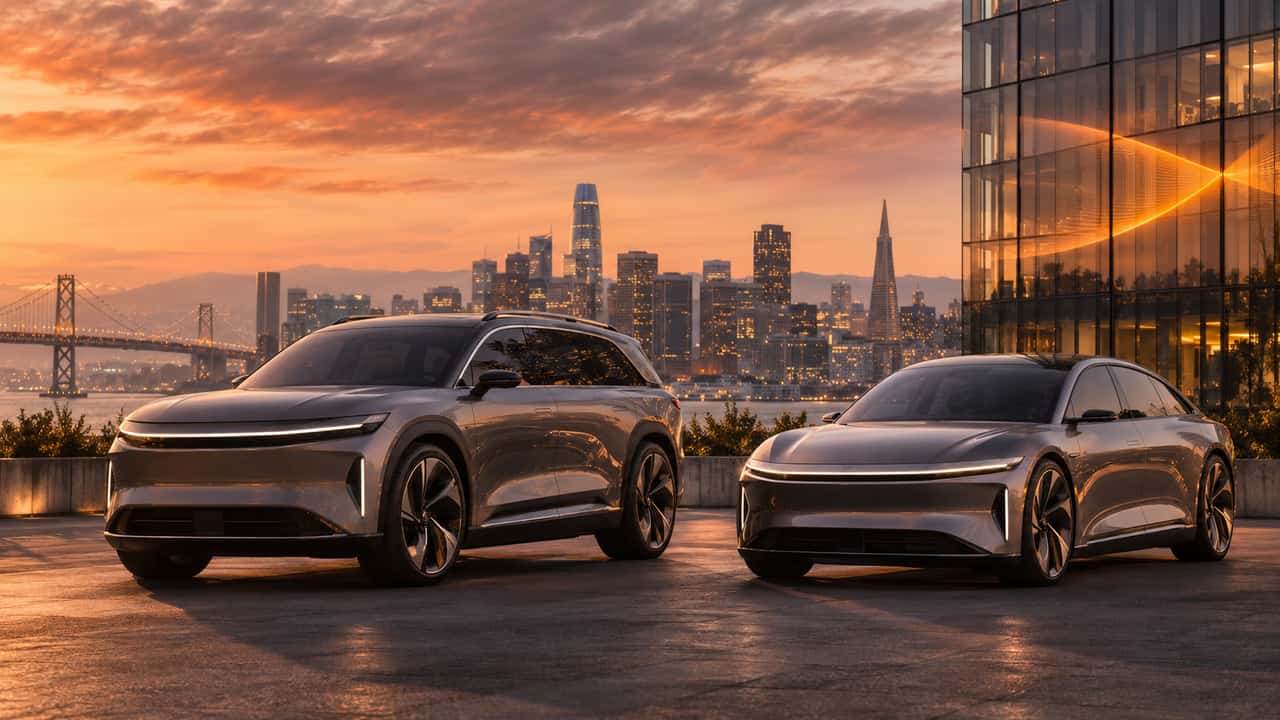
The vehicle order now stands at a minimum of 35,000 Lucid cars for Uber’s robotaxi fleet, up from the 20,000 agreed last year. That number spans two very different vehicles. One is the Gravity, Lucid’s three-row luxury SUV that starts north of $80,000. The other is the still-unreleased Midsize platform, a smaller car Lucid has said will start under $50,000. Lucid is explicit that the cheaper Midsize, not the Gravity, is the vehicle meant to carry the robotaxi business at real scale. A luxury SUV can seed a city launch. It can’t be the backbone of a fleet business that needs thousands of cars built at a cost Uber can live with.
The companies are targeting a commercial robotaxi launch in the San Francisco Bay Area later in 2026, running on Nuro’s self-driving system layered onto the Gravity. Lucid has said it finished delivering its test fleet in February, and on-road autonomous testing with Nuro began in December 2025. San Francisco is already the most contested robotaxi market in the country. Waymo is running commercial service across the city, and Tesla is pushing its own robotaxi ambitions in Texas and California. Uber doesn’t operate a robotaxi fleet of its own anywhere. It is instead betting on becoming the dispatch and demand layer for other companies’ self-driving cars. Lucid is now the vehicle it has put the most money behind.
That’s the real shift here. Uber built its original business by owning no cars and employing no drivers. The robotaxi era is pulling it in the opposite direction: it now holds an equity stake in the company making the cars, and a say in vehicle design. It also has a direct financial interest in whether Lucid survives long enough to build 35,000 of them.
Lucid needs that money. The company has burned cash every year since going public and has leaned on PIF, which has committed billions in total funding, to keep operating. Convertible preferred stock from an Ayar entity is a familiar instrument for Lucid at this point. It’s a way for its largest backer to inject capital without an outright common-stock dilution hit at today’s price. Uber’s additional $200 million checks a different box. Uber has no obligation to prop up a struggling automaker, yet it sees enough value in locking in vehicle supply and ownership upside to keep writing checks.
Lucid shares jumped as much as 13.9% intraday on the news before settling to a gain of roughly 4.6% to 5.3%, according to figures reported by Nasdaq and Barchart. That’s a real pop for a stock that has spent most of the past two years sliding. It’s also a reminder of how thin the margin for enthusiasm is: Lucid still posted another unprofitable quarter heading into this deal. And the robotaxi order, however large, is a promise of future vehicle sales rather than revenue booked today.
What Uber is actually buying with that 11.5% stake is optionality. If the Bay Area launch works and Nuro’s technology scales, Uber already owns a piece of its own supply chain. In effect, it has a discount on the cars it’s going to need by the tens of thousands. If it doesn’t work, Uber has still spent $500 million acquiring equity in a company whose biggest backer is a sovereign wealth fund unlikely to let it go under quietly. Either way, Uber didn’t just sign a supply contract. It bought a seat at the table.
Also read: How to Calculate Your Startup’s Net Dollar Retention by Cohort • How To Calculate Your Startup’s Expansion Revenue Ratio Before Renewal • How to Calculate Your Startup’s Pilot-to-Paid Conversion Rate
This article is posted in Startup News, check it out for more related stories.
Almost there. Sign in and your reply posts straight away.