Reno’s Positron AI has raised $1.105 billion this year and Las Vegas-based TensorWave $350 million; both took their first checks from Nevada sources, while Korea’s FuriosaAI raised 820 billion won in October
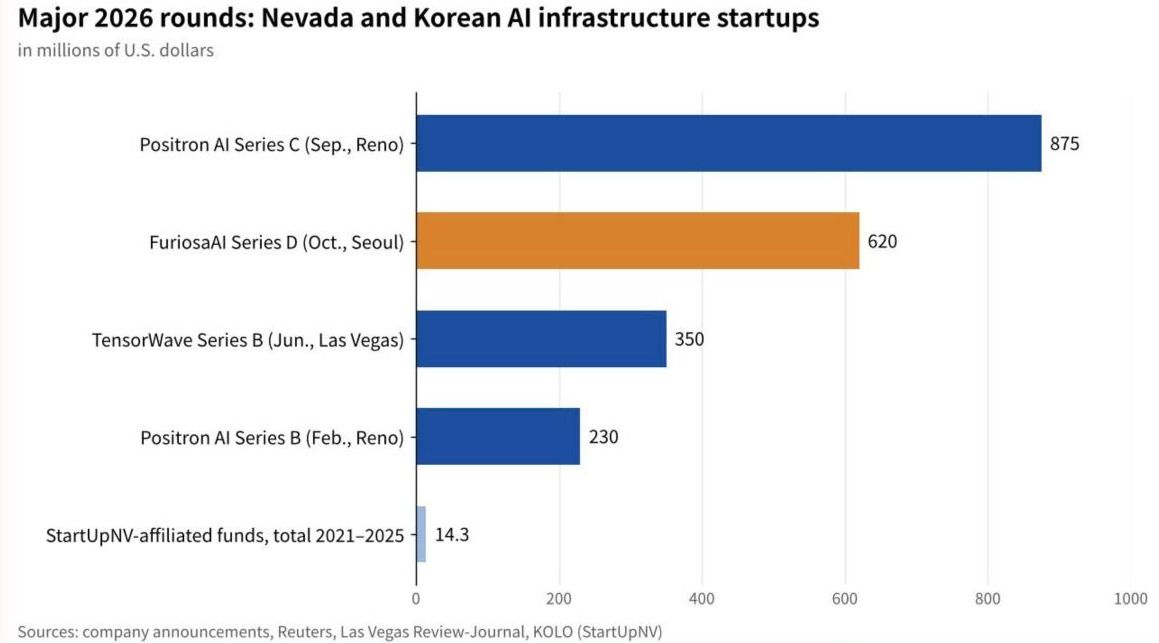
Positron AI, an AI inference-chip startup in Reno, Nev., raised $875 million on Sept. 10 at a $5 billion valuation. The round came seven months after the company raised $230 million in February.
TensorWave, a Las Vegas AI cloud company, closed a $350 million Series B in June. It was the largest Series B in Nevada startup history, the Las Vegas Review-Journal reported. Together, the two companies have raised $1.455 billion this year.
Nevada’s local early-stage pool is far smaller. Since 2021, three funds affiliated with the nonprofit StartUpNV have put $14.3 million from 475 investors into 27 startups, KOLO reported. That is less than 1% of what the two companies raised.
The flow of money into AI infrastructure mirrors the national market. AI companies took 86% of the $412.7 billion in U.S. venture investment in the first half, and deals of $100 million or more accounted for 87.5%, according to the PitchBook-NVCA Venture Monitor. In Nevada, that trend shows up in one AI chipmaker and one AI cloud. Both got their first investors at home.
Positron’s valuation more than quadruples in seven months: $230 million in February, $875 million in September
Positron builds chips and servers for inference, the work of running AI models in live products. Its design uses commodity memory instead of costly high-bandwidth memory to cut power and cost.
The September round came in two parts. A $375 million Series C was priced at a $3.5 billion pre-money valuation and co-led by NEA, Atreides Management, Valor Equity Partners, Andra Capital and SemiAnalysis Capital. A Series C-1 of up to $500 million is led by NEA and Netscape co-founder Jim Clark, Reuters reported.
The Qatar Investment Authority, Arm and Supermicro joined the $230 million Series B in February, which valued the company at more than $1 billion. Positron’s first backer was Nevada venture firm Flume Ventures, which led a $23.5 million seed round in February 2025. “Northern Nevada gave us the environment to do that,” CEO Mitesh Agrawal said at the time of the Series B, referring to scaling the company in the real world.
TensorWave’s seed, Series A and Series B each set Nevada records for an AMD-only AI cloud
CEO Darrick Horton, President Piotr Tomasik and Jeff Tatarchuk founded TensorWave in Las Vegas in December 2023. The company runs its AI cloud entirely on AMD Instinct GPUs instead of Nvidia chips.
Less than a month after its founding, it received $2.2 million from StartUpNV. It then raised a $43 million SAFE in October 2024, a $100 million Series A in May 2025 and the $350 million Series B this June, each a Nevada record. Magnetar and AMD Ventures led the Series B at a $1.55 billion valuation, and the money will expand its AMD Instinct MI355X GPU clusters.
TensorWave has secured more than two gigawatts of long-term data center capacity. It also received $210,000 in tax abatements from the Nevada Governor’s Office of Economic Development (GOED), the Review-Journal reported.
| Company | Location and field | 2026 funding | Valuation | First investor |
|---|---|---|---|---|
| Positron AI | Reno, AI inference chips | $230 million (Feb.), $875 million (Sept.) | $5 billion | Flume Ventures (Nevada) |
| TensorWave | Las Vegas, AI cloud | $350 million (June) | $1.55 billion | StartUpNV (Nevada) |
| FuriosaAI (퓨리오사AI) | Seoul, AI inference chips | 820 billion won ($620 million, Oct.) | 3.8 trillion won ($2.9 billion) | — |
State-linked seed funds put in $14.3 million over five years, with matching programs filling first checks
State matching underpins Nevada’s early-stage investing. StartUpNV is affiliated with three funds: FundNV, AngelNV and the 1864 Fund. The 1864 Fund is paired with Battle Born Venture, the state’s venture program, which uses federal State Small Business Credit Initiative (SSBCI) money to match the fund’s investments one-for-one. The 1864 Fund has invested $10 million in eight companies so far.
There is matching at later stages too. The Battle Born Growth Escalator matches part of the venture money that Nevada startups raise; Las Vegas startup Lucihub received up to $750,000 through it. Private capital is growing as well: Flume Ventures filed with the Securities and Exchange Commission in December to raise a $125 million fund.
Positron and TensorWave took their first checks inside this system, then drew large rounds from national venture firms and chip companies. State and local funds cover the seed stage, and outside capital such as NEA, AMD and Magnetar fills the later rounds.
FuriosaAI raises 820 billion won as Korea competes in the same inference-chip market
Korean AI chipmaker FuriosaAI (퓨리오사AI) closed a Series D of 820 billion won ($620 million) in October at a valuation of 3.8 trillion won ($2.9 billion). Korea’s National Growth Fund (국민성장펀드) led with $280 million. FuriosaAI began mass production of its RNGD inference chip in January and plans to make 20,000 this year and more than 40,000 next year. It is developing its third-generation chip with Broadcom.
Positron and FuriosaAI both build AI inference chips, now valued at $5 billion and $2.9 billion. Their funding paths differ. In Nevada, state money comes in at the seed stage through one-for-one matching, and private venture firms and strategic investors take the large rounds. In FuriosaAI’s case, a government-led fund led a late-stage round.
For Korean AI infrastructure and chip startups, Nevada’s setup matters in two ways. A Nevada entity can tap state programs such as Battle Born Venture matching and GOED tax abatements. And companies like TensorWave are locking up large amounts of data center capacity around Reno and Las Vegas, putting customers close to makers of inference chips, servers and cooling systems.
The AI-infrastructure tilt continues; Positron’s C-1 and new data centers are the 2027 variables
Positron’s Series C-1 brings in up to $500 million depending on conditions, and whether all of it arrives will set the pace of the company’s production ramp next year. TensorWave is moving to fill its two gigawatts of secured capacity with GPU clusters.
Las Vegas rose four places to No. 23 in the U.S. in StartupBlink’s 2026 Global Startup Ecosystem Index, the Review-Journal reported. With most of Nevada’s startup money concentrated in two companies, the size of the state’s 2027 total will depend on whether a next wave of companies follows them. Korean AI and chip companies heading to Las Vegas for CES 2027 in January can see the region’s data center and investment ecosystem firsthand.
Source link
