September 12, 2025
13 min read
Key takeaways:
- Health care startup accelerators are an increasingly popular business model in medicine.
- Accelerators can help physicians commercialize innovative tools to solve health problems at scale.
Many physicians are moving to the private sector with health care technology startups and accelerators, looking to make a difference without relying on philanthropy or federal funding.
Health care startup accelerators are “varied types of programs that support early-stage health care companies or new health care ideas, and help them develop and scale up their business,” Adam M. Klein, MD, FACS, chief of the division of laryngology, vice chair of faculty development and mentorship, and the Willard and Lillian Hackerman Professor in Voice at Emory University School of Medicine, told Healio.

That can be done in various ways, Wilbur A. Lam, MD, PhD, associate dean of innovation at Emory University School of Medicine, vice provost for entrepreneurship at Emory University and director of the Center for Advancement of Diagnostics for a Just Society, told Healio.
“Typically, an accelerator offers a few things to the startups — sometimes it’s literal space — like you can come to our place and we will house you — and sometimes it’s services. Maybe it’s commercialization services, for example,” Lam said. “Typically, startups are formed by ideas and concepts generated by research scientists or physicians, like myself, who know about the biomedical problem, know about the technology, but maybe don’t know about the commercialization side of things — the business side of things. So, an accelerator often helps on that front.”
The accelerator then receives something in return — typically, rent or a part of the company’s equity. Of course, the exact situation will vary, but “that is kind of the typical definition,” Lam said.
The two most popular accelerator models are an in-house academic model and an external model, where the accelerators “basically are feeder programs” for venture capitalists, he said.
Klein agreed, noting that accelerators can “come in all shapes and sizes.”
“Those of us in the academic world have access to the university-affiliated programs, but there are a lot in the ecosystem that are open to all,” he said.
For example, Techstars and Portal Innovations “have a presence in many cities,” Klein said.
Lam also mentioned Techstars and Y Combinator as “the big, national accelerator ‘chains’ that are almost like the Starbucks of accelerators — there’s almost one in every city.”
According to Rock Health, a digital health innovation company, venture funding for digital health startups in the United States reached $10.1 billion in 2024, with more investors focusing on early-stage deals.
Hansa Bhargava, MD, Healio’s chief clinical strategy and innovation officer, said that physicians and other health care providers “should consider being involved in health tech startups as they are truly the experts in what happens with patients in practice and hospitals.”
“It is essential for products being developed to have the insights of outcomes and workflow integration that clinicians bring to the table,” she told Healio.
Firsthand experiences
Lam has had a few startups come out of his laboratory, but there is one project he has been focused on in the last few years, as he saw it from an idea to product launch.
It started as an academic problem. Lam is a pediatric hematologist, “so everything that we do is very focused on solving biomedical problems through that lens of helping patients,” he said. About one-third of the world has anemia, particularly in countries without many resources, so he directed a few students to work on biomedical projects focused on anemia. The undergraduate students created a test that takes a drop of blood and changes its color based on the severity of anemia it detects, if any at all.
The group then had to “do what academics do,” Lam said: they published a formal research paper on the test and filed for patents. While waiting for the patents to come through, they decided to form a startup, Sanguina. The main undergraduate student on the project was graduating and opted to take on the project full-time as the CEO.
“Over the next few years, we …. went through both our own university’s accelerator program as well as an external accelerator program and, ultimately, got some funding,” Lam said.
Now, he works as the chief medical officer of the startup company alongside CEO Erika Tyburski — the former student.
“I manage a team of 16 brilliant minds navigating the world of accessible blood health tools. We have a few products, including Ruby, a smartphone app wellness tool for blood health management,” Tyburski told Healio. “We are … launching the only FDA-cleared home anemia test, AnemoCheck Home, this fall.”
The app, Ruby, can be used “to check your fingernails to understand your risk for iron deficiency and iron deficiency anemia, and track your circulation scores,” Tyburski said.
Lam said he helped cultivate what he likes to call “the fingernail selfie” with a PhD student who has beta thalassemia major — a genetic disease that makes him chronically anemic. The student worked to develop a machine learning algorithm to determine whether someone is anemic “by taking pictures.”
“He was the best person to do this, because he was not only a great computer coder, but he also has chronic anemia. In fact, needs and receives a blood transfusion every month,” Lam said. “He was his own dataset initially, and it worked. Then, he expanded his dataset to include different patients who we had at our academic medical center.”
Lam said he and the student leveraged all the assets of the academic center to benefit the startup company, “so that they could create this kind of virtuous cycle together.”
“Our startup right now is trying to figure out how much are we an app company that goes straight to the consumer, or how much are we a company that works with the pharmaceutical industry, or a little bit of both,” he said. “Every startup is constantly having an identity crisis, because otherwise it wouldn’t be a startup.”
Tyburski said creating a startup is very “high risk, high reward.”
“We have seen other companies rise and fall very quickly in our space. Funding alone is not sufficient; a great idea alone is not sufficient; and a great team alone is not sufficient. You need all three, plus some luck to succeed. For Sanguina and my journey, specifically, it has absolutely been worth it,” she said. “It took a lot to get here, but the right team and idea can get you a long way.”
Klein has worked on several projects but told the story of his first experience with intellectual property that was commercialized. He focuses on laryngology and said it was evident early on “that it was very challenging to train residents and fellows and early-career surgeons how to perform this kind of surgery.”
“It’s very nuanced. It’s under the microscope, a lot of it. So, we were trying to figure out a way to train people so that they didn’t have to practice on real people,” he said. “The intellectual property that I developed was a training device or station that simulated the type of surgery that we do, phonosurgery.”
Emory University helped them patent the technology, and the team then made a prototype that they validated and used in their own lab.
“We made a couple of them, and it wasn’t until a random encounter with someone who actually worked in the laryngology space as a vendor happened to pop by my office one day. We were talking about instruments that he sold, and he saw my prototype sitting there,” Klein said. “A couple months later, we saw each other at a meeting, and he approached me.”
The vendor asked about commercializing the trainer, negotiations started, the startup licensed the intellectual property through Emory, they improved the model with an engineer’s help and the product hit the market.
“It was a pretty exciting time. I stayed on as an advisor, and then we started selling the trainers to various ENT training programs around the country,” Klein said. “This was the year or so leading up to COVID … and so, unfortunately, about 2 years into COVID, they ended up folding because money was frozen at the university level.”
“They did sell out of their inventory, which was nice, but they decided it was just a little too risky [to keep going],” he continued. “But it was a very exciting journey to see something actually take on some legs and make it out there to the market.”
Mentorship
Lam and Klein said a major way accelerators help startups is through interpersonal relationships: mentorship, network and consulting can all help startups take their idea to commercialization.
Usually, a mentor is someone who has experience with startups, but there are “many different flavors,” Lam said. They can be all-around guides, or they could have a more specialized focus on the clinical, commercialization or regulatory aspects of the process.
“Mentors are people who have done this before and want to give back. That’s the best type of mentor: a mentor who doesn’t have any personal gain,” Lam said. “Sometimes mentors do become part of the team, and that’s fine, too — you just have to know where they’re coming from.”
In fact, that is one of the places where Lam has landed in his career.
“I tell people who want to do this that you need to find at least one person whose livelihood depends on this for this to work out, and that’s probably not you, unless you’re going to take a leave from your position or you’re changing your career trajectory,” he said. “That’s my own soapbox, and I’ve certainly practiced what I preach: in the companies that have come out of my laboratory, I’m not the CEO. I’m an advisor, I’m part of the C-suite, but I’m not the person who’s spending 24/7 on this.”
Tyburski said working with Lam has been a major benefit to the startup.
“The clinical insight he brings to Sanguina has been invaluable,” she said. “In small companies, there is no set way to do something. You and your other co-founders have the freedom to run it as you like. We’ve been very lucky to have the right team and the right time to build Sanguina from the ground up.”
Klein said mentors often have a “pay it forward attitude” since “we all, on some level, have had to figure certain things out ourselves.” One of the benefits there is that mentorship can come in a variety of forms, he said.
“At the academic level, there are undergraduate, graduate and undergraduate and graduate programs that often are calling for physician mentors,” he said. “For example, at Georgia Tech, there’s something called the Capstone Program. They have a master’s program in biomedical innovation and development. I’m a mentor for those programs, and that allows us to work with engineer undergrads and engineer grad students who are looking for opportunities to develop a device. We mentor them through all of those stages over a basically year-long process to help them try to find an unmet need and then try to do their customer discovery, figure out different prototype ideas, and take them all the way through to their final presentation at the end of the year.”
Klein and a colleague also recently created an innovation curriculum for faculty to help them learn about the process, generate ideas, “and just give them more awareness of the innovation ecosystem.”
Being a board member or advisor for a company is another way to become a member, but Klein said it is also about “just being available for people.” In the project he is currently involved with developing, for example, Kein is reaching out to colleagues with relevant expertise related to Parkinson’s disease or wearable technology.
“We reach out to people who are in that respective space to just pick their brain, figure out how to avoid making mistakes — or perhaps they have good networking opportunities for us,” Klein said. “A lot of it is just kind of informal mentoring, and I would say that’s just the nature of the innovation space: a lot of conversations, a lot of networking. In general, a lot of people are willing to help out.”
Why and how to get involved
Klein said there are several reasons for physicians to get involved in startups, and it can be as simple as being “someone who notices or acknowledges unmet needs that you want to try to fix. It taps into creativity, it taps into problem solving, it taps into the innovation process and it can be rewarding in a lot of ways to see an idea come to life.”
“I would recommend people try it even if they don’t know much about it,” he continued. “Step out of your comfort zone and try it, because you just don’t know what journey you’re going to have.”
Klein also said there is some responsibility for providers to help advance medical technology “because we’re the ones who are kind of in the trenches, so to speak, and so we’re very familiar with a lot of the issues, or pain points.”
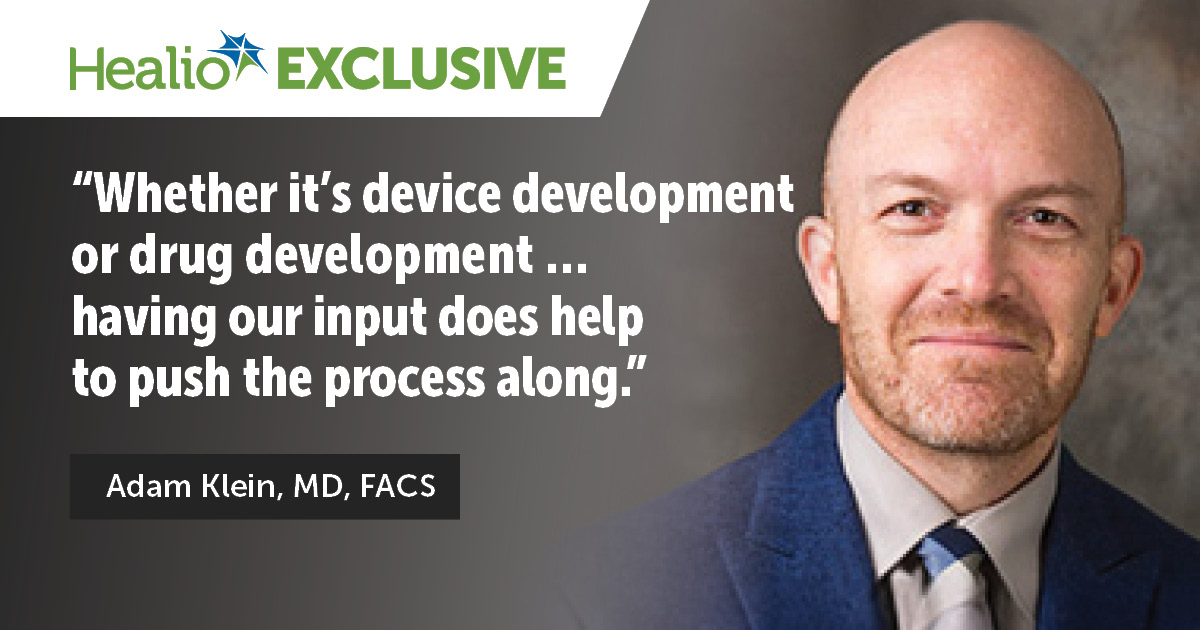
“It is useful to have us actually helping to either develop products or iterate on products to make them better, because we understand those issues quite well,” he added. “Whether it’s device development or drug development or whatever it might be, having our input does help to push the process along and improve the standard of care for people.”
So, Klein said that even for independent practitioners, engaging with an accelerator after finding an idea to develop “is a fantastic idea, even at an early stage, because they can take you from what they call phase zero — design development and concept generation — all the way through full commercialization. They can usually deliver at all different levels and help you navigate those different steps. The challenge, of course, is that they usually charge for those services. I mean, it’s a business, and they’re trying to, basically, contract with clients, and so the challenge becomes funding,” Klein said.
He advised anyone considering a startup to investigate the resources in the local ecosystem — especially if that is a university setting — seeking out grant funding, “or working with foundations that might be related to the problem you’re trying to address.”
“There are different ways to get funding that might help you support the involvement of an accelerator,” Klein said. “If the funding is in place, then an accelerator is typically going to come with people with know-how, people with a lot of connections to help with networking, and they can really help push you forward through the development and commercialization process.”
Lam said “the key is to figure out which accelerator is best for the individual project and investigator.” He also recommended seeking out a mentor.
“Work with people who have done this before. As a physician, you have a certain domain of expertise, and you have a certain domain of expertise that you lack,” he said. “Find the people in your ecosystem who have done this. Find a good partner who is willing to learn from you on the clinical side.”
Lam also said it is important that “you, yourself, have to be willing to be a little humble and reduce yourself, in many ways, like a child when it comes to these aspects that you haven’t done before. It’s very humbling, but it’s worth your while. Basically, learn as much as you can and work with people who can teach you.”
Klein’s advice is to learn to recognize “there’s no cookie cutter way to do this,” and be adaptable throughout the process.
“Understand that the journey is totally unpredictable, but also exciting at the same time,” he said. “Be aware that there’s a lot of pivots in the process. Being open to moving around those challenges and to making adjustments, I think, is an important part of the process.”
Privatization without compromising morals
Lam said it is possible to enter the private sector without compromising morals or ethics — in fact, it may even be necessary.
“There is a role for commercialization when it comes to biomedical science, and it doesn’t need to feel icky. It doesn’t need to be ‘selling out.’ … It’s an understanding that commercialization is needed to solve a biomedical problem at scale and for it to be financially sustainable,” Lam said. “You have to deal with the private sector, because otherwise you’ll never be able to solve a biomedical problem at scale in a financially sustainable manner, at least as of 2025.”
He said it may be necessary to use health care startups as a way to work within the system to make it better because more traditional avenues like philanthropy “can only go so far.”
“What we’re learning is, in today’s political climate, even the federal government can only go so far, because they’re starting to scale back their interest in research,” Lam said. “NIH budgets are probably going to decrease and the universities are probably going to get less federal funding. If that’s the case, then it’s up to the inventors to really figure out how best to scale up their technology so that they can help as many people as possible, and in a financially sustainable manner so that they’re not at the whim of politics.”
Even so, Lam said he sometimes speaks to physicians who are hesitant to work with the private sector, “which is often perceived as an ‘evil, capitalist’ system that is the main reason why health care costs in our society are so high.”
“I understand the sentiment completely. But if you’re trying to help as many people as possible, and at a scale where you really want to solve problems, unfortunately, you can’t really ignore it,” Lam said. “We live in a fairly capitalist society, and unless there’s a huge revolution that happens, that will remain the case, so, therefore, you can’t ignore the private sector. I am not a capitalist by nature, but I’ve realized that the only way I can solve a problem at scale is to work on some of these aspects.”
“That’s why I think it’s important,” Lam continued. “It’s really the final stage of clinical translation and the end part of solving a biomedical problem at scale. And if you want to help as many people as possible in a sustainable manner, you have to deal with this aspect of medicine.”
For more information:
Hansa Bhargava, MD, and Erika Tyburski can be reached at [email protected]. Adam M. Klein, MD, FACS, can be reached at [email protected]. Wilbur A. Lam, MD, PhD, can be reached at [email protected].
References:
Sources/Disclosures
Source:
Healio Interviews
Disclosures:
Bhargava and Klein report no relevant financial disclosures. Lam and Tyburski are executives for Sanguina.

Ask a clinical question and tap into Healio AI’s knowledge base.
- PubMed, enrolling/recruiting trials, guidelines
- Clinical Guidance, Healio CME, FDA news
- Healio’s exclusive daily news coverage of clinical data