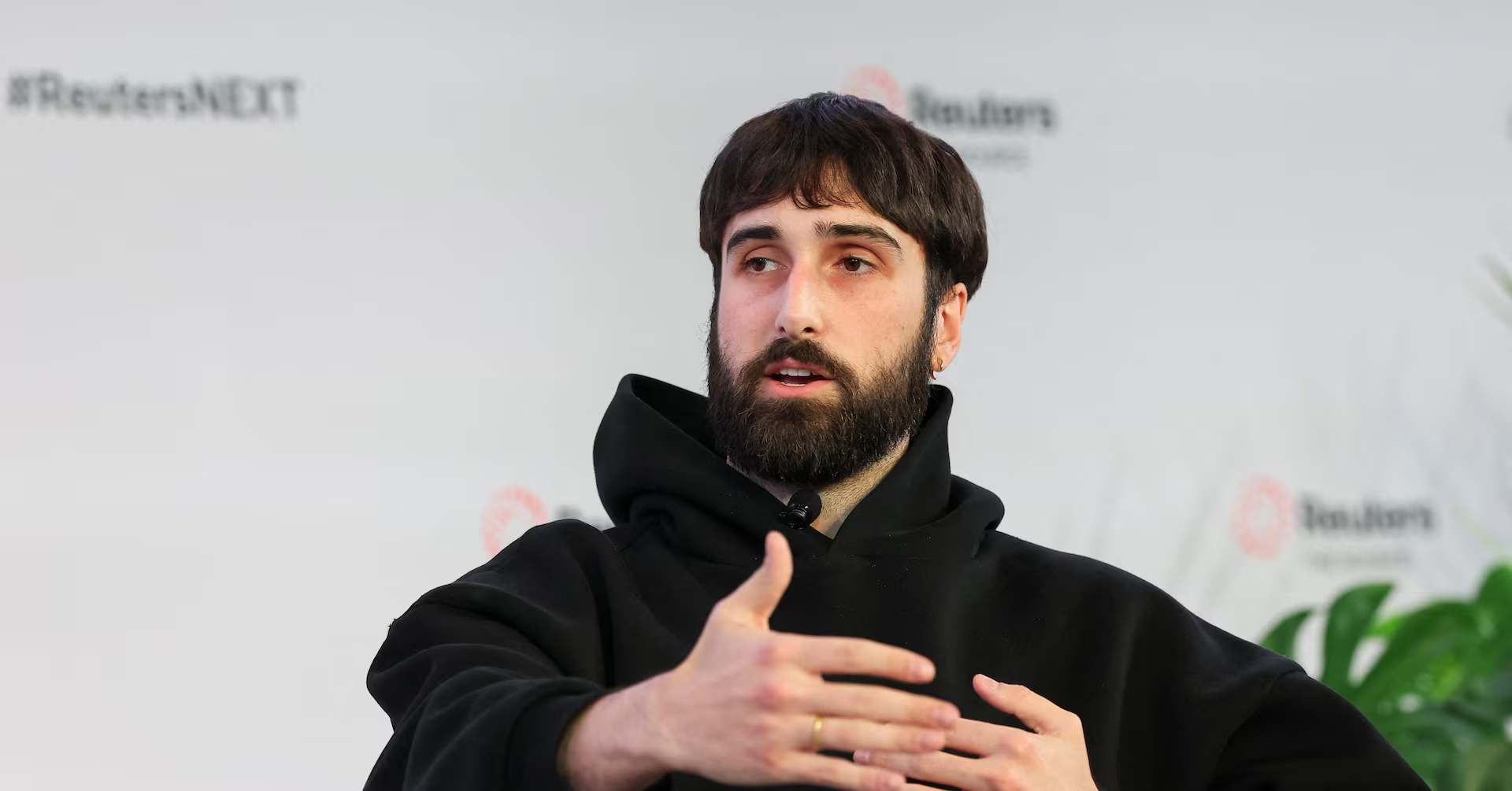
Dec 4 (Reuters) – Canadian tech startup Cohere’s CEO Aidan Gomez said on Thursday the U.S. and Canada hold an “incredible position” to partner with economies adopting AI around the world, putting the countries in the lead against China in the global AI race.
Speaking in an interview at the Reuters NEXT conference in New York, Gomez noted China has put out extremely high-performing AI models, narrowing the gap between some of the best closed-source large language models, such as OpenAI’s.
Sign up here.
But “the thing that actually matters is who is the primary service provider of this technology – it’s not who gets the technology first, but who commercializes it at scale. The U.S. and Canada sit in an incredible position to be the world’s partner in adopting this technology,” Gomez said.
“I think we will win against China.”
To fuel America’s ambitious goals of being an AI frontrunner, Big Tech and AI companies in the U.S. have poured billions of dollars to boost computing capacity and their AI infrastructures.
LIBERAL DEMOCRACIES NOT WILLING TO USE CHINESE TECHNOLOGY
Gomez added that liberal democracies around the world tend not to be very willing to use Chinese technology as critical infrastructure in their economies: “If you’re going to pick a partner to rely on to transform your entire economy, I think you will pick a liberal democracy.”
Toronto-based Cohere builds enterprise-specific AI models.
“Spending an incremental $10 billion a year to improve your model does not deliver the return on investment on the technology itself to justify that … over the past few years, since there’s been all of this scaling, we’re seeing a slowdown in the improvement of the models,” Gomez said.
While companies’ efforts to reach artificial super-intelligence have scaled higher in recent years, so have concerns around the risks of such advanced AI technologies.
“I personally don’t believe a lot of these stories of ‘Terminators’ and doomsdays and these sort of sci-fi narratives that emerged,” Gomez said.
“They’ve since become unpopular, because people have been faced with the reality of the AI technology.”
Reporting by Deborah Sophia in Bengaluru and Juby Babu in Mexico City; Editing by Chris Reese
Our Standards: The Thomson Reuters Trust Principles.
