
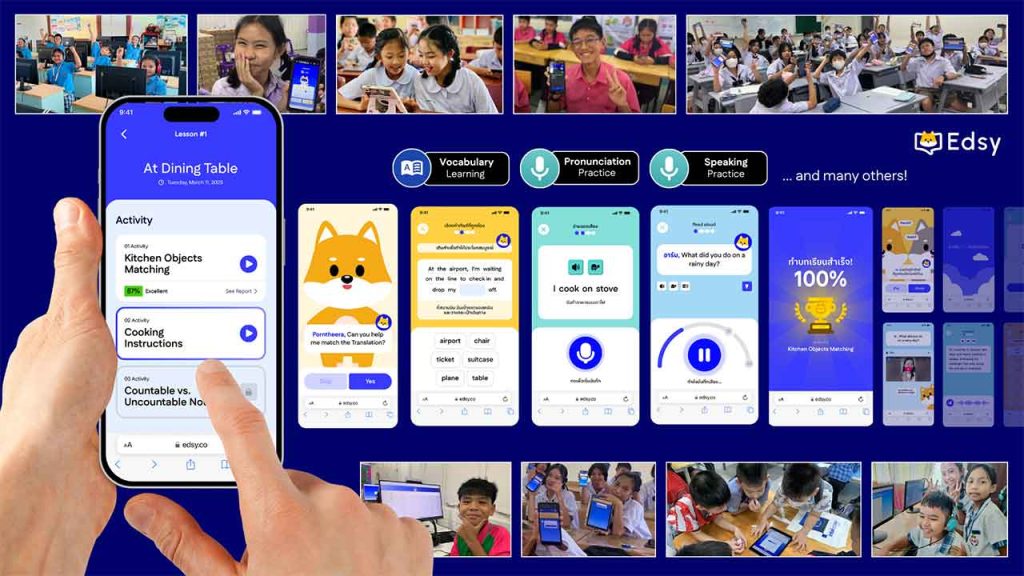
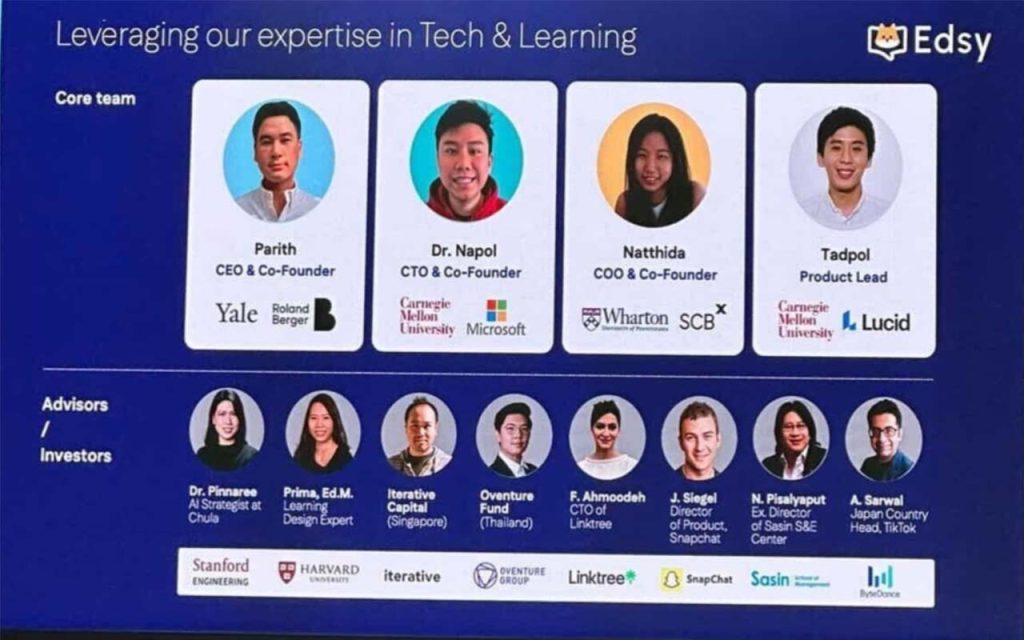
Across Asia, millions of students study English for over a decade but still hesitate to speak a full sentence aloud. Edsy, a Thai startup founded by Parith Thiengtham (CEO) and Dr. Napol Rachatasumrit (CTO), believes that artificial intelligence can finally fix that gap—not by replacing teachers, but by empowering them.
After building Thailand’s largest AI-powered English learning network, now used in over 800 schools, Edsy joined K-Startup Grand Challenge (KSGC) 2025 Phase 2 to bring its adaptive speaking coach to Korea—the region’s most ambitious and competitive education market.
In this exclusive interview, KoreaTechDesk spoke with Parith Thiengtham to uncover the mission and growth of Edsy as the company advanced through the KSGC 2025 program.
Edsy: Rewriting the Story of English Learning in Asia
Q1. What motivated you to start this company, and what core problem were you trying to solve?
The primary reason I started Edsy was because despite becoming a universal passport to global knowledge, mobility, and opportunity, access to English fluency remains deeply unequal across Asia.
Even though they spend more than a decade studying English in school, over 95 percent of students in countries like Thailand, Korea, and others across the region still struggle to speak fluently. And the issue is not the lack of instruction, but more on the lack of practice.
In a traditional classroom, one teacher manages more than twenty students, leaving little room for each learner to speak meaningfully or receive personalized feedback. This persistent gap between teaching and actual speaking proficiency has held millions back for generations.
I wanted to change that — to build a solution that gives every student, regardless of background, the chance to speak, practice, and improve every single day.
Discovering the Same Challenge in Korea
Q2. What opportunity or unmet need did you identify in the Korean market, and what early signals convinced you that your solution could gain real traction here?
In Korea, we found the same structural gap that exists in Thailand: English education remains heavily focused on grammar, test preparation, and rote learning, while real communicative practice is scarce.
Many students hesitate to speak up in class — some even fear being teased for their pronunciation — and teacher quality varies widely from school to school. The result is a persistent “practice gap,” where students learn about English but rarely get to use it.
This is exactly the problem our AI Coach and Teacher Assistant was built to solve. Already deployed in over 800 schools and adopted citywide in Bangkok, our system provides scalable, personalized speaking practice and real-time feedback that traditional classrooms cannot deliver.
Moreover, we also saw clear and obvious early signals in Korea: a persistent, nationwide struggle with speaking proficiency, minimal practice opportunities in classrooms, and growing government and industry interest in AI-driven English learning tools — and yet no clear market leader. It’s a gap we are uniquely positioned to fill.
Insights That Shaped the Korea Strategy
Q3. During KSGC, were there any mentors, partners, or specific insights that significantly influenced your product or strategy?
Absolutely. During KSGC, we were fortunate to meet mentors and partners who played a meaningful role in shaping our Korea strategy.
Albert Shafiev of AGCC was especially instrumental; he not only supported us throughout the program but also connected us with several leading Korean edtech startups with strong access to schools. Through those conversations, we gained invaluable insights into the local ecosystem, including market dynamics, procurement challenges, and how Korean teachers actually integrate technology into their classrooms.
Another key partner was ZEP Quiz, whom we had first met in Thailand. Their team generously shared on-the-ground perspectives on how various educational tools resonate with Korean students and teachers. We also worked together on lead generation and market intelligence, which helped us understand what truly drives adoption in this market.
These collaborations gave us a much deeper and more realistic understanding of what it takes to localize, partner, and scale successfully in Korea.
Building Momentum through Local Partnerships
Q4. After joining KSGC, what has been the most meaningful change for your company and what evidence supports this growth?
The most meaningful change after joining KSGC has been the strategic partnerships we’ve built in Korea.
Thanks to the KSGC network — and with the support that allowed our team to relocate to Seoul during the program — we were able to connect with many of the most influential organizations in Korea’s education sector. These relationships have fundamentally accelerated our market entry.
During our visits, we met several top-tier education companies and strategic partners who were not only open to sharing deep market insights but were also eager to explore product integrations, joint R&D opportunities, and distribution collaborations. These discussions have progressed far beyond surface-level introductions; they’ve given us a concrete roadmap for localizing our technology, co-developing new features, and effectively scaling in Korea.
This growing partnership momentum is the clearest sign that we’re ready for real, sustained growth in the Korean market.
Making English Practice Universal and Human-Centered via Edsy
Q5. Looking ahead, what is the most important vision or long-term goal your company aims to achieve, and what steps are you taking to move toward it?
Our long-term vision is to build the world’s most effective AI English Coach for schools — a solution that integrates seamlessly into everyday classroom practice, supports teachers rather than replacing them, and helps every student, especially the weakest ones, gain genuine speaking confidence.
We want English practice to become as natural and accessible as opening a textbook.
A major step toward that vision is the development of Personalized Scaffolding, built on our CTO’s PhD research at Carnegie Mellon University’s School of Computer Science. Using advanced knowledge-tracing and intelligent-tutoring frameworks, this feature enables our AI Coach to adapt in real time to each student’s proficiency, misconceptions, and learning pace. It moves us beyond generic AI feedback toward truly individualized, high-impact learning — especially for novice learners who are often left behind.
From a business standpoint, our goal is to become a leading AI English-education platform not only in Thailand, but also in Korea and Japan within the next few years. We are also exploring the B2C test-preparation market, where students increasingly seek personalized, AI-driven speaking practice.
Every product milestone, partnership, and expansion effort brings us one step closer to that mission — making quality English practice universal, effective, and human-centered.
As one of the companies joining the Phase 2 of K-Startup Grand Challenge 2025, Edsy is redefining how AI and teachers work together — not to automate education, but to humanize it, giving millions of Asian students the confidence to speak for themselves.
“The collaborations we built through KSGC gave us a much deeper and more realistic understanding of what it takes to localize, partner, and scale successfully in Korea.”
About This Series
This article is part of the “K-Startup Grand Challenge 2025 Interview Series,” featuring 40 global startups from Phase 2 of Korea’s leading accelerator program. The series highlights how international founders are scaling innovation through Korea’s startup ecosystem.
Read more stories from the K-Startup Grand Challenge 2025 Interview Series on KoreaTechDesk.
– Stay Ahead in Korea’s Startup Scene –
Get real-time insights, funding updates, and policy shifts shaping Korea’s innovation ecosystem.
➡️ Follow KoreaTechDesk on LinkedIn, X (Twitter), Threads, Bluesky, Telegram, Facebook, and WhatsApp Channel.
Source link