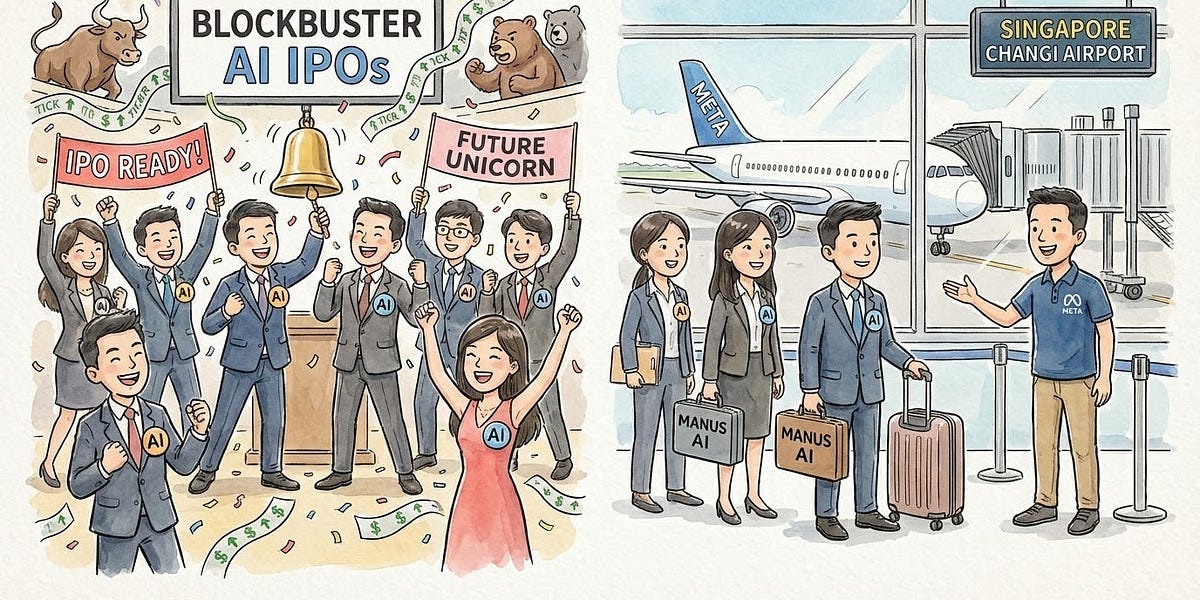
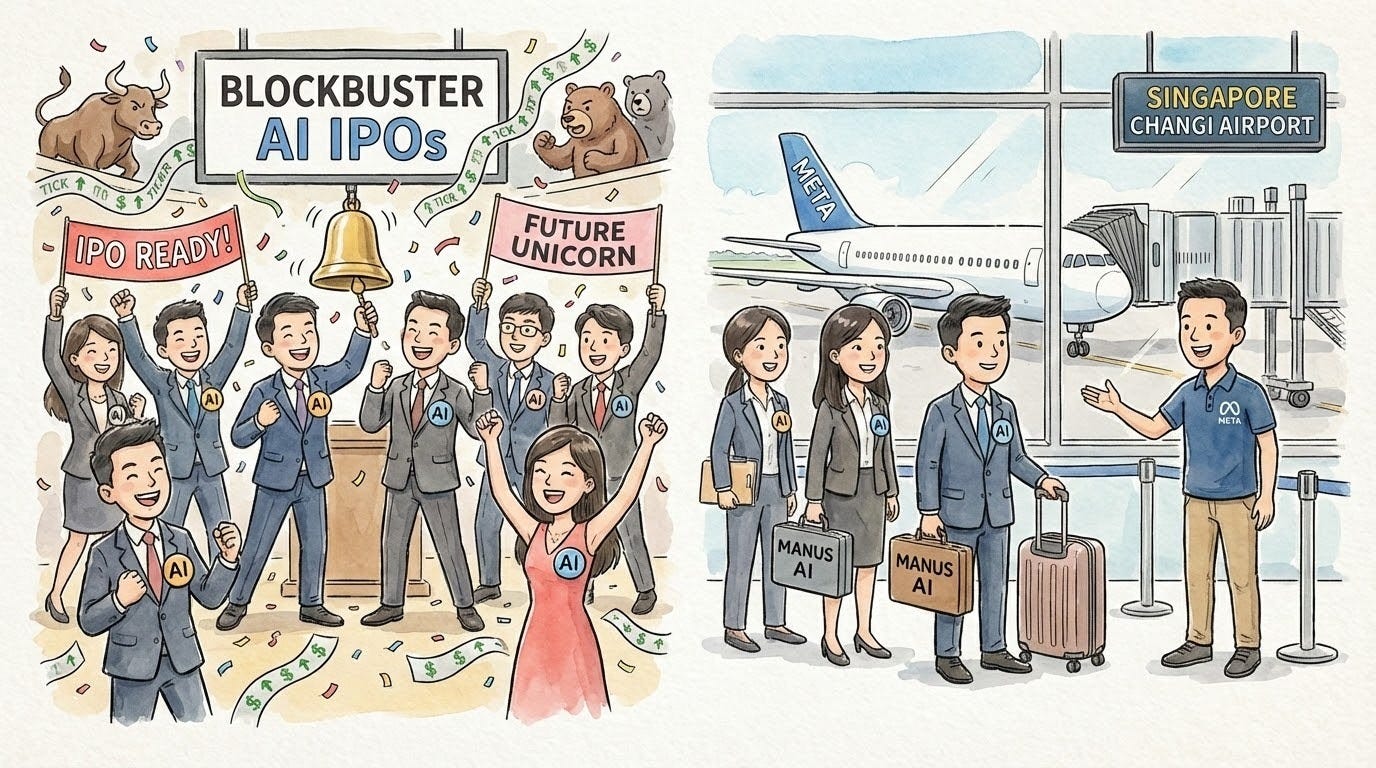
Welcome back and happy New Year—I’m excited for 2026 with Asia Tech Review now that I’ve returned after a break in the UK. This week’s big story isn’t hard to guess: the acquisition of AI startup Manus by Meta for a reported $2.5 billion.
Key details:
-
Meta will acquire the technology and leadership from Manus, which will continue to be based in Singapore
-
Meta will continue to operate and sell services from Manus, and integrate its AI agents into Meta products for consumers and businesses
-
But Manus will exit all Chinese ownership, and close down all remaining operations and services in China
-
The deal price is undisclosed but it is widely reported to be $2.5 billion, with a $500 million retention pool for Manus employees
-
Manus crossed a $125 million revenue run rate in December, an impressive feat just eight months after launch, and it was considering a fundraise at a $2 billion valuation when Meta approached it
This is one of the most significant US-Asia tech acquisitions in history and there’s plenty to analyse.
Manus is one of the highest-profile developers of AI agents, and it has been a hot topic this year after parent company Butterfly Effect relocated its business from China to Singapore, as we wrote in July. Long story short, that happened after the US reviewed Benchmark’s $75 million investment into the startup in May. It was also a route to avoid restrictions on Nvidia product sales in China
Its revenue alone may not command a $2 billion exit, but that growth was rapid and that almost makes this price seem cheap, especially if it could have raised another funding round independently.
There’s been lots of chatter about whether this is a win for Singapore.
Yes, of course it is.
Meta is buying a Singapore-based company for over $2 billion. That draws attention and builds credibility, but its relocation means Manus isn’t fundamentally a Singapore success story so this deal is less repeatable.
It does, though, show Singapore is a place that existing tech startups can move to for growth or exits, particularly those in China. But Singapore has moved on from that narrative, which served a purpose in the previous decade. There’s more ambition and sophistication now.
Singapore has a strong venture capital scene, government support and talent so naturally it should want to build startups like Manus on its soil from day one.
How much of that money will stay in Singapore? Much will go back to VCs in the US and China. But the deal may advance Singapore’s goals the same way that exits in places like Silicon Valley enrich the local startup scene. Ex-employees remain and start new businesses, they make angel investments and there’s buzz.
There’s been plenty written that the Meta-Manus deal also sets a path for how Chinese AI startups can get acquired or make themselves eligible for US venture capital.
I get that angle, but it seems unlikely. Sure, China’s AI startups lag their US peers significantly when it comes to monetisation, as we wrote in our last issue of 2025. The revenue Manus claims is minuscule for Meta, but far more than most of its Chinese peers, as my former colleague Alex Wilhelm noted. But there’s a huge amount happening in China to satiate young companies.
We wrote last week about China’s new national investment programme earmarking $7 billion for early-stage investments across a range of emerging tech sectors. And, as you’ll read in the section below, IPOs are firing on all cylinders in China and Hong Kong.
Beijing is understandably annoyed by the Manus outcome. This is a startup that symbolised China’s new era of tech influence worldwide. It cannot be repeated.
Have a great week, I look forward to bringing you more news and analysis in 2026.
Jon
Follow the Asia Tech Review LinkedIn page for updates on posts published here and interesting things that come our way. If you’re a news junkie, the ATR Telegram news feed has you covered with news as-it-happens or join the community chat here.
Singapore may be an escape hatch, but it’s one that most Chinese companies with traction aren’t considering since their domestic public markets are hot.
The total number of IPOs on mainland China nearly doubled last year as Beijing reaped the rewards of an easing of regulations to allow pre-profit businesses and tech companies to access public markets.
A total of 115 companies raised a combined 128 billion yuan (US$18.3 billion) from IPOs on the Shanghai, Shenzhen and Beijing exchanges last year, according to Bloomberg data.
At the same time, Hong Kong has emerged as a target for technology companies. China’s AI startups are leading the charge, with prominent publicly-traded Chinese tech firms are listing there too for additional retail investor exposure.
December was the busiest month for Hong Kong deals since November 2019, Bloomberg reported, with at least 25 companies listing on HKEX last month. Around half are tech companies, with a number from China leading the way such as AI chipmaker Biren which raised $717 million.
Ten further listings are expected during January and experts said the AI narrative is likely to continue.
An upcoming highlight is Chinese AI startup MiniMax, which is aiming to raise $600 million. It secured Alibaba and Abu Dhabi Investment Authority the cornerstone investors for an IPO that could happen as soon as this week.
Rival Zhipu kicked off its efforts to raise $560 million in the final week of last year. It looks likely to become China’s first listed AI business with as many as 400,000 investors tipped to buy in. Also in the mix is Baidu-owned AI chip firm Kunlunxin, which just filed a prospectus in the new year period.
Others of note include:
Up first though, DRAM memory maker CXMT is raising $4.2 billion (!) on Shanghai’s Star market. It will be something if this momentum can continue.
The New York Times looks at US startups that are trying to break China’s monopoly on rare-earth metals which are key to the tech industry link
ByteDance is increasing its annual spend on Nvidia chips to $14B in 2026, up nearly 20%, if there’s US approval for sales of H200 GPUs to China link
Nvidia asked TSMC to ramp up production of its H200 chips to meet surging demand from Chinese technology companies—sources claim there are 2M Chinese orders for 2026 but currently holds just 700,000 units in stock link
US prosecutors claimed to have dismantled a China-linked network that tried to smuggle at least $160M worth of export-controlled Nvidia H100 and H200 AI chips into China between October 2024 and May 2025 link
The Trump administration blocked US photonics firm HieFo Corp’s $3M bid for assets of New Jersey–based aerospace and defence group Emcore, claiming it is controlled by a Chinese citizen and that the deal threatens US security link
China is reportedly requiring chipmakers to use at least 50% domestically made equipment when adding new capacity link
China began paying interest on holdings of its digital yuan from January 1, with commercial banks compensating users based on balances—the move is said to be an effort to boost adoption against entrenched rivals like WeChat Pay and Alipay—the digital currency has processed 3.48B so far, according to a deputy governor at the People’s Bank of China link
Meanwhile, a Coinbase executive warned US lawmakers of the consequences of limiting rewards on US-issued stablecoins link
SMIC will take full control of SMNC, its unit focused on 12-inch integrated circuit wafer manufacturing, in a $5.8B deal link
Xiaomi increased its EV sales target by 34% to 550,000 vehicles in 2026 link
India ordered X to urgently modify its AI chatbot Grok after complaints over the generation of obscene content, including AI-altered images of women link
Oyo’s parent company reportedly made a confidential filing for IPO link
India has approved $4.6B in electronics component investments as the government accelerates efforts to build domestic supply chains and counter China link
That push has been bolstered with a government announcement that four semiconductor plants in the country will begin commercial production in 2026 link
Banking infrastructure startup Knight Fintech raised $23.6M led by Accel link
A Pakistan-aligned hacker group launched a fresh cyber-espionage campaign against Indian government, academic and strategic institutions link
Arya.ag, which provides near-farm crop storage and lending services to farmers, raised an $81M Series D round link
Online dating giants are betting on Asia for their next wave of growth, as user fatigue and falling engagement in North America and Europe link
Thailand’s IPO looks set to continue this year as prospective firms chase more attractive valuations overseas link
South Korean startup FuriosaAI, an Nvidia rival that previously rejected an acquisition offer from Meta, is moving its first AI chip into mass production link
Coupang will pay out more than $1B in compensation to the 33.7 million customers that were affected by Korea’s largest-ever data breach link
Meanwhile: the e-commerce firm has recovered the smashed laptop that the alleged data leaker threw into a river link
South Korea’s stablecoin bill has stalled as there’s a dispute over what entities should be permitted to issue them link
US is reported to have approved Samsung and SK Hynix chipmaking tool for shipment to China link
Samsung Electronics shares gained their most in about six months (7.2%) after co-CEO Jun Young Hyun quoted customers as saying “Samsung is Back” link
SoftBank will acquire DigitalBridge, a PE firm that invests in assets such as data centres, for $3B link
Elsewhere: SoftBank completed its much-anticipated $40B investment in OpenAI after it closed a further $22.5B just before the end of the year, adding to a previous investment made back in March 2025—it now owns around 11% of the business link
A viral horse-racing game has got players flocking to stables in real-life link
Kioxia Holdings, a NAND flash maker, was the world’s best-performing stock in 2025 as its share rose 540% across the year thanks to surging demand for storage, helped significantly by the world’s AI boom link
The US granted TSMC an annual license to import US chipmaking equipment for its Nanjing fabs link