
Why it matters:
- Half of all adults are considered financially illiterate in the U.S., according to The World Economic Forum.
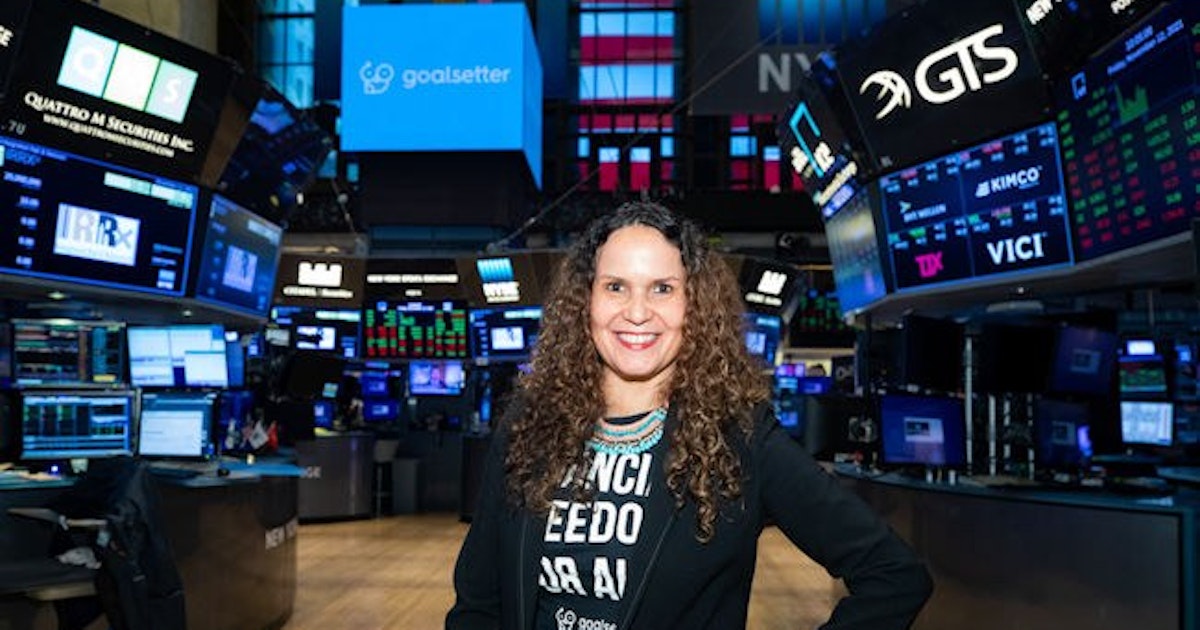
- Goalsetter’s Founder and CEO Tanya Van Court has raised over $31 million for her award-winning financial literacy app for kids and families.
- She’s attracted a long list of celebrity, banks, and venture capital investors who see a need for financial literacy education in the U.S.
It’s not every day that a successful Stanford engineer and corporate media executive decides to quit their job and become an entrepreneur. But that’s what Tanya Van Court did 10 years ago when she realized she had a calling.
Equipped with a wide range of digital, marketing, and product development skills honed when she worked at Nickelodeon, Discovery Education, and ESPN, she saw an overlooked niche in the fintech market that needed to be filled: educating kids and their families about financial responsibility.
In 2016 Van Court launched Goalsetter, a company that has developed a financial literacy classroom platform for schools K-12 and college, as well as a mobile banking and education app that teaches kids smart saving, spending, and investing habits.
The goal-based savings app uses pop culture to teach money basics and offers fun financial literacy quizzes and games and helps parents monitor kids’ spending. The company, through partnerships, also offers tweens and teens “smart” debit cards. Goalsetter users can link existing bank accounts, send cash instantly, set up autosave, and access other savings tools.
To get her company off the ground, Van Court was able to attract a list of celebrity seed-stage investors — including actor Lance Gross and NBA stars Kevin Durant, Carmelo Anthony, and Chris Paul — who saw a tremendous need for the product. That’s because half of all adults in the U.S. are considered financially illiterate, according to The World Economic Forum.
Since then, as Goalsetter’s CEO, she has been able to raise over $31 million to build her business from venture capital investors, including Seae Ventures and the MassMutual Catalyst Fund, as well as from a wide range of financial institutions and banks such as Fiserv, Liberty Bank, Mastercard, and the MSU Federal Credit Union.
Today, Goalsetter has been adopted as a financial education platform in 10 states, including Georgia, Louisiana, Michigan, Ohio, Pennsylvania, and Virginia. Last year, the company won the prestigious FinTech Breakthrough Award for the world’s best financial education platform based on its innovative technology.
CO— spoke with Van Court to learn how she is reimagining financial education in the U.S. and why it’s so important.
CO—: How did you get the idea for Goalsetter?
TV: I spoke with lots of parents from all income levels when I was overseeing preschool and parenting programming at Nickelodeon. They were all looking for ways to develop healthy financial habits for their kids from an early age. It piqued my interest. I got my ‘Eureka moment’ when my daughter turned 9 and asked me for an investment account and a bike for her birthday. That’s when I decided to take a leap of faith, quit my job, and start this new venture. I knew it was an overlooked niche, so I started researching the marketplace to see what type of products and tools were needed to improve financial literacy from the earliest age.
I learned the hard way why financial education is so important from my own personal experience. In 2001, when I worked at an internet broadband company, I lost $1 million in stock options during the dot-com bust. That’s because at the time I didn’t know the basics of investing and finance.
CO—: Explain how you incubated the company and went on “Shark Tank” to get funding.
TV: I started my entrepreneurial journey by going to business plan pitch competitions to learn about the startup fintech ecosystem in New York City. I knew it was a rapidly growing global hub for fintech startups with a lot of resources for founders.
Luckily, I met a successful entrepreneur who was on a panel who agreed to be an adviser. He gave me advice on how to put together a deck and a go-to-market strategy, as well as how to tap my existing business network to raise angel financing. In March 2016, I raised $700,000 in pre-seed funding from angel investors to launch my company with the help of former colleagues at Nickelodeon and the Stanford National Black Alumni Association.
The following year, I applied to the Entrepreneurship Roundtable Accelerator in New York so I could learn more about the fintech industry. I got accepted due to three factors: my experience in developing and launching great digital and gaming products for big brands, my ability to raise pre-seed capital for my new venture, and the large market opportunity I was targeting.
While I was there, I applied and got accepted to pitch my business plan on “Shark Tank.” I got an offer from Mr. Wonderful for $200,000 in exchange for 25% of the company, but I turned him down in three seconds because he was offering me money at a very low valuation for my stock.
[Read more: 3 Businesses Reveal How They’re Using Ultramodern Tech in Niche Ways to Drive Sales and Efficiency]
I knew it was an overlooked niche, so I started researching the marketplace to see what type of products and tools were needed to improve financial literacy from the earliest age.
Tanya Van Court, Founder and CEO of Goalsetter
CO—: Did that TV exposure give you the visibility needed to raise a seed round of funding from such NBA stars as Kevin Durant, Chris Paul, and other celebrities?
TV: It might have helped, but I am not sure. I raised my first $3.9 million seed round led by Astia in 2021. Kevin Durant and Chis Paul were among investors, as well as PNC Bank and Mastercard.
The same year, I raised another $15 million from a large group of angel and VC investors. These angel investors were looking to invest in something they believed in that would make a difference in the world. They felt that Goalsetter’s mission was very important. It was a way to help empower kids and their families with the tools they needed to understand money management and build wealth. The ability to achieve the American dream relies heavily on understanding these principles.
CO—: What types of tools did Goalsetter develop?
TV: We created an app that uses pop culture, quizzes, memes, and games to teach kids about financial literacy. It allows parents to give allowances through the app — and even pay their kids their own specified amount for every quiz question they get right in the app. Plus, family and friends can give “goal cards” instead of gift cards, helping kids save for the things they really want in the future. We also offer a “smart” debit card for kids that lets parents control the way the card is used.
In addition, we have a classroom financial literacy platform that gives teachers a comprehensive curriculum that meets state legislative requirements. Some 30 U.S. states have mandated that financial literacy be taught in all public schools, yet many school districts and teachers don’t have the funding or financial resources to meet the standards.
There is a real need for this product. Currently, no state has met the minimum financial literacy standards for effective financial education, according to the National Financial Educators Council.
Our platform delivers a high-impact curriculum at a fraction of the cost. And it has helped schools — such as Portsmouth schools in Virginia, and East Baton Rouge Parish schools in Louisiana — achieve double-digit gains in financial literacy. These two school districts now have students with over an 80% mastery in the subject.
Through public-private partnerships, we often offer the platform at no cost to schools.
[Read more: Franchises Leverage Diverse Revenue Streams to Rev Up Sales and Weather Ups and Downs]
CO—: Is this type of financial education also needed at the college level?
TV: Yes. Last year, we took a 15-question personal finance quiz called “Are You Smarter Than a 12th Grader?” and surveyed over 1,000 undergraduate students at the nation’s top universities — including Stanford, Harvard, and the University of Pennsylvania — to find out how knowledgeable they are about financial matters.
The results were poor. Respondents had an average score of 51%. Only 1 in 4 knew how stocks and bonds differ from one another. And while 70% have credit cards, the majority don’t understand strategies for managing debt.
CO—: What is your revenue model?
TV: It’s a licensing model and a subscription service. Goalsetter sells directly to school systems or to sponsors like foundations, corporations, or nonprofits, which pay for the platform for school systems through public-private partnerships. Some companies also buy the platform and offer it as an employee wellness benefit.
On the consumer side, kids and parents can download our family financial app that comes with two subscription plans. The standard Goalsetter plan, which costs $3.95 a month, includes features like FDIC savings accounts, debit cards, and allowance management. The plan, that costs $5.95 a month, adds stock and ETF [exchange-traded fund] trading, automated advice, and investment educational content.
We have a partnership with Mastercard that allows us to offer kids and teens a prepaid debit Mastercard with unique features like “Learn Before You Burn,” which requires kids to complete financial literacy quizzes to unlock their spending money.
CO—: Any measure of how Goalsetter is having an impact in improving financial literacy in the U.S.?
TV: Last year, a Mastercard-sponsored study showed that 84% of Goalsetter users improved their savings habits, 52% explored investing, and 88% had more open financial conversations within their families.
CO—: A lot of fintech companies have sprung up to address the financial literacy crisis in America. How do you plan to outflank the competition?
TV: Many of these companies focus on getting debit cards and other tools in kids’ hands. At Goalsetter, we put financial education for kids and their families first. That’s how we are different.
CO—: What are your plans for the company in the future?
TV: We want to market our program and tools internationally and use artificial intelligence to develop localized content specific to a particular demographic and region. We have been having conversations in Asia, Canada, Europe, and South America on this issue.
CO—: What advice would you give other entrepreneurs interested in launching fintech companies in this burgeoning industry?
TV: I think we are at a moment in time where past companies and products don’t necessarily determine future success. Advances in AI and other technology allow you to now leapfrog an existing tech or competitor. Don’t be constricted by whatever has been done, just go for it.
CO— aims to bring you inspiration from leading respected experts. However, before making any business decision, you should consult a professional who can advise you based on your individual situation.
CO—is committed to helping you start, run and grow your small business. Learn more about the benefits of small business membership in the U.S. Chamber of Commerce, here.
Published