Toronto startup hopes Series A round will propel it beyond its 60,000 patients.
After seven years bootstrapping a telemedicine platform that has helped tens of thousands of Canadians manage their hormone health, Science&Humans has turned to venture capital (VC) to accelerate its growth as interest in its services has heated up.
“When we started, this was not a category.”
Aftab Pashaw, Science&Humans
The Toronto-based healthtech company announced today that it has secured $10 million CAD in funding. That figure includes $7 million in equity and $3 million worth of venture debt as part of its Series A round, which closed in December and marks the company’s first external financing to date beyond a prior, $1-million line of credit from BDC.
Science&Humans offers software that helps Canadian men and women digitally access personalized treatment for hormone health imbalances. It connects them with specialists to diagnose and address often-stigmatized issues like low testosterone, menopause, weight management, hair restoration, and sexual wellness with a combination of continuous care and prescription drugs, if necessary. Interest in hormone health is on the rise, and Science&Humans is part of a crop of new healthtech companies that have popped up to meet this demand.
In an interview with BetaKit, CEO Aftab Pashaw and CPO Hira Siddiqui said they think the startup can do much more than that. “The opportunity that we have is to really go out and capture the market,” Pashaw said. “We can run faster.”
Science&Humans has already been profitably growing. Pashaw did not share the company’s valuation or current sales with BetaKit, but claimed that it is generating “seven figures” in annual revenue at the moment.
The all-primary, equity component of Science&Humans’ Series A round was led by Pender Ventures, with participation from fellow Vancouver firm Well Health Technologies, Michele Romanow, and undisclosed US healthcare investors, physicians, and longevity experts. CIBC Innovation Banking provided the venture debt.
Hormone health enters the “mainstream”
Hormones regulate a variety of core bodily functions, from metabolism to growth, mood, and reproduction. Hormone imbalances caused by factors like stress, diet, aging, or genetics can lead to symptoms ranging from fatigue to weight issues, mood swings, and infertility. They can be rectified with lifestyle changes and medical care.
RELATED: Felix Health raises $53 million in growth financing to get “more aggressive” in telehealth
But Siddiqui and Pashaw noted that hormone health has historically gone undiagnosed or mistreated due to a lack of specialized training, long wait times, and social stigma.
“When we started, this was not a category,” Pashaw said. But he added that new research indicating the benefits of starting hormone treatments early, coupled with the emergence of digital health platforms, has made this more “mainstream.”
VC funding appears to have reflected this, as two of Science&Humans’ Canadian competitors, Toronto-based Phoenix and Felix Health—which launched around the same time as Science&Humans—have closed sizable rounds over the past year. Montréal’s Eli Health, which has developed a device for hormone monitoring, also closed a sizable round in the last year.
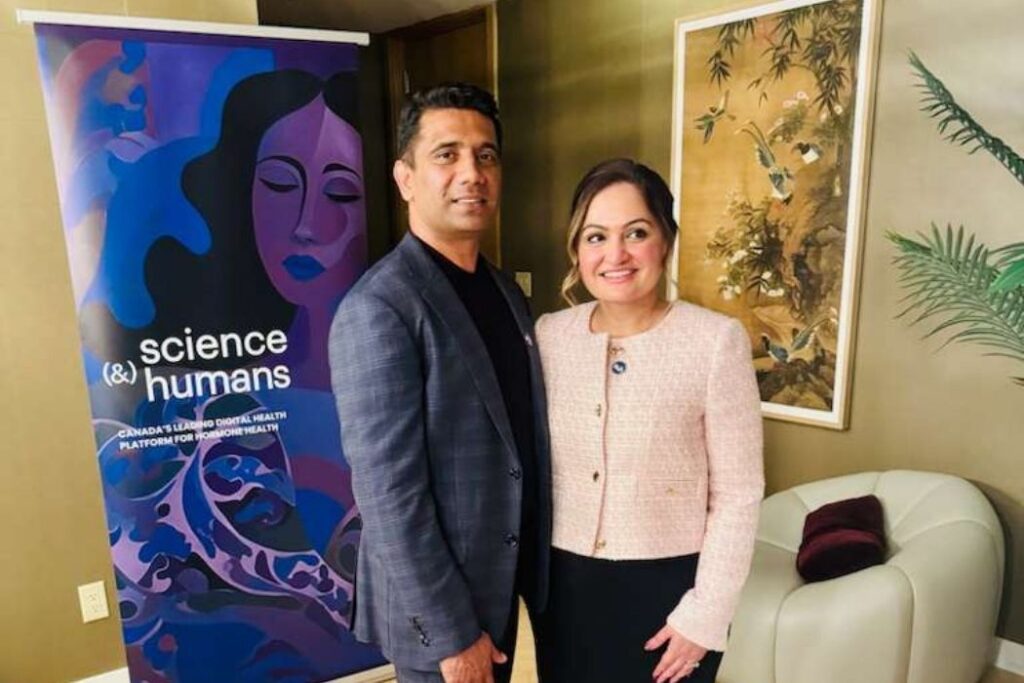
Image courtesy Science&Humans.
Pashaw views Science&Humans’ business-to-business (B2B) model, which works with major health insurer GreenShield and large companies to deliver care to plan members and employees, as a differentiator from other digital hormone health providers in Canada.
The CEO described Science&Humans as “not a pharmacy-first model,” but rather “a care delivery model for outcomes” that seeks to help patients address the root cause of their issues, the solution to which may or may not involve drugs. The startup has developed this approach with the help of chief health advisors Dr. Kristy Prouse and Dr. Fady Hannah Schmouni.
To date, Siddiqui said that Science&Humans has helped nearly 60,000 Canadians access hormone health treatment, facilitating upwards of 500,000 tests, almost 300,000 prescriptions, and approximately one million patient consultations.
RELATED: Phoenix secures equity funding from Valspring, venture debt from CIBC for prescription drug service geared to men
Science&Humans claims that more than 80 percent of its patients reported meaningful symptom improvement within three to six months. Pashaw claimed the strength of Science&Humans’ 130-person team—which includes about 78 employees and 52 contractor specialists—protocols, and care outcomes gives it an edge in the market.
During the pandemic, some online pharmacies have come under fire for prioritizing speed and business interests over patient safety and prescribing drugs too quickly without proper checks.
Pashaw said that Science&Humans typically requires patients to complete “thorough” intake forms, bloodwork, and virtual calls with nurse practitioners before prescriptions are issued. That process repeats with consultations every three months. He noted that only a small percentage of erectile dysfunction and hair loss treatments do not require virtual calls.
Targeting B2B growth
Science&Humans launched as a direct-to-consumer telemedicine platform focused on men’s health before expanding to cover women’s health. Gender-affirming care is also part of the startup’s roadmap. Science&Humans generates revenue through consultation fees and subscriptions. It also charges pharmacy partners to list on its platform.
A year and a half ago, Science&Humans adopted its B2B model, where Pashaw says he sees “the biggest opportunity” to grow.
“With a vertically integrated model that can scale through employers and insurers, the company is well positioned to deliver consistent, high-quality care at scale,” Pender principal Meryeme Lahmami argued in a statement.
Using its Series A funding, Science&Humans hopes to expand the B2B side of its business and scale nationwide. It also intends to expand its tech and AI capabilities as it looks to build what Pashaw described as a complete “hormone operating system” that fully integrates the pharmacy and lab.
Feature image courtesy Science&Humans.