If you’ve ever held your phone in your hand for too long, you’ll know that batteries heat up.
A lithium-ion battery – the basic essential chemistry is the same whether it’s the tiny one in your phone or a big one in an electric car – heats up quite a bit when it’s in use, both when charging and when you’re using its stored power.
That heat can lead to damage, and it’s why batteries have to be thermally controlled to keep them in their optimum window for performance right now, and for longevity into the future. If we’re talking EV batteries, then the best temperature window is in and around 21 degrees.
Clearly, a big lithium-ion battery powering an electric car will become far hotter than that when it’s being used, and so car makers adopt systems to keep the batteries from overheating.
Overheating leads to a loss of performance, potential damage to the battery’s cells, and in the worst and most extreme – and thankfully vanishingly rare – cases, a battery fire.
Most of those systems are basically simple radiators. There’s a large panel, usually attached to the bottom of the battery pack, which is connected to a liquid cooling system, although there are some variations on this, such as Tesla, which runs a snake of cooling pipes in between the battery cells.
This works much better than the early air-cooling systems for EV batteries, as any owner of an original Nissan Leaf can attest. Liquid cooling essentially unlocked much better battery performance.
What if we could do better, though? What if we could cool the entire battery pack from the inside? Would that unlock even better performance?
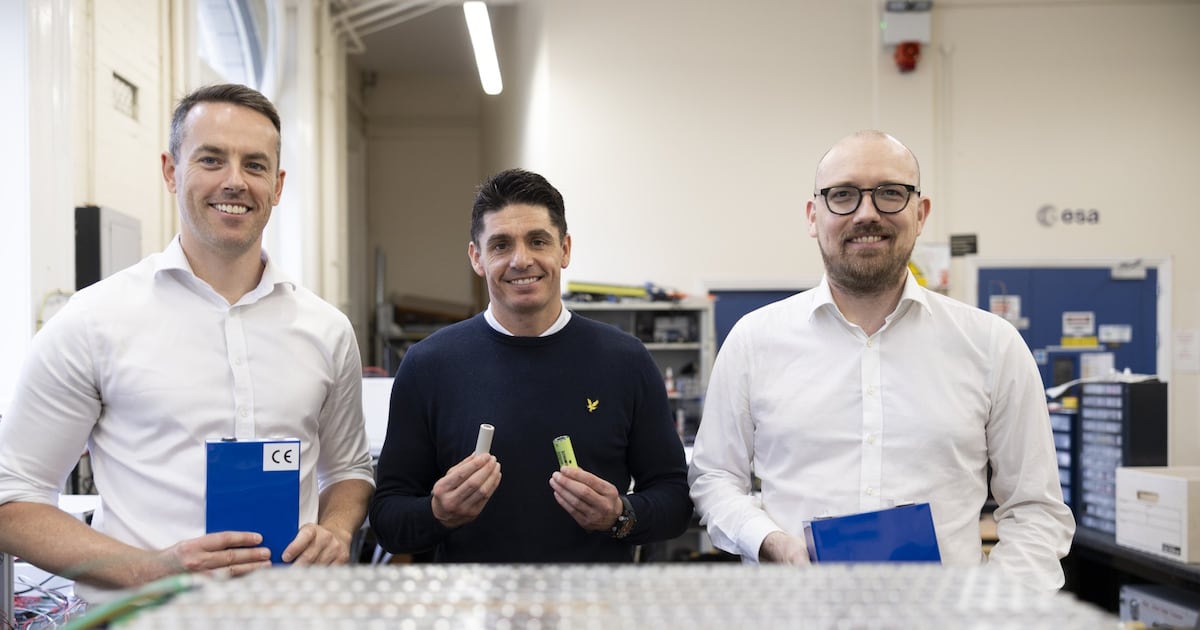
That’s the thinking of Drive, a battery tech start-up established by Dr Séamus O’Shaughnessy and Dr Daniel Trimble, both of Trinity College Dublin. Their idea seems simple on the face of it, but as ever with simple ideas, getting them to work properly is never easy.
[ Carbon neutral fuels: When will we see them and why are some so staunchly opposed?Opens in new window ]
“We actually started with a single cylindrical battery cell as a proof of concept,” O’Shaughnessy says. “You can mitigate a lot of battery degradation effects with better cooling, and we kept building on that, scaling it and trying to achieve the same benefits as the scale increased.
We’ve used some predictive modelling that shows we can also increase the lifespan of the battery by around 20 per cent
— Dr Séamus O’Shaughnessy, Drive
“The general approach has been around for years, the idea that you can put electronics in direct contact with a cooling liquid. We call it immersion cooling, and obviously, it has to be a nonconducting liquid, which is called a dielectric fluid. It’s not the kind of thing that has been done up till now by car makers, although it has been used in Formula One.”
O’Shaughnessy’s point is that the cooling systems used by car makers for their batteries, thus far, have been pretty simple, even crude, and that they’re effectively wasting battery performance. Drive’s concept of cooling the entire pack at once from the inside could potentially claw back that lost performance.
“We’ve evidence that we can increase the capacity of the battery by about 14-15 per cent,” O’Shaughnessy says. “On top of that, we’ve used some predictive modelling that shows we can also increase the lifespan of the battery by around 20 per cent.”
Those figures would make for significant improvements in electric vehicle performance. A 15 per cent increase in battery capacity would add an extra 84km of range in a Volkswagen ID.4, the most popular EV in Ireland this year, pushing its claimed range to 650km.
Or, you could instead potentially shave 15 per cent of the battery pack off and just keep the existing 566km range, which could save 72kg of weight, which could improve the car’s overall efficiency as well as cutting the cost of the battery pack.
[ There will be more electric cars on Irish roads this year, along with more affordable modelsOpens in new window ]
A 20 per cent improvement in battery lifespan is a little harder to quantify, mostly because lithium-ion battery packs are proving to be far more long-lived than we ever expected, but assuming it would result in a pro-rata increase in the warranties car makers offered for such batteries, it could mean a battery warrantied for nine years and 185,000km.
Drive’s plan is that their cooling system should cost no more to install than any existing set-up. “Every prototype that we have been building, we’ve been conscious that this has to seamlessly integrate into current systems,” Trimble says. “So what we’re trying to do at the moment is take apart second-hand battery modules, and we’re using that as a benchmark to test the performance, and then we’re going to integrate our new technology on to that and then demonstrate our improvements. I would say, in general, if you were to manufacture at scale, no, there will be no kind of significant increase in cost.”
Little wonder that Drive has just been awarded more than €1 million in prize funding from the Research Ireland National Challenge Fund. Such cooling technology could help not only to improve the overall performance of electric car batteries, but could also give existing – and therefore more affordable – lithium-ion battery tech a longer shelf-life against the oft-promised, but still unrealised, potential of solid-state batteries.
“I suspect that it will probably end up a bit like renewables, like many other technologies, there will be a mix going forward,” O’Shaughnessy says. “There will be some that are better suited to solid state, and there will be some that are better suited to lithium-ion. So any improvements that you can make to lithium-ion battery operation, which is really what we’re talking about here, will sustain the technology well into the future.”