Excitement is ramping up as NordSpace prepares to launch the first suborbital flight of its Taiga rocket – an achievement that would make history as the first Canadian commercial rocket to launch from a Canadian commercial spaceport.
Nordspace postponed an earlier attempt in September due to a technical challenge with the rocket’s cryogenic propellants.
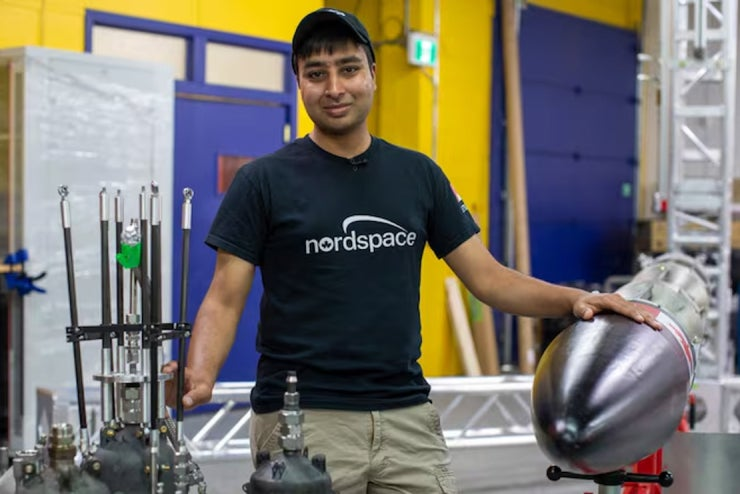
Rahul Goel, a PhD candidate at the U of T Institute of Aerospace Studies, says he founded Nordspace in a bid to make Canadian commercial space exploration a reality (photo courtesy of NordSpace)
“Building the most complex commercial rocket developed in Canadian history in less than a year, on a fully self-funded budget and [with] a small team has been an incredible experience,” says NordSpace CEO and founder of Rahul Goel, a PhD candidate at the University of Toronto Institute of Aerospace Studies (UTIAS).
“We can’t wait to get back to our spaceport in Newfoundland and launch Taiga to close this chapter.”
Goel founded NordSpace in 2022 with the goal of building and launching rockets from Canada, part of his vision for a sovereign Canadian space program. The company is also developing larger rockets – the Tundra and the Titan – and is planning the launch of its first satellite next year.
“We have so many other missions running at the same time. Taiga is just one of several projects that we’re excited to be working on,” says Goel.
“Our first launch attempt gave our team the information and experience to move on to our orbital launch vehicle: Tundra.”
—
Goel says he nurtured his passion for aerospace and entrepreneurship at U of T. After graduating from engineering science in the Faculty of Applied Science & Engineering with a major in aerospace engineering, Goel began pursuing his PhD at UTIAS while working under Professor Jonathan Kelly.
Goel credits the university for supporting his first entrepreneurial journey when he founded PheedLoop, which provides end-to-end solutions for event management. The company, which has now been operating for more than a decade, has a long list of clients in academia, government and the private sector.
Early in PheedLoop’s development, Goel connected with the Entrepreneurship Hatchery, a startup incubator at U of T Engineering that helps students turn ideas into ventures. He says the incubator played a key role in helping him establish PheedLoop’s initial business case.
“U of T Engineering and the Hatchery gave me discipline and structure in my life, and mentorship,” says Goel. “I think those things really helped make me into who I am today,”
Joseph Orozco, the executive director of the Entrepreneurship Hatchery and one of Goel’s mentors, says the accelerator has developed a unique methodology that encourages student founders to think big and act big.
“Rahul’s entrepreneurial journey truly embodies that spirit: understanding value creation and executing a vision,” Orozco says. “We are proud of his accomplishments so far and excited for those still to come.
“The Hatchery continues to support current student entrepreneurs inspired by his journey.”
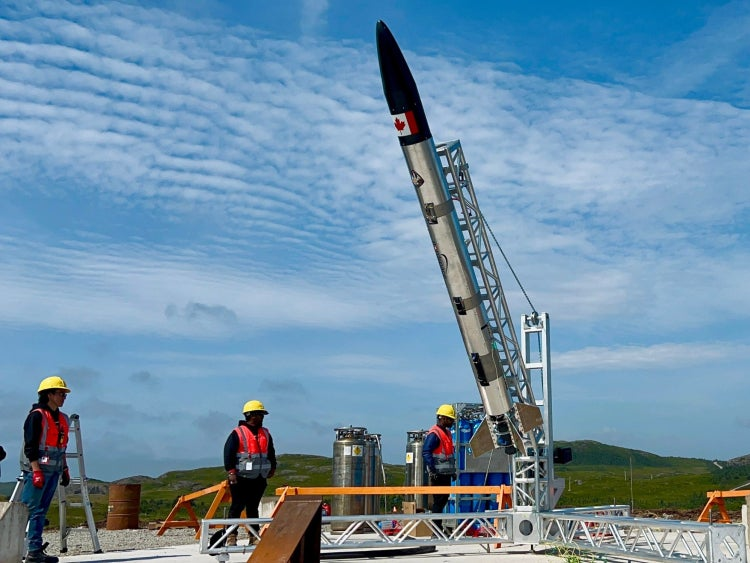
Nordspace’s Taiga suborbital rocket (image courtesy of Nordspace)
Goel’s long-held passion for space took flight when he noticed how Canada’s lack of sovereign launch capability pushes many aerospace engineers to pursue careers outside the country.
“I started noticing that Canadian talent was leaving, and commercial space companies in other countries were racing ahead and pushing their nations further, whereas Canada was not paying attention to this,” says Goel.
“My anchor was always space because it was cool and unexplored, and there was adventure and risk in it – but now I’m very focused on it from the perspective of jobs, economic development, national security and Canada’s reputation in the world.”
Goel says he has always had a knack for trying to solve problems that nobody else was working on.
“I’ve always been in these positions where I’ve had to start initiatives because no one else was doing it,” he says. “I’m the type of person that really struggles when I see something that should be done, not being done. I just have to do something about it and that sort of gave me that entrepreneurial spirit.”
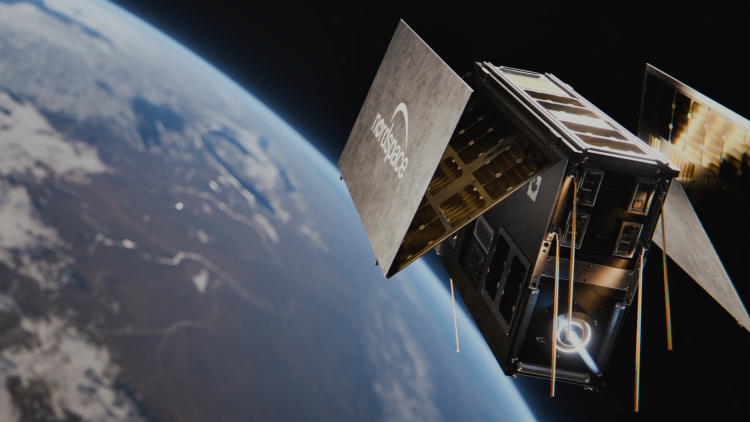
A rendering of NordSpace’s Terra-Nova satellite (image courtesy of Nordspace)
Goel has a detailed plan to build NordSpace into a sustainable commercial business.
In June, NordSpace aims to launch Terra-Nova, its first satellite. This mission will also test the company’s Athena satellite bus, its Zephyr-EP propulsion system and its Chronos edge-AI camera in orbit.
“Our goal is to be an end-to-end space missions company,” says Goel. “We’re building our own spaceport for the first time ever in Canada, we’re building our launch vehicles here and we’re building the stuff that’s going to go in the rockets as well. All so we have this full-cycle company.”
The company also hopes to solve Earth-based problems from outer space.
“We’re launching satellites next year that help monitor Canadian forests and wildlife because that’s important,” says Goel. “That’s why we do what we do. We want to focus on things that help life on Earth.”
Goel says that one of the critical skills required to build viable businesses is getting comfortable with failure. He originally tried to start NordSpace immediately after completing his undergraduate degree in 2016. “Investors weren’t lined up to give millions of dollars to a recent graduate to build rockets,” he says.
By waiting to launch NordSpace after the success of PheedLoop, Goel was able to create a company that is over 90 per cent self-financed, with recent support from the Canadian Space Agency and others contributing to technology development.
“In the Hatchery, we thought failure was a good thing. It teaches you how to figure out how to do something better. Rahul understands that idea,” says Jonathan Rose, a professor in the Edward S. Rogers Sr. department of electrical and computer engineering who mentored Goel.
“He gets that when you’re going to start a company, it’s got to have value to someone who’s willing to pay money for it. It’s inspirational that he’s pursued his passion for space, but in a commercial way.”
In between running NordSpace and working on his PhD, Goel still finds time to give back to the U of T community. This past September, he spoke to a crowd of future entrepreneurs at the Desjardins Speaker Series as part of U of T’s Acceleratorfest.
His advice?
“Make your idea exist first, then make it better,” says Goel. “Just start.”
Source link