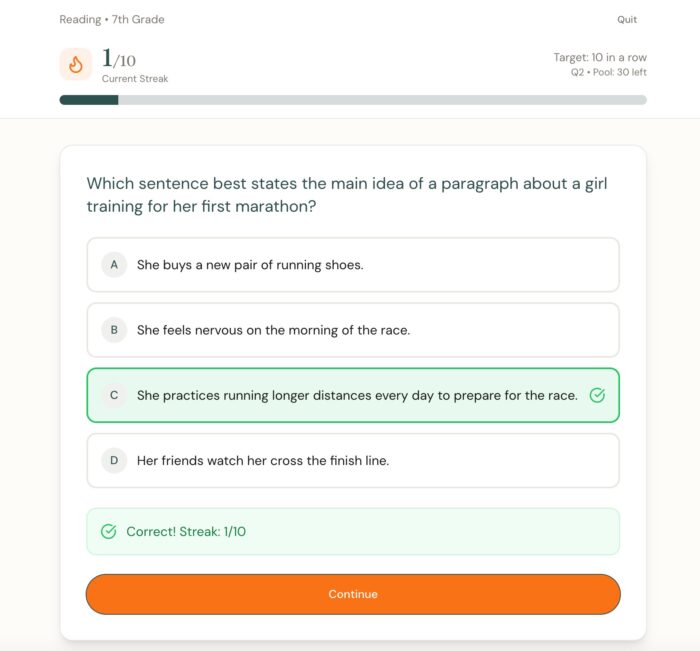

An example of a streak challenge from Streak Labs.
A Richmond couple’s pet project to help their kids improve their grades has blossomed into a business.
Husband-and-wife duo George and Shannon Webster last month launched education tech company Streak Labs, whose first product is a web-based application that creates AI-generated quizzes for students based on the uploaded study guides from teachers, parents and tutors.
The Websters are both Richmond natives who met in high school. Shannon began her career as an English teacher, later working at the Federal Reserve, while George has a tech background, currently working as a digital project owner at the Virginia Farm Bureau Family of Companies. He previously worked as a senior digital project manager at EAB.
They live in the East End with their two sons, who attend Henrico County schools Fairfield Court Elementary School and Arthur R. Ashe Jr. Elementary.
George said the idea for Streak Labs came when they were thinking of ways to help their kids study for school tests with the study guides their teachers gave them.
“We were hand writing quizzes and things for them to practice, and that got old real quick,” he said. “With a technology background and Shannon’s education background, we were like ‘we can probably come up with something.’’’
That led to the creation early last year of a rudimentary application of their StreakChallenge product online, which they first used just for their kids to study.
After seeing their sons’ memorization improve while using the program, the Websters wondered if they could turn it into something useful to all teachers and students.
Out of that thought, Streak Labs was born. Made for teachers to use for their classrooms, as well as for parents and tutors, users can upload a study guide and receive AI-generated questions based on the guide’s material.
Teachers can then choose a “streak goal” for students to try to get to, answering either five, 10 or 15 questions correctly in a row to “beat the streak,” George said. If students get a certain number of questions right in a row, the quiz adds bonus questions.
Students do not play against each other, but can participate at the same time via a shareable link to the quiz. George added that the application does not give students a grade, trying to keep the focus on repetition and memorization rather than a punitive measurement.
George and Shannon Webster
“If they mess up, or make a mistake, they’ll start back at zero. When they do make a mistake, it gives them an explanation of what they had done wrong, or explains the question a little bit better,” George said.
Teachers can also look at what questions their students are getting right or wrong to shed light on what areas need improvement.
“They can use this in their morning warm-ups, they can use this a day before the test, right before the test, as a method to practice,” George said.
Streak Labs can be used without a study guide, with teachers able to pick their students’ grade level (third through twelfth grade) and from an array of subjects like science, language arts, history and geography.
If no study guide is uploaded, questions regarding these general subjects will be provided for the streak challenge, though George said he designed the application to be best suited for custom study guides.
In late 2025, the Websters completed two test runs of Streak Labs with school students in Richmond and at a middle school in State College, Pennsylvania. Receiving positive feedback spurred them to launch it to the public last month.
“That was the catalyst for, ‘Okay, I think we have something here,’” George said. “We can try to do something.”
Streak Labs is currently free for both students and teachers to use. George said that if it gains momentum, the Websters may look to implement a subscription model that would require teachers to pay a small per month fee to upload their study guides, along with a $5 per month or $50 per year pro subscription that would allow teachers to upload an unlimited number of study guides and create unlimited challenges.
Participation for students would remain free, with no change in price depending on classroom size. Several teachers in the Richmond area are now using Streak Labs regularly, George said.
Now, the Websters’ goal is to get more eyes on Streak Labs ahead of the busy SOL testing season that starts in April. George added that he and Shannon hope to target Richmond classrooms first, particularly those in the East End.
“We wanted to help our own kids, and we saw the benefits of it, and so this gives us an opportunity to do that in our own community,” he said.
The Websters are bootstrapping funding for the company; George remains in his full-time position while running Streak Labs, while Shannon is helping lead Streak Labs after leaving her position at the Federal Reserve last May, per her LinkedIn.
Source link