HYDERABAD: A Hyderabad-based startup founded inside a college campus is taking on one of electric mobility’s biggest headaches, range anxiety, with technology that runs on hydrogen gas and emits only water.
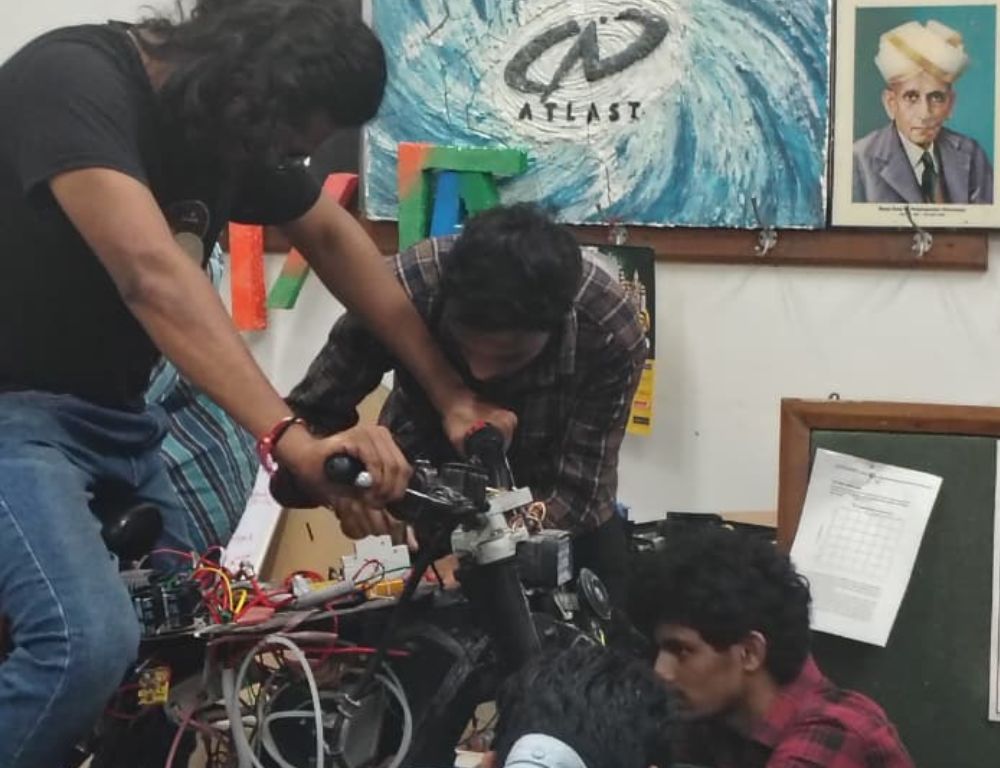
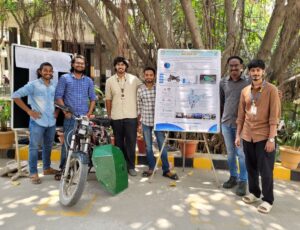
When Gopichand along with his friends Aditya Pramod and Nikhil Swamy founded ATLAST, short for Advancing Technology for Large Scale Affect through Sustainable Transition, he was still a student at VNR Vignana Jyothi Institute of Engineering and Technology (VNRVJIET) in Hyderabad 2021-22. From over three to four years , his small team of eight is quietly building what could be one of India’s earliest hydrogen fuel cell motorcycles, operating out of the very college that first believed in them and supported their Initial journey with a seed grant in 2022.
“ATLAST our step towards sustainability,” says Gopichand Anumolu, reflecting the company’s tagline, a deliberate play on the word ‘Atlast’, meaning ‘finally’. The name captures the sense of meaning , finally our collective step towards sustainability.
India’s electric vehicle movement has made remarkable strides, but for long-distance motorcycle riders, the kind who strap their luggage to their bikes and ride across states, EV charging remains a stubborn obstacle. Even with fast charging, a rider must stop for at least thirty minutes. Do that several times on a 300 plus -kilometre tour, and the inconvenience adds up quickly.The team themselves are riders who travel to Goa, Pune and other cities on the motorcycles for rides has persistently experienced the issue.
ATLAST’s answer is a hydrogen fuel cell fitted to a motorcycle. Unlike a conventional battery, EV, the fuel cell generates electricity by reacting hydrogen gas with oxygen from the air, the same basic chemistry students learn in school electrochemistry chapters. The motor and drivetrain are otherwise identical to an EV. What changes is the source of power.
The result, according to Gopichand, is a range of over 300 kilometers on a single fill, and a refuelling time of just two to three minutes. “If it is an EV, you have to charge it for half an hour no matter how fast the fast charging is,” he informs HyderabadMail. “With hydrogen, you refuel like you fill petrol, and you go.”
The environmental credentials are also striking. Because the fuel cell reaction produces only water as a by-product, the motorcycle’s exhaust consists entirely of water vapour. No NOx. No CO2. No particulate matter.
Gopichand is candid about how steep the learning curve was. Hydrogen fuel cell technology is not the kind of subject one picks up from a YouTube tutorial. He visited research laboratories at NIT Warangal and IIT Madras, where scientists have been working on fuel cell applications for years, securing permission to observe their work firsthand. The rest he pieced together from academic papers and through email exchanges with researchers.
Startup secures IIT Hyderabad, IISc-backed grants
“Most of the learning is through research papers,” he says. “I write emails to people. That is how I learn things from them.”The startup has since received a grant through TiHAN EiR IIT Hyderabad, a government-backed initiative supporting deep-tech ventures.Additionally the startup has also recived grants from FSID IISC Banglore, MeiTY TIDE from SRIX SRU warangal , A CSR grant from Thought works India through Venture Centre Pune .
Presenting Hydrogen technology to funding panels has taught Gopichand that two questions come up almost every time, safety and cost. On safety, the concern is understandable. Hydrogen is a fuel, and like all fuels, it carries risks if handled poorly. ATLAST addresses this through compliance with AIS 206, the Indian standard governing hydrogen-powered vehicles. The standard specifies requirements for pressure handling, storage, leak detection mechanisms, and component certification.
Gopichand says, “Hydrogen is safe but people generally have a misconception about safety.” Every vehicle the company builds will need to meet these requirements before it can be legally deployed.
On cost, Gopichand draws a parallel that most people find immediately convincing, for instance the cost curve of mobile internet. Broadband was very expensive in its early years in India. As adoption grew and infrastructure scaled, prices collapsed. He believes Hydrogen will follow the same trajectory. “Technology is initially expensive, but down the line, once it is in use, the cost will come down,” he says hopefully.
ATLAST eyes ARAI nod
ATLAST is aiming to achieve Automotive Research Association of India(ARAI) homologation, the type approval certification issued by the Automotive Research Association of India, next year. Without it, no vehicle can be legally sold or deployed on Indian roads. Securing it will mark a significant milestone for what remains a very small team.
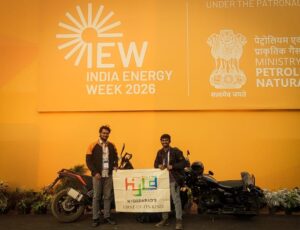
With that certification in sight, the company is already planning a pilot. A hydrogen refuelling station exists in Ladakh, making it one of the few places in India where deploying a fleet of hydrogen motorcycles is logistically feasible. ATLAST plans to send up to ten motorcycles there for real-world testing, essentially, under demanding high-altitude conditions. Full-scale testing is targeted for 2027–2028, with commercial production ambitions pointing in 3 years.
Beyond solving range anxiety for motorcycle enthusiasts, Gopichand frames ATLAST’s work within a much larger national conversation. India imports a significant share of its crude oil, leaving its economy exposed to global supply shocks, a vulnerability that global conflicts have repeatedly highlighted in recent years.
Green hydrogen, produced by electrolyzing desalinated seawater using solar or other renewable energy, could allow India to generate its own transport fuel domestically. “Wherever there are wars, our oil prices will increase because we are importing. Hydrogen is very much beneficial for the country in terms of the economy,” Gopichand says.
ATLAST is also exploring energy applications beyond two-wheelers, though Gopichand is careful to keep the current focus tight. A startup that chases too many directions at once rarely masters any. For now, the motorcycle is the product, and the next decade is the timeline.
Whether hydrogen ultimately wins the clean mobility race alongside battery EVs, or carves out a specific niche for long-range applications, remains an open question. But from a corner office in VNRVJIET, a small team is working to ensure that India is not merely a bystander in that transition, but a builder.
Source link