
- Africa’s biggest startup funding rounds are going to infrastructure sectors like energy, fintech, and mobility rather than artificial intelligence.
- While AI captured about $211 billion, nearly half of global venture funding in 2025, African startups raised roughly $3.6 billion in total across all sectors.
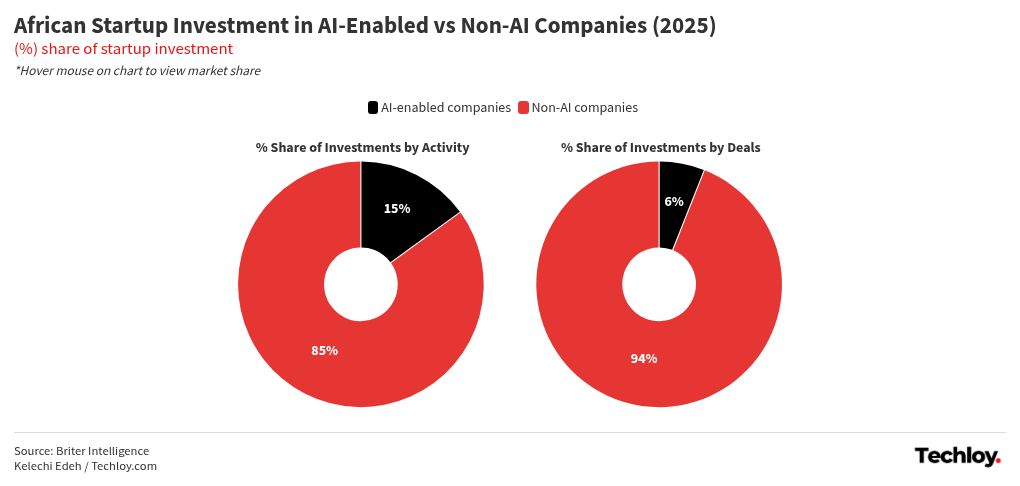
- AI startups are growing across the continent, but capture only about 6% of venture capital despite accounting for roughly 15% of funded companies.
The biggest startup funding round in Africa last year didn’t go to an AI lab, a software company, or a developer platform. It went to a solar power business.
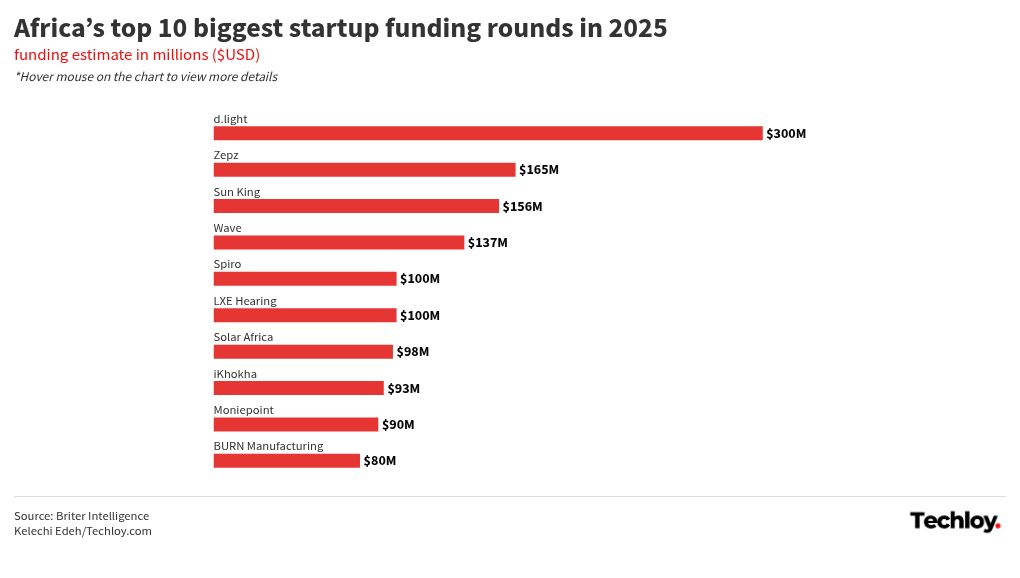
In 2025, off-grid energy startup d.light raised $300 million, the largest single startup round recorded on the continent, according to data compiled by Briter. A few months earlier, another solar platform, Sun King, secured $156 million. Around the same time, fintech firms Zepz and Wave raised $165 million and $137 million, while mobility startup Spiro pulled in $100 million to expand its electric motorcycle network.
If you only looked at Africa’s venture deals in isolation, you might think the global startup economy had never discovered artificial intelligence (AI). But that assumption collapses the moment you zoom out.
Globally, AI has become the gravitational center of venture capital. Investors poured over $425 billion into startups in 2025, according to Crunchbase. Nearly $211 billion, about 50% of all venture funding, went into AI companies alone (as seen in the chart above).
A handful of firms absorbed an extraordinary share of that capital. OpenAI, Scale AI, Anthropic, Project Prometheus, and xAI raised roughly $84 billion combined, close to 20% of the world’s venture funding in a single year.
Put simply, the global startup economy increasingly revolves around AI. Africa’s does not. And the reason has less to do with technology than with the kind of problems African startups are still trying to solve.
MORE INSIGHTS ON THIS TOPIC:
Where is Africa’s venture capital actually going?
African startups raised about $3.6 billion in disclosed funding in 2025 across more than 635 deals (via Briter’s latest investment report). Add another $200 million in estimated undisclosed funding, and the total likely edges closer to $3.8 billion.
Yet even within that pool of capital, the distribution is strikingly uneven. The ten most-funded companies alone absorbed more than $1.3 billion, over a third of all capital deployed across the ecosystem. In fact, just 1% of deals captured roughly 25% of the money raised.
That concentration reveals something important. Venture Capital in Africa doesn’t spread evenly across sectors. Rather, we see that it clusters around companies building systems that underpin everyday economic activity.
EEnergy is one of them. Solar companies like d.light and Sun King are building distributed power networks for households and businesses that cannot rely on national grids. Financial services are another. Companies like Zepz, Wave, iKhokha, and Moniepoint are constructing digital payment rails across economies where cash still dominates and cross-border transfers remain expensive.
Mobility platforms are emerging alongside them. Spiro’s $100 million raise is funding electric motorcycle networks and battery-swapping stations designed to serve cities where transport systems are expanding faster than infrastructure can keep up. Even healthcare appears in this category. LXE Hearing’s $100 million round, for example, is aimed at scaling diagnostic technologies and hearing solutions across underserved markets.
When we step back, we see that the largest startup rounds across Africa aren’t funding frontier software, but instead, economic infrastructure.
The product categories attracting the most capital confirm the same trend. According to Briter’s dataset, the most funded products across African startups include solar energy systems, digital payments, credit infrastructure, money transfers, electric vehicles, and diagnostic technologies. Artificial intelligence barely appears in that list.
AI startups are growing in Africa — just not attracting the biggest checks
But Artificial intelligence isn’t absent from Africa’s startup ecosystem. In fact, founders across the continent are increasingly building products around it.
According to Briter’s Intelligence, AI-enabled startups accounted for roughly 15% of funded companies in 2025, but they captured only about 6% of the venture capital deployed.
At first glance, that gap looks puzzling. If AI is leading in global venture capital, why is it barely visible in the largest African funding rounds? The answer, though, becomes clearer once you look at how those startups actually use the technology.
Most African AI companies operate in what investors often call the application layer. Instead of building foundation models or massive computing infrastructure, they apply machine learning tools inside existing industries.
Fintech startups use AI to improve credit scoring and fraud detection. Agricultural platforms use predictive models to forecast crop yields and disease outbreaks. Logistics companies rely on machine learning to optimize delivery routes and fleet operations. Healthcare startups experiment with diagnostic tools powered by computer vision.
These businesses behave like software startups. They typically require far less capital than companies building energy systems or financial networks. Which is why their funding rounds tend to be smaller.
As venture investor Wale Ayeni of Helios Digital Ventures puts it, “Frontier markets are often described as catching up, but in reality, they are not early, they are different.”
That difference is visible in the structure of venture capital itself. In Silicon Valley, the most valuable startups often come from breakthroughs in computing. In Africa, the most valuable opportunities frequently lie in solving structural gaps in electricity, payments, logistics, and mobility.
Artificial intelligence still plays a role in those industries. It just rarely appears as the product itself. Instead, it works quietly inside the systems being built.
Where is Africa’s technology ecosystem heading?
Will the continent eventually produce large AI companies capable of attracting billion-dollar venture rounds like the companies dominating funding in the United States and Europe? Or will artificial intelligence remain embedded inside sectors such as fintech, agriculture, logistics, and healthcare, improving the infrastructure platforms already taking shape?
For now, the numbers point toward the second path.
Globally, venture capital may be chasing artificial intelligence. Across Africa, investors are still backing companies building the foundations of modern economies — electricity, payments, mobility, and logistics.
AI may transform those industries over time. But the continent’s startup boom is being driven by a much older challenge: building the infrastructure that makes digital economies possible.
The AI funding boom is here—but most of the money is flowing to a tiny club
Which AI startups are scoring big funding in 2025, who’s investing in them, and what does it signal for the wider ecosystem?
Source link