At a webinar organised by the age-tech startup Ivory, a participant quietly said: One evening, when his daughter walked into the house, he just could not recall her name. By the time he sought help, the window for meaningful intervention had largely closed.
“Imagine the number of signs the family probably ignored before it got to this,” says Issac John, cofounder of Ivory, a Bengaluru-based company focused on measuring cognitive decline in older adults and helping them fight it. “This gentleman was already past the serious stage.”
A father in Delhi found himself navigating an even more disorienting journey. His 41-year-old daughter had been diagnosed with early-onset Alzheimer’s disease. He went from hospital to hospital, including the All India Institute of Medical Sciences, only to be told that there was little that could be done.
With no roadmap and no support system, he turned to Ivory. While the case was outside its core offering, the company’s clinical team connected him to a specialist who now works with the family, helping them manage her behavioural spikes and track her condition.
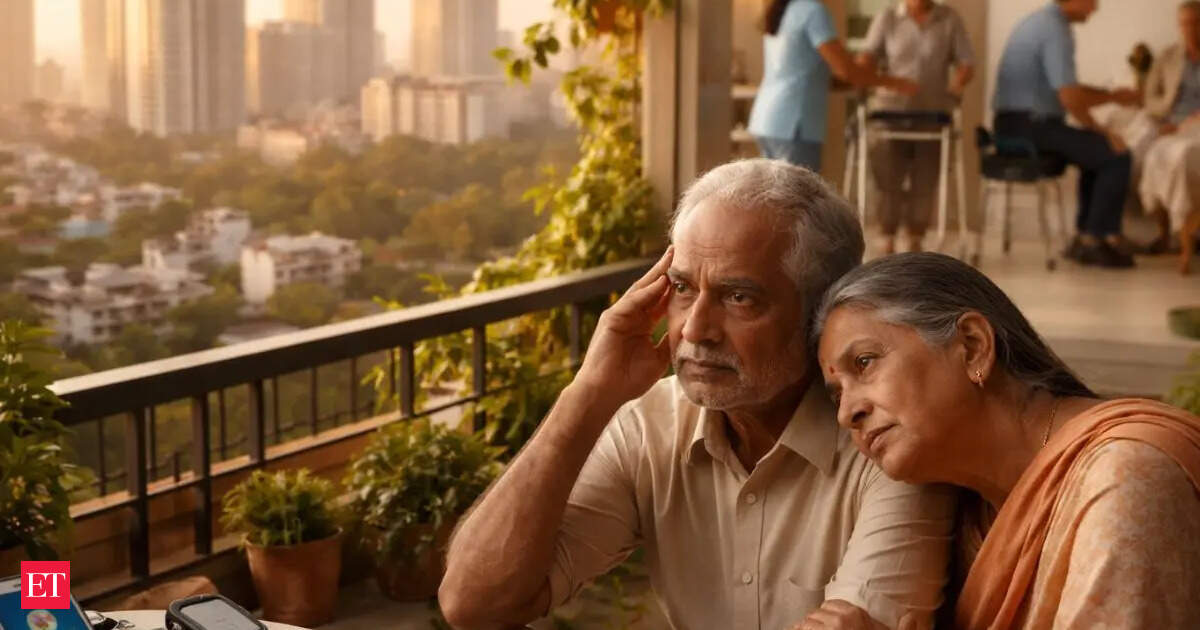
These are not isolated stories. They signal a structural shift India is only beginning to confront: a country ageing faster than ever before.

According to Census 2011, India has close to 100 million people above the age of 60. By 2050, that number is expected to cross 300 million, accounting for nearly a fifth of the population.
But what makes this demographic shift significant is not just its scale, but its character.
This is possibly the most financially secure and aspirational generation of seniors India has seen. Many have pensions, investments, or income from property. They are digitally aware, increasingly health conscious and are willing to spend on improving their quality of life.
This is the context in which the silver economy is taking shape. As families shrink into nuclear households and migration scatters children across cities and countries, a care gap has opened up that the state is unequipped to fill. This vacuum is being filled by an emerging ecosystem of age-tech startups, spanning cognitive health platforms, community networks and senior-focused consumer products, ambient monitoring and assisted living.
For this new silver economy to succeed, it must solve a paradox: how to provide professionalised, tech-driven care in a culture that still views outsourcing eldercare with deep-seated guilt.
Rethinking ageing
One of the first things founders in this space confront is a deeply entrenched assumption: that seniors are passive, dependent and disengaged.
Neeraj Sagar, who runs WisdomCircle, a platform that connects retired professionals with meaningful work opportunities in India and abroad, pushes back on that view. “The elderly want relevance, engagement, contribution, identity. They don’t want to be ‘serviced’. They want to be respected and useful,” he says.
This insight is shaping how products and services are being designed. The opportunity for age-tech is not just to manage decline, but to extend purpose. In that sense, ageing is no longer just a healthcare problem. It is a lifestyle, economic and social design challenge.
After all, even as seniors redefine what they want, the systems that once supported them are changing. India’s traditional caregiving model, rooted in joint families, is steadily weakening. Nuclear households, migration and global careers have left a growing number of seniors living alone or only with their spouses.
According to the Longitudinal Ageing Study in India (LASI), nearly 27% of urban seniors now live alone or with their spouses. At the same time, almost 75% live with one or more chronic conditions, many requiring sustained care.
“We have seen families struggle with situations they were not equipped to handle,” says Ishaan Khanna, CEO of Antara Assisted Care Services. “An ageing parent who needs help with daily activities, someone recovering from surgery with no one at home, or a family dealing with dementia and not knowing where to turn.”
Antara’s approach has been to build assisted living ecosystems that combine independence with structured care. “Our care homes have embedded care layers that kick in as a resident’s needs evolve, ensuring all their requirements are met in one familiar place,” says Khanna.
Mind, your business
While physical care is the most visible aspect of ageing, cognitive decline is emerging as one of its more complex challenges. For startups like Ivory, the biggest barrier has been awareness. “A sugar test is easy. Measuring brain function is not,” says John.
That is changing. Ivory, which runs tests through healthcare providers, says it has seen a marked shift in its user base. Earlier, nearly 70% of users seeking diagnostic support were above 50 years of age. Today, it is almost evenly split between those aged 40-50 years and above 50.
A growing number of users are coming in proactively. A 35-year-old signed up for annual cognitive testing simply because he had seen his grandfather suffer from neurodegeneration and wanted to act early.
There is a broader behavioural shift underpinning this. The same generation that tracks sleep, heart rate variability and stress, is now beginning to track cognition.
“There’s a sea change. People are talking about brain fog, forgetfulness, attention issues—conversations that didn’t exist a decade ago,” says John.
Science is reinforcing this trend. Global studies have shown that cognitive decline can be slowed through multi-modal interventions, combining diet, exercise, sleep and mental engagement.
“When we detect changes early, we can intervene meaningfully,” says John. “Cognitive assessments will eventually become like a treadmill test for the brain.”
Falling and rising
Beyond cognition, startups are also tackling the physical and environmental challenges of ageing, many of which have long been overlooked.
Take fall prevention. Falls areamong the leading causes of injury in seniors globally, yet India lacks even the basic infrastructure, from well-designed walking aids to accessible home modifications.
Antara has responded by redesigning everyday aids and integrating them with technology, fall detection, SOS alerts and wearable devices.
Meanwhile, startups like Bengalurubased Kubo Care are going deeper into predictive monitoring. “The catastrophic fall that sends someone to the hospital isn’t the first fall,” says cofounder Anurag Ram Chandran. “It’s the smaller, unreported incidents that build up risk.”
Kubo Care uses proprietary AI and radar-based sensors installed at homes to track daily movement and generate personalised fall-risk scores, allowing early intervention. The broader idea is ambient care—technology that operates in the background, monitoring continuously, without intruding on privacy like cameras would.
Multi-dimensional problem
As the ecosystem evolves, startups are realising that ageing cannot be addressed through isolated solutions. It is a multidimensional journey, spanning health, mobility, safety, emotional wellbeing and social connection.
“We realised that elders’ needs don’t begin when they move into a senior living community. They already exist while they are living at home, whether it’s safer bathrooms, healthcare access, or companionship,” says Adarsh Narahari of Marzi by Primus, a platform focused on active ageing through community, health and curated experiences in Bengaluru.
This is leading to the emergence of full-stack platforms combining services across the ageing lifecycle. “We are building a system that helps seniors stay independent while improving their quality of life,” says Narahari.
The consensus among founders is clear: age-tech will not remain a standalone category for long.
“Ageing is not a single problem,” says Sagar. “It spans health, lifestyle, financial planning and social connection.”
The shift is also perceptual. Senior living, once seen as a last resort, is slowly being repositioned as a lifestyle choice, one that prioritises independence rather than dependency.
Affordability Paradox
Despite obvious and growing demand, one major constraint continues to limit scale: affordability.
Healthcare in India remains largely out-of-pocket. Nearly 40% of healthcare expenditure is borne directly by households, according to National Health Accounts estimates. And long-term care, assisted living, rehabilitation and memory care are rarely covered by insurance.
This creates a paradox. Urban seniors are already spending up to 30% of their income on health-related needs, according to the Ministry of Statistics and Programme Implementation. Yet, access to organised, high-quality care remains limited.
“Ageing needs are continuous, but insurance frameworks are still hospitalcentric,” says Khanna. Until long-term care is integrated into mainstream insurance, the market will continue to grow, but below its potential.
If affordability is a structural barrier, trust is an emotional one. In India, caregiving is traditionally seen as a family responsibility. Outsourcing it, even to professionals, can carry stigma and guilt.
“Families are not just evaluating a service,” Chandran says. “They are rethinking long-held beliefs about responsibility.”
This makes trust the defining currency in the sector. A story from Samarth Eldercare, which provides elder care services in 200 towns and cities in India, illustrates this. During a routine visit, a care manager noticed subtle changes in a client—slightly laboured breathing, low energy. The client insisted he was fine. She insisted otherwise.
A hospital check revealed a severe lung infection already affecting multiple organs. Doctors said a delay of even 24 hours could have been fatal. What followed was not just treatment, but coordinated recovery, home monitoring, specialist consultations, medication management and emergency support.
The patient recovered fully. His children, livingabroad, later described the care manager as their “guardian angel”. But the company emphasises it was a system at work. “It’s not about finding a superhuman caregiver,” says Asheesh Gupta, founder, Samarth Eldercare. “It’s about building a care system.”
Post-pandemic inflection
The Covid-19 pandemic was a catalyst for this sector. For families, especially those with members living abroad, it exposed the fragility of distance.
“Nearly 68% of families now want to plan long-term support, compared with less than 35% before the pandemic,” Gupta says. At the same time, seniors themselves are becoming active participants in decision-making. According to a survey of customers by Samarth, around 30% of families report that parents co-create or independently decide their care plans, viewing professional care as empowerment rather than dependency.
Deeper scientific efforts are also underway. At the Indian Institute of Science (IISc) Bengaluru, the Longevity Initiative is studying ageing through a multidisciplinary lens. “The diversity of India allows us to identify what truly drives ageing, separating genetic, lifestyle and biological factors,” says Deepak Saini, professor of molecular reproduction, development and genetics, IISc. India-specific factors such as low muscle mass, higher visceral fat and unique dietary patterns make this research particularly relevant.
Senior care, by its very nature, is built on trust, empathy and relationships. The future, therefore, lies in integration: platforms that can bring these elements together seamlessly. Technology will play a central role, but not as a replacement for human care. The most effective models will be those where technology operates in the background, adding to efficiency and insight, while human caregivers remain at the centre.
The silver economy is no longer a future projection. It is the present. It will take time for these startups to make their impact felt and rake in the moolah. But then, the success of these startups will be measured not just in market share, but in how many Indians can finally face old age without the long shadow of fear.