Beyond Screens, a Hybrid Learning Model Takes Shape
The first idea Tesfamikael Tekleberhan and his colleagues considered was straightforward: a digital platform that would provide answers to textbook questions for students.
The concept emerged four years ago, as a group of young entrepreneurs explored opportunities in Ethiopia’s expanding digital sector. At the time, the proposal appeared both practical and commercially viable.
“At the beginning, we discussed creating a platform that would show solutions to textbook questions like classwork and homework,” Tesfamikael said.
From The Reporter Magazine
Textbooks remain central to Ethiopia’s education system, and a service offering ready-made solutions to exercises had clear market potential. But the group reconsidered.
“Although the proposed platform could have gained market traction in a short time, we realized it would not help students truly understand their lessons,” he said.
Instead of focusing on answers, the team shifted toward building a platform designed to support learning itself. That decision led to the creation of A Plus Online Tutors, an Ethiopian education technology startup offering structured tutorials for students from Grade 5 to Grade 12.
From The Reporter Magazine
The platform is designed to allow students to learn at their own pace, a model that developers say addresses gaps in a system where classrooms are often large and teachers have limited capacity to provide individualized support.
A Plus Online Tutors has attracted more than 10,000 subscribers, each paying a monthly fee of 300 birr, according to the company.
The startup is part of a growing group of Ethiopian EdTech firms seeking to expand access to education through digital tools.
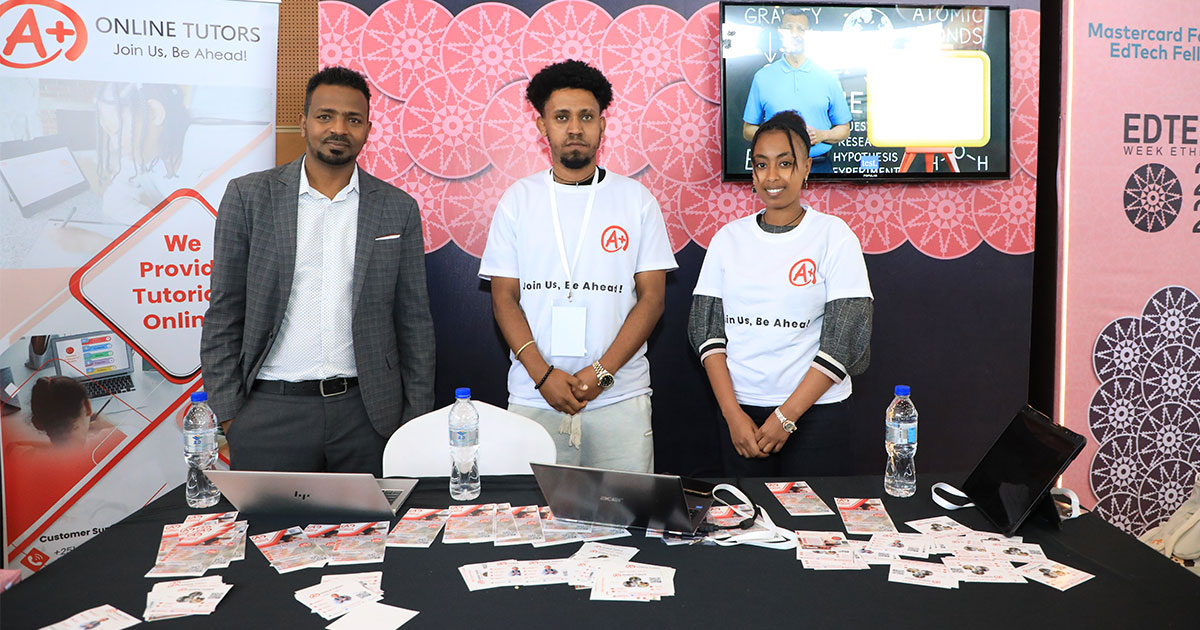
Their efforts were on display in late March 2026, when Addis Ababa hosted a High-Level EdTech Demo Day and Investment Forum, part of a broader EdTech Week held under the theme “Integrating EdTech for Inclusive, Impactful, and Gender-Responsive Learning.”
The event, organized by Reach for Change Ethiopia in partnership with Ethiopia’s Ministry of Education and supported by the Mastercard Foundation, brought together entrepreneurs, policymakers and investors focused on the role of technology in education.
Discussions at the forum centered on how digital solutions could help address the country’s education challenges, including expanding access and improving learning outcomes for millions of students.
For A Plus Online Tutors, the forum served as both a showcase and a proving ground.
Presenting to investors and policymakers, Tesfamikael outlined not only the platform the company had developed, but also the direction it had chosen to pursue. Beyond its digital offering, the startup is testing a hybrid model that combines online learning with in-person study environments.
The approach reflects broader constraints in Ethiopia, where access to devices, reliable internet and suitable study spaces remains uneven.
At the forum, the company introduced a plan to establish neighborhood-based study centers within condominium communities. The model is designed to provide students with a structured setting after school, where they can access lessons through the platform while also engaging in group-based learning.
According to Tesfamikael, students attend sessions where they use audio-visual materials, discuss lessons with peers and receive guidance from facilitators. The format also incorporates opportunities for students to present what they have learned and complete assignments within the center.
The company currently operates one study center as a pilot. It plans to expand to 30 centers across Addis Ababa within a year, each designed to accommodate up to 600 students. A further expansion to 50 centers is under consideration for the following year.
The proposed scale would represent a significant increase in access to supplementary learning spaces in the capital, particularly for students who may lack adequate study environments at home.
“These study spaces are designed so that students can access quality education in a standard and structured environment close to their homes,” Tesfamikael says.
To support this expansion, A Plus Online Tutors is seeking investment and strategic partnerships. Company representatives used the forum to engage potential backers and present the model as a scalable solution within Ethiopia’s education sector.
The event also marked 10 years of operations for Reach for Change Ethiopia and highlighted a broader shift toward building long-term support systems for education-focused enterprises.
As part of a new five-year initiative, Reach for Change Ethiopia announced grants of up to USD 60,000 for early-stage EdTech companies, alongside technical support that includes marketing training, business coaching and digital content design courses delivered in partnership with Carnegie Mellon University.
The program is structured in phases and tied to performance milestones, reflecting a broader effort to support startups beyond initial funding.
At the center of the initiative is the Mastercard Foundation EdTech Fellowship, a three-year acceleration program designed to support three cohorts of 12 enterprises each. A Plus Online Tutors is part of the second cohort.
Company representatives say the fellowship has contributed to refining their business model, strengthening partnerships and preparing for expansion.
“We have redefined the concept of educational impact, optimized our solutions to enhance the learning experience, forged strategic alliances, and made substantial progress in expanding our social contributions,” he further stated.
Government officials have also signaled support for the sector. Speaking at the opening of EdTech Week, Kindeya Gebrehiwot (Prof.) said expanding the use of education technology has “significant national benefit” and plays a role in improving both access and quality in education.
Officials from the Ministry of Innovation and Technology highlighted the government’s broader digital transformation agenda, pointing to efforts aimed at aligning technological development with social and economic priorities.
Despite growing interest and investment, structural challenges remain. Limited infrastructure, uneven internet access and affordability constraints continue to affect the reach of digital learning platforms.
Some startups are adapting their models in response. A Plus Online Tutors’ hybrid approach, which combines digital content with physical study centers, is designed to address gaps in access while maintaining a structured learning environment.
The model, however, introduces additional operational and financial demands, including the need for sustained investment and logistical coordination as the company expands.
A Plus Online Tutors reflects a broader shift among Ethiopian education technology startups, many of which are seeking to move beyond content delivery toward more comprehensive learning models.
The company’s approach emphasizes guided learning rather than answer-based solutions. This approach was echoed during discussions at the forum, where participants highlighted the potential for technology to complement and, in some cases, enhance traditional education systems.
Ethiopia’s push to expand access to education for a rapidly growing student population has placed increasing attention on such innovations. Policymakers and industry stakeholders have pointed to EdTech as one of several tools that could help address capacity constraints in the sector.
As the two-day forum concluded, announcements were made, partnerships explored and new initiatives introduced, though many emphasized that implementation remains the primary challenge.
For Reach for Change Ethiopia and its partners, the coming years will focus on translating programmatic support into measurable outcomes. For startups, the emphasis is on scaling operations while maintaining service quality.
While expectations around EdTech remain high, stakeholders at the forum underscored that its impact will ultimately be determined by how effectively solutions are deployed and sustained in real-world learning environments.