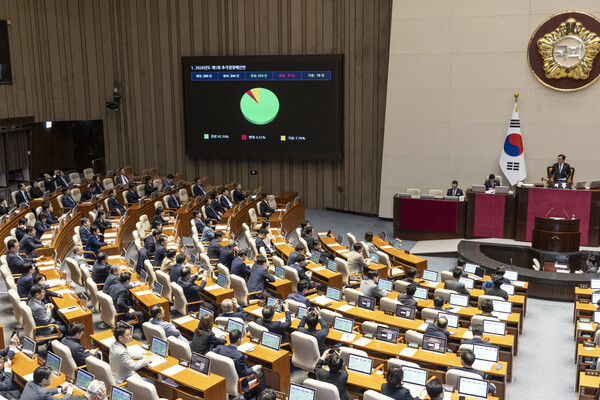
South Korea’s Ministry of Science and ICT said on Thursday the National Assembly approved a 78.7 billion won supplementary budget under the ministry’s remit at a plenary session. The ministry will secure a total budget of 23.83 trillion won for this year, after adding the supplementary budget to its main budget of 23.74 trillion won.
The supplementary budget includes projects to support recovery and growth amid a crisis of high oil prices and high inflation stemming from the Middle East war. It focuses on strengthening the innovation capabilities of young entrepreneurs and intensively supporting traditional companies to raise productivity through an artificial intelligence transition. It also includes a budget to speed commercialisation of carbon capture and utilisation technology, or CCU, to raise energy self-sufficiency and secure low-carbon competitiveness for major industries.
Support will be expanded to build science-focused startup cities with the four science and technology institutes including KAIST and R&D special zones as bases. Through a startup league involving the four science and technology institutes, the plan will identify youth technology startup teams and provide linked support such as team building, advancement of business models and global expansion through institute-specific startup specialisation programmes (39.8 billion won). It will also support step-by-step customised programmes (6.0 billion won) to revitalise regional deep-tech startups centred on R&D special zones.
It will also provide vouchers (10.0 billion won) so traditional companies can purchase and use AI transition solutions from youth startups. Through this, the plan will raise the productivity and efficiency of traditional firms and spread a win-win AI transition model in which young AI companies open stable early sales channels.
The supplementary budget will also be used for large-scale demonstrations of alternative energy development technologies. The plan will pursue early commercialisation of large-scale CCU demonstration facilities that capture carbon dioxide generated in petrochemical or steel processes and convert it into high value-added compounds. With the budget secured through the supplementary budget, it will start process design, orders for large equipment and basic civil engineering work within the year, and proceed without disruption with completion of the demonstration facility in 2028 to bring forward the commercialisation timeline.
Bae Kyung-hoon (배경훈), deputy prime minister and minister of science and ICT, said, “Although this is a time of great uncertainty at home and abroad, we will do our best to create an environment that can move toward recovery and growth.” He added, “We will make every effort in execution so the supplementary budget that the National Assembly and the government urgently 마련한 can reach people’s livelihoods on the ground as soon as possible.”