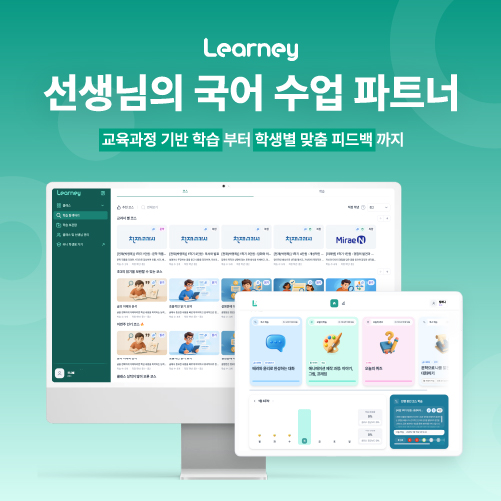
– Learney, an AI-based literacy platform integrating reading, writing, speaking, and listening
– Teacher-centered design structure directly connected to classroom instruction
– Accelerating global expansion based on GESA finalist and ESSA certification
What is more important than field data or technology is whether it is actually used. The same applies to EdTech. While numerous educational technologies are emerging, few services are repeatedly used within the classroom. Particularly in the field of literacy education, which integrates reading, writing, speaking, and listening, the gap between theory and actual instruction remains significant. Teachers must conduct classes under the constraints of time and burden, while students participate in learning with varying levels of proficiency.
Learnney is a service created to bridge this gap. It aims to build a structure that teachers can use immediately in the classroom, rather than simply serving as a learning tool. It is a platform that implements literacy education in an actionable form by combining AI with the Science of Reading theory.
It is different from the start in that it is a service designed based on the reality of the classroom, rather than being centered on technology.
Problems that started in the classroom, unimplemented literacy education
Artificial Society, the operator of Runny, is an edtech startup founded in 2022. Currently, it is developing an AI-based literacy platform with a team of approximately 11 people. Although the organization is small, the scope of the problems it seeks to solve reaches the core of the educational field.
What this company focused on was not mere learning efficiency, but the ‘difficulty of implementation.’ While there is a strong consensus on the importance of literacy education, fully realizing it in actual classrooms is not easy. Although the principle that reading, writing, speaking, and listening should be taught integrally is clear, designing and operating this on a lesson-by-lesson basis places a significant burden on teachers.
Particularly in situations where there are disparities in learning levels among students, it is difficult to provide individual feedback simultaneously. As a result, many classes end up compromising between theory and practice, leaving literacy education as an “important but difficult area.”
Runny focused on changing this point. The core idea is to reduce the burden on teachers and create a flow that operates naturally within the classroom by implementing the entire process—from lesson design to execution and feedback—within a single platform. Teachers can manage learning progress during the pre-, mid-, and post-lesson stages, while students can continue reading, writing, and speaking activities tailored to their individual levels.
CEO Kim Ki-young explains this approach as not a simple functional issue, but a ‘standard issue.’
There is already plenty of good content. I thought the important thing was whether it actually works in the classroom.
The moment it started being used in the classroom, the direction of the product changed.
Runny’s turning point was created not in technical perfection, but in ‘usage’. No matter how good a tool is, it is not a good product if the user finds it difficult to get used to using it.
As classrooms are adopting a conservative approach to digital transformation, it is crucial to keep pace with this speed. Therefore, the direction of product development focuses not on expanding features, but on creating a structure that can be used repeatedly within the actual flow of a lesson. A design that seamlessly integrates into the class without disrupting the teacher’s workflow has become the core criterion for product improvement.
In particular, the interface and feedback methods were reorganized based on the criteria of ‘usability’ as well as ‘learning effectiveness.’ This is because meaningful learning experiences can only be created for students if teachers can use them without burden.
“When the teachers started writing without explanation, that’s when I became convinced. That the direction we are heading is the right one.”
Since then, Runny has evolved from a simple learning tool into a service that functions as part of a class.
A Model Started in Korea Expands into a Global Classroom
Runny has recently begun receiving significant recognition on the global edtech stage. By being selected as a finalist in the literacy improvement category at the ‘2025 Global Edtech Startup Awards (GESA),’ it was acknowledged for both its technological prowess and educational contribution. This evaluation is significant in that it verifies not only technical competitiveness but also applicability and scalability in actual educational settings. In particular, whether the same learning structure can be applied to learners with diverse linguistic and cultural backgrounds serves as a key criterion.
Runny is expanding its Korean-based literacy model by restructuring it to align with English Language Arts (ELA) abroad. This approach strengthens reading, writing, and speaking simultaneously through a structure that analyzes the student’s comprehension process and provides explanations and feedback, rather than focusing on problem-solving.
In this process, the language changes, but the learning structure is maintained. This ‘structural consistency’ is becoming the key to global expansion.
Currently, in some U.S. states, the product is being utilized in conjunction with actual classroom instruction, moving beyond the simple testing phase into the real-world usage phase. This can be interpreted to mean that the product has moved beyond merely adapting to the field and has begun to establish itself within the educational landscape.
Beyond technology to the market, and a matter of speed
The next challenge Runny faced was scaling up. While product completeness had been secured, the more critical issue was how to expand it into the market. In particular, verifying product fit (PMF) in the global market was a time-consuming and highly uncertain area. In this process, the Startup Leap Package played a role in accelerating the process. Through financial support, manpower
We were able to secure and enhance our products, and based on this, we were able to rapidly improve our global responsiveness.
This change first appeared in global inbound tourism. Previously non-existent overseas inquiries began to come in, and as the number of cases leading to actual meetings with decision-makers increased, the market response gradually
It took shape. Collaboration with the Kyungpook National University Startup Support Center also served as a crucial foundation in this process. Rather than simple administrative support, a process was established to connect products with markets through flexible feedback and strategic reviews tailored to the business situation.
Runney has also secured the credibility standards necessary to enter the public education market. By obtaining U.S. ESSA Tier IV certification, it has been recognized as an educational solution equipped with a learning science-based design and research plan. This certification goes beyond simple functional verification; it is a process that evaluates whether the structure is applicable in actual educational environments. In particular, it serves as a crucial criterion for public schools and school districts when adopting solutions based on their budgets.
Runny collaborated with Leanlab Education to systematically organize and validate the product structure and educational design flow. This was not merely a process of proving the technology, but one of verifying its ability to function within an educational system. CEO Kim Ki-young views this as the starting point for global expansion.
The most important point is that a model proven in Korea works in other educational environments as well.
The question that ultimately remains: How should we make them read and write?
Runny’s goal is not merely global expansion. It is to create a meaningful case study in the U.S. market and, based on this, set a new standard for literacy education. Currently, the company is expanding its market by combining partnerships with direct sales targeting North America, Europe, and the Middle East. Particularly given the nature of its native-language-based literacy education, the potential for global expansion is structurally open.
In the long term, the goal is not to become a platform used by millions of students, but to provide a single answer to the question of ‘how to develop reading and writing skills.’
CEO Kim said this in conclusion.
We are not a company that makes tools; we want to change the way children understand and express language.
Runny currently stands on an attempt to redefine the very method of education, going beyond technology. And this change is not a grandiose innovation, but is beginning little by little in the most realistic space: the classroom.
Related
Source link