The listing of Resense Medical is evaluated as the fruit of UNIST’s “R&D scale-up” strategy aimed at commercialization from the original technology stage. The university supported the entire start-up process, including manufacturing and licensing prototypes for Resense Medical, clinical trials, investment attraction, and overseas expansion. An official from UNIST said, “The goal is to commercialize basic and sourced research results of teachers and students and to grow them in the market,” adding, “License Medical must have received a lot of help from universities in the production facilities and network sectors for overseas expansion.”
Ulsan, an industrial city with Korea’s largest industrial complexes such as automobiles, shipbuilding, and petrochemicals and research-oriented universities, is rapidly emerging as a good city to start a business.
Ulsan City announced on the 31st that it ranked 391th in the world in the Global Startup Ecosystem Index 2026 released by Startup Blink, a global startup analysis agency. Since 2017, start-up Blink has been releasing its start-up ecosystem index to 1,500 cities around the world every year.
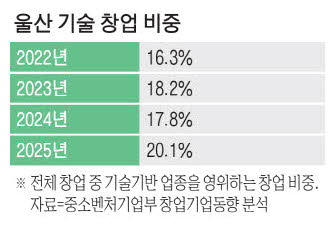
Ulsan City analyzed the results as a result of reflecting the strengths of the nation’s largest industrial city. Among technology-based startups, Ulsan accounts for 25.6% of manufacturing startups, 1.8 times higher than the national average (15.6%). UNIST’s five-year survival rate for deep-tech startups, which the government fosters as southeastern start-up bases such as Busan, Ulsan, and Gyeongnam, is 70%, the highest in the country. In particular, Ulsan showed strength in the field of environmental purification technology. In the evaluation of the field, Ulsan was recognized for its competitiveness in Korea and fourth place in East Asia. The growth rate of related start-up ecosystems was 145%, the fourth-largest in East Asia.
Ulsan City explained that it received positive reviews for strengthening the technology-based start-up support system, including the operation of the Ulsan Startup Hub at the Jongha Innovation Center, UNIST’s selection of a deep tech start-up-oriented university, and the creation of a 50 billion won regional growth fund.
Ulsan City plans to enter the world’s top 100 start-up cities in the next five years by fostering 500 deep-tech start-ups, cultivating 500 artificial intelligence (AI) talents, and establishing strategies to promote manufacturing artificial intelligence start-ups in connection with major industrial innovation.
The government’s selection of Ulsan as a manufacturing start-up city is also a positive factor. In order to leapfrog the local start-up ecosystem to a global level, the government designated the area where the four major science and technology centers are located as start-up cities. To this end, it plans to strengthen the investment ecosystem centered on start-up cities by creating a regional growth fund worth 450 billion won starting this year.
Ulsan’s strength is that it has an environment in which startups can freely demonstrate technology in global companies such as Hyundai Heavy Industries, Hyundai Motor, S-Oil, and Korea Zinc.
Accordingly, Ulsan City plans to designate UNIST as a deep-tech start-up-oriented university and cultivate key talents by establishing a start-up center and strengthening educational cooperation with local universities. Lee Young-hwan, director of the Corporate Investment Bureau of Ulsan City, said, “The results of this evaluation mean that Ulsan’s foundation for start-ups is well established. The biggest strength is the start-up ecosystem that connects startups with major industrial conglomerates such as automobiles, shipbuilding, and petrochemicals.”
[Ulsan reporter Seo Daehyun]
Source link