The data kept producing the same anomaly.
At first, Prashant Gupta assumed it was a mistake. Wealthy’s customers looked remarkably similar on paper. They were roughly the same age, worked similar jobs and earned comparable salaries.
But some accounts were inexplicably larger than others.
The company had been founded on a conviction that would have sounded familiar to anyone who followed Indian fintech in the 2010s. Investing, Gupta believed, should be as frictionless as buying something online. “People are buying a ₹60,000 iPhone on Amazon and why can’t they do a ₹5,000 SIP online?” he said, recalling the original thesis behind Wealthy.
It was a powerful idea and, at the time, a fashionable one. Across India’s emerging fintech ecosystem, founders were trying to eliminate friction. The future, it seemed, belonged to software.
Gupta had little reason to think otherwise. An IIT Madras graduate who later attended IIM Ahmedabad, he spent his early career at Morgan Stanley and Société Générale, where he worked closely with wealth management and institutional finance. The inefficiencies were obvious. Wealthy, founded in 2015 with Aditya Agarwal, emerged from the belief that technology could change that equation.
For a while, the thesis appeared to work. Customers were signing up, assets were growing and the company was finding its place in a rapidly changing market. Yet two numbers continued to bother Gupta. One, customer acquisition costs remained stubbornly high. “It was also retention. Retention was low,” he said. Neither problem was unusual for a startup, but together they hinted at something deeper.
The more interesting clue emerged from a handful of customers who seemed to defy expectations. Their profiles looked almost identical to everyone else’s. Similar age. Similar profession. Similar life stage. Yet, they entrusted Wealthy with significantly larger amounts of money. Gupta and his team began investigating what separated them from the rest.
The answer turned out to be surprisingly simple.
“Ultimately we found out that he either knows one of the team members or he has spoken to them or he’s spoken to the customer services team. So a human in the loop.”
Gupta uses the phrase often enough that it begins to sound like a philosophy. At a time when much of fintech was focused on removing intermediaries, Wealthy’s data suggested that customers responded better when another person entered the equation.
“The human in the loop was very important,” Gupta said. “Increasing the account size was a big insight that we got from the data.”
The finding challenged one of the central assumptions on which Wealthy had been built. If technology was supposed to remove intermediaries, why did customers seem to perform better when an intermediary appeared?
The team decided to test the theory. They identified customers with similar profiles and deliberately introduced human interaction into the relationship. Advisors called them, answered questions and helped them think through decisions.
What happened next surprised even Gupta.
“Those account sizes didn’t grow 2x. They went 7x, 8x.”
The pivot would eventually reshape Wealthy’s trajectory. What began as a consumer investing platform evolved into a network of financial advisors and wealth entrepreneurs, attracting backing from investors including Alpha Wave and, more recently, Bertelsmann India Investments. Last year, Wealthy raised ₹130 crore in a series B round.
The numbers forced Gupta to confront the possibility that the company’s original thesis was incomplete. Wealthy’s pivot emerged from evidence that challenged one of fintech’s most cherished assumptions.
Perhaps investing was never fundamentally an information problem.
The more Gupta thought about it, the more convinced he became that information had never really been scarce. Research reports, financial news, market commentary and investment advice were already widely available.
“The customer has no problem getting information right now as well,” Gupta said. “The problem is to process the information and put it in your context.”
That distinction sits at the heart of what has become Gupta’s anti-DIY thesis.
Much of fintech was built on the idea that investors needed better tools. Gupta increasingly believes they need better judgement. Or, more accurately, they need someone who can help them apply judgement at moments when emotion threatens to overwhelm reason.
Most of Wealthy’s customers today are over the age of 30. Gupta sees that as more than a demographic detail. It marks the point at which investing stops being an intellectual exercise and starts becoming consequential. Careers advance, people get married, children arrive, parents age and unexpected expenses emerge. Wealth management rarely sits at the top of that hierarchy of concerns, no matter how financially literate someone might be.
“Wealth management should be maybe number two, number three priority in life after family,” he said. “But it kind of keeps going down your to-do list.”
The observation helps explain why Gupta rejects the notion that DIY investing will inevitably dominate as markets mature. In his view, the question isn’t whether people are smart enough to manage their own money. It is whether they have the time, attention and emotional discipline required to do so consistently.
He often returns to one conversation from the early days of the pandemic. Markets were collapsing, uncertainty was everywhere and one client wanted to liquidate his investments. “The world is going to die, everybody is going to die. I want my money out,” the client told him.
Gupta responded with a question.
“I said, assume that your theory is correct. Everybody is going to die. Does it even matter that you have one-and-a-half crores?”
The client stayed invested. Later, he increased his investments.
For Gupta, the lesson was obvious. The value of advice rarely appears when markets are rising. It emerges when investors are afraid. Financial advisors, in this formulation, are not primarily product distributors. They are behavioural coaches.
That insight has reshaped Wealthy itself.
The evolution is visible in the products the company now emphasises. While mutual funds remain the core offering, Gupta talks about customers as a three-legged stool. The first leg is wealth creation through products such as mutual funds. The second is protection through life and health insurance. The third is what he calls ‘play money’ or riskier allocations such as bonds and other alternatives.
The mix is interesting. Mutual funds account for roughly 80-85 per cent of business volumes, Gupta said, but contribute about 65 per cent of revenue. Insurance, particularly health insurance, contributes roughly 25-30 per cent of revenue despite representing a much smaller share of transactions.
“Health insurance is a great product,” he said. “All of us will use it at some point.”
The people who join the platform come from a surprisingly diverse set of backgrounds. Some are chartered accountants looking for additional revenue streams. Others are insurance agents who already possess deep customer relationships. Many are private bankers or retail bankers who want to build independent practices. Increasingly, software engineers are joining too.
Gupta describes these cohorts almost like a sociologist mapping a new profession. Each enters wealth management for different reasons, but they share a common advantage: trust. The chartered accountant already advises clients on financial matters. The insurance agent may have spent years building relationships with families. The banker understands financial products. The engineer often begins with a network of peers facing similar life decisions.
“They don’t have to go and make new relationships,” Gupta said. “They are already in the auxiliary services of financial services.”
Every month, Wealthy recruits hundreds of new partners, many of whom are entering the industry for the first time. The company trains them, helps them obtain certifications and teaches them how to build advisory practices. “We teach them how to do client handling, complaint handling, objection handling, how do you do goal planning,” Gupta said.
Ask him what success looks like and he doesn’t mention valuation, assets under management or market share. Instead, he talks about a number.
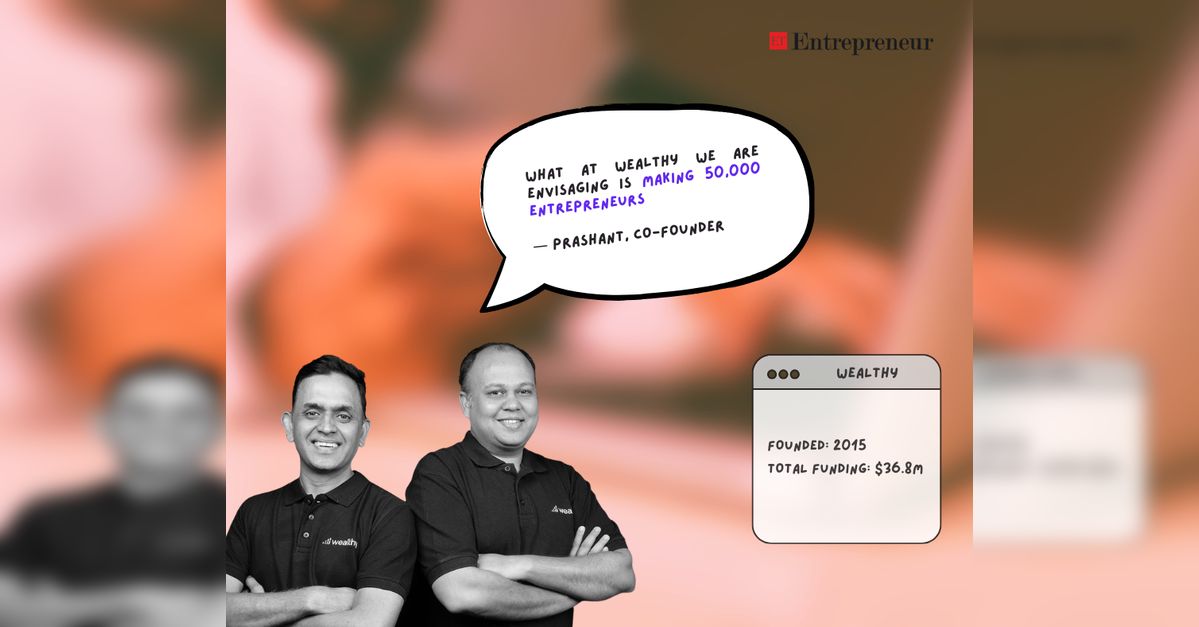
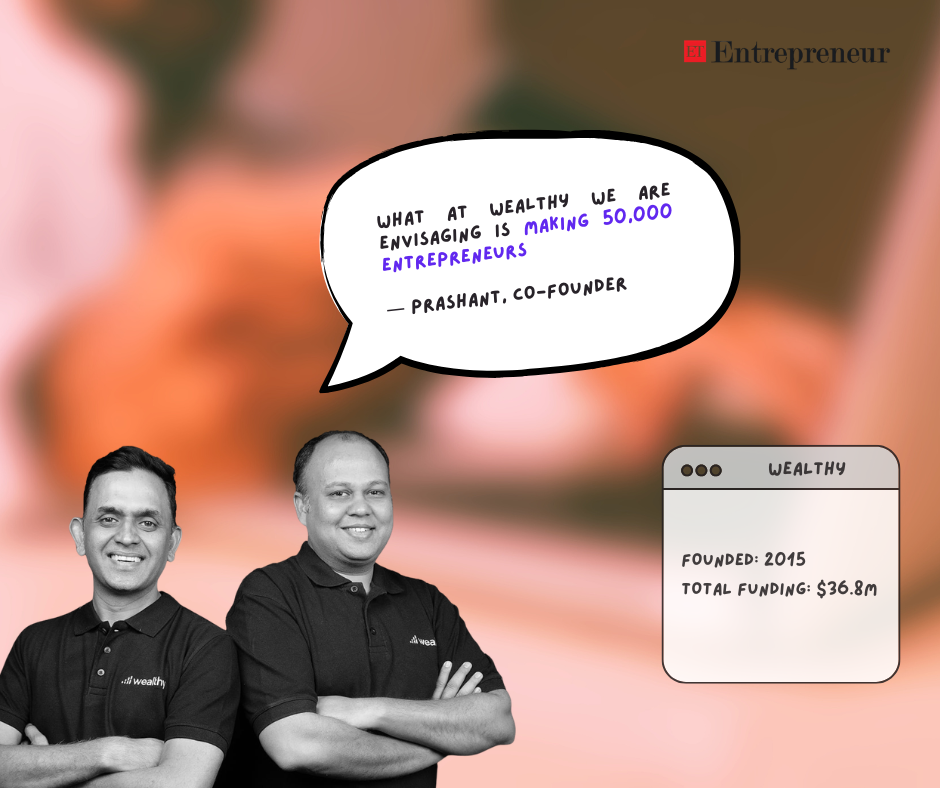
“What at Wealthy we are envisaging is making 50,000 entrepreneurs.”
The ambition becomes more tangible when Gupta talks about what those entrepreneurs can earn. The median advisor on the platform earns about ₹50,000-₹60,000 a month, he said, while top performers can make as much as ₹15 lakh a month. The appeal lies in the independence it offers, according to Gupta.
An insurance agent can move beyond selling policies while a banker can leave behind sales targets and build a practice of their own.
It is an unusual answer but reveals something important about Gupta’s worldview. That advisors are the centre of the model. Wealthy’s role, as he sees it, is to help thousands of individuals build businesses around trust.
Even Gupta’s thinking about artificial intelligence follows the same logic. While many founders speak about AI replacing expertise, he sees it primarily as a productivity tool. Advisors can use it to summarise meetings, generate portfolio reviews, identify gaps in conversations and prepare recommendations.
“The customer has no problem getting information,” he said again. It is a point he returns to repeatedly. Information is abundant, judgement is scarce and trust is scarcer still.
The irony of Gupta’s journey is difficult to miss. A decade ago, he helped build a company around the idea that investing could be simplified through technology. Today, he finds himself arguing for something far less fashionable: that people still need people.