

The Capital Markets Authority’s innovation sandbox is emerging as a key part of Kenya’s conversation on virtual asset regulation, with officials highlighting the programme as a potential pathway for startups facing the capital and compliance demands of the country’s proposed licensing regime.
The discussion surfaced during the 7th Africa Fintech Forum in Nairobi, where James Obonyo Hillary, a fintech and regulatory innovation specialist at the Capital Markets Authority (CMA), outlined how regulatory sandboxes can support the development of Virtual Asset Service Providers (VASPs) as Kenya advances oversight of the sector.
The presentation came as industry participants continue to assess the practical implications of Kenya’s evolving virtual asset framework, including proposed capital requirements that could reshape entry into the market.
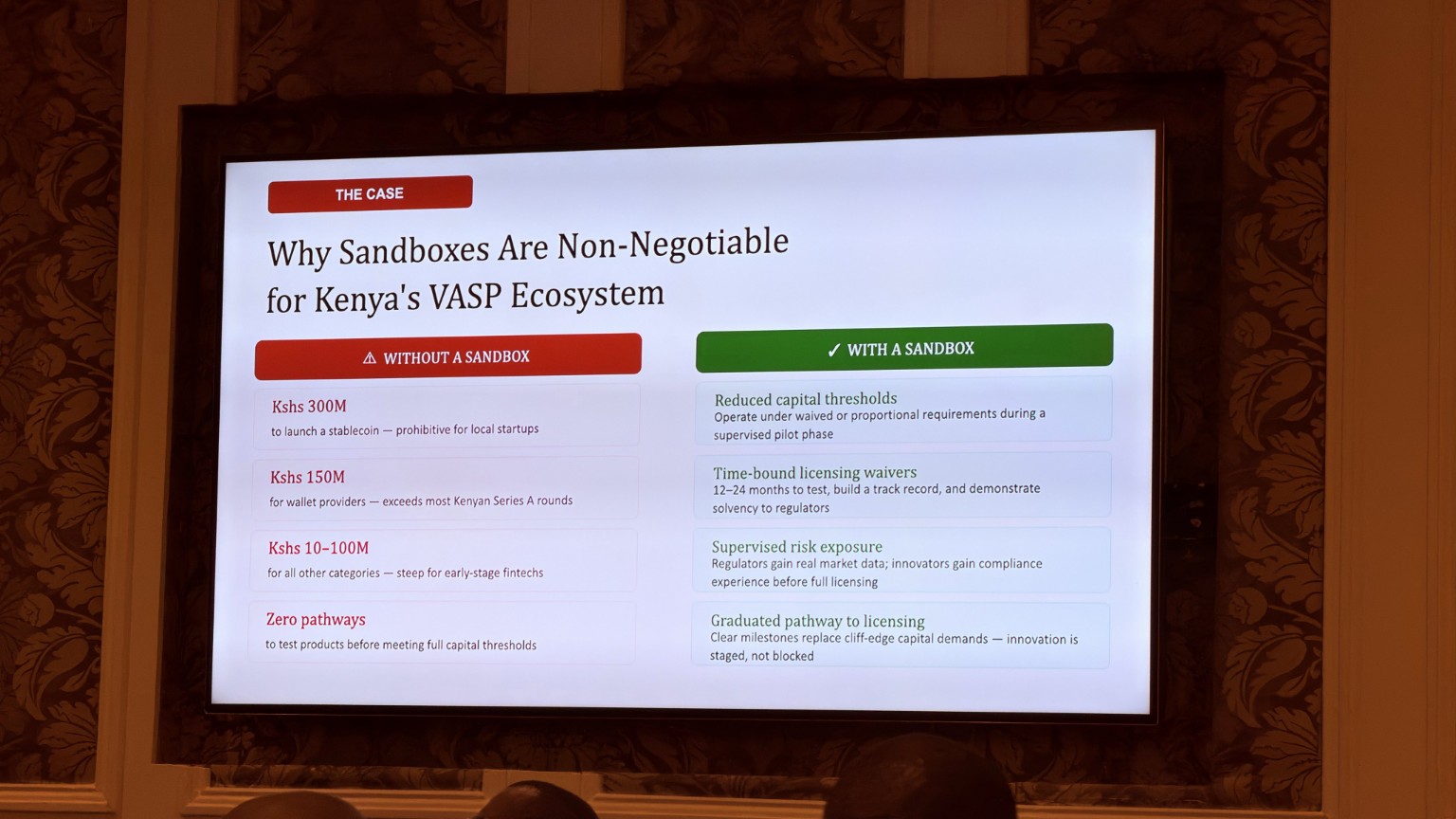
Figures presented during the session showed stablecoin issuers facing capital thresholds of approximately KSh 300 million, while wallet providers could require about KSh 150 million. Other VASP categories would be subject to requirements ranging between KSh 10 million and KSh 100 million.
For established financial institutions, those figures may represent another compliance obligation. For early-stage firms, they raise a different question: how can new products be tested and refined before companies are expected to meet full licensing requirements?
The CMA’s innovation sandbox offers one answer.
The programme allows eligible firms to operate within a supervised environment where products can be tested under agreed parameters while regulators observe operational, consumer protection and compliance outcomes. Participants can gather evidence on how their products function in real-world conditions before pursuing broader market approval.
According to material presented at the forum, sandbox participants may benefit from temporary regulatory exemptions, reduced thresholds during pilot phases and structured pathways toward full compliance once testing is complete.
That framework is attracting renewed interest as Kenya positions itself for the next phase of financial technology development. Virtual assets, tokenisation and digital financial infrastructure featured prominently throughout discussions at the Nairobi conference, which brought together regulators, banks, fintech firms, payment providers and technology companies from across the continent.
The timing is notable. Kenya is moving from broad discussions about digital assets toward the mechanics of regulation, licensing and market supervision. As those rules become more defined, the question of how local innovators enter the market is becoming increasingly important.
Capital requirements are typically designed to promote resilience, consumer protection and market integrity. They can also create barriers for companies that are still validating products, building governance structures and attracting investment.
A regulatory sandbox introduces an intermediate stage between concept and full authorisation. Regulators gain visibility into emerging business models, while firms receive an opportunity to demonstrate operational readiness in a controlled setting.
The model is already familiar within financial technology. What is changing is its relevance to virtual assets.
As Kenya develops a formal framework for VASPs, the CMA sandbox is increasingly being viewed as more than an innovation programme. It may become one of the country’s most important mechanisms for helping digital asset startups navigate the path from experimentation to licensed operation.
Go to TECHTRENDSKE.co.ke for more tech and business news from the African continent and across the world.
Follow us on WhatsApp, Telegram, Twitter, and Facebook, or subscribe to our weekly newsletter to ensure you don’t miss out on any future updates. Send tips to [email protected]
Source link