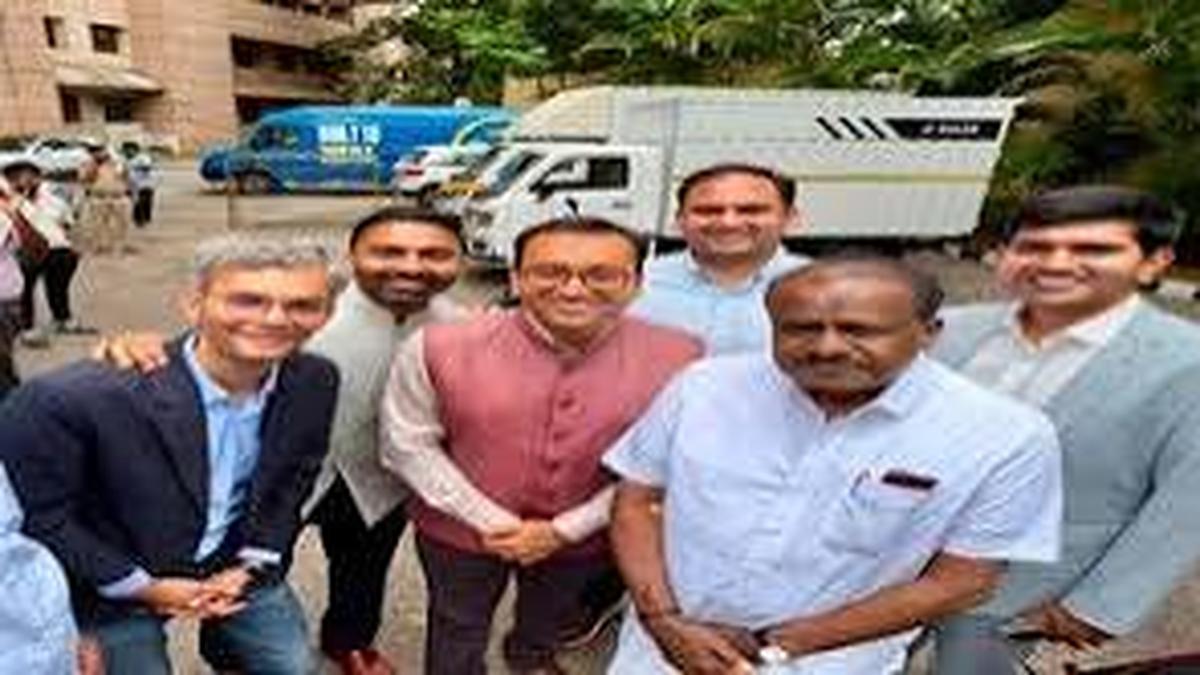
Having collectively invested an estimated ₹20,000-25,000 crore to build India’s electric mobility ecosystem, Founders of EV startups who met Heavy Industries Minister H.D. Kumaraswamy on Saturday in Bemgaluru to request him to widen the ₹25,938-crore Automotive Production Linked Incentive (PLI) scheme through five key changes.
The founders want the government to lower the ₹10,000-crore global revenue threshold, ease the ₹3,000-crore fixed asset requirement, reopen the application window for companies that have scaled up since the scheme was launched, recognise research and development (R&D) and intellectual property alongside manufacturing investments and account for cumulative investments in engineering and localisation while evaluating eligibility. They argue the framework, conceived in 2021, no longer reflects an EV industry that has matured rapidly over the past five years.
The interaction brought together Ather Energy Co-founder and CEO Tarun Mehta, River Co-founder Aravind Mani, Euler Motors Founder and CEO Saurav Kumar, Matter Founder and CEO Mohal Lalbhai, and Raptee.HV Co-founder and CEO Dinesh Arjun.
While these companies have individually advocated changes to the Auto PLI framework over the past few years, the Bengaluru meeting marked one of the first coordinated efforts by India’s new-age EV manufacturers to present a common policy blueprint before the Heavy Industries Ministry
The Minister’s Message
Following the meeting, the minister said the discussions covered industry perspectives on both the PM E-DRIVE Scheme and the Auto PLI Scheme.
“I assured the stakeholders of all possible support towards building a robust, innovation-driven and globally competitive EV ecosystem in the country,” Kumaraswamy said, adding that the interaction focused on strengthening indigenous manufacturing and unlocking greater opportunities for Indian-made electric vehicles in domestic and global markets.
Why Start-ups say the scheme no longer fits the market
Between 2020 and 2025, India’s EV transport ecosystem attracted an estimated ₹2.23 lakh crore in investments and public outlays. Of this, pure-play EV startups and early-scale disruptors are estimated to have invested ₹20,000-25,000 crore through venture capital, private equity and structural debt, while legacy automakers deployed an estimated ₹80,000 crore to ₹1 lakh crore from internal accruals into dedicated EV platforms, supplier localisation, manufacturing capacity and nationwide distribution.
Founders argue the two groups built different pillars of India’s EV ecosystem. Startups absorbed the heaviest customer-acquisition costs and engineering risks between 2015 and 2022, developed indigenous battery management systems, vehicle control units and software platforms and helped build India’s early fast-charging and battery-swapping ecosystem before consumer demand had been established.
Legacy automakers subsequently industrialised the market through manufacturing scale, vendor localisation and nationwide distribution. They contend the current Auto PLI framework predominantly rewards the latter.
What Exactly Needs To Change
In a post following the meeting, Ather Energy Co-founder and CEO Tarun Mehta said India’s “new-age deep tech companies are one of the largest investors in R&D and manufacturing” and have “played a critical role in opening up segment after segment in EVs”. He said bringing these companies within the ambit of the Auto PLI scheme would accelerate manufacturing, exports and create a level playing field. Mehta and Euler Motors founder Saurav Kumar have argued that the present eligibility framework leaves qualifying incumbents with an effective 13-16 per cent cost advantage, while excluding technology-led manufacturers because of the ₹10,000-crore global revenue and ₹3,000-crore fixed asset thresholds.
Collectively, the founders are seeking a redesign of the scheme’s eligibility architecture. They want the government to reopen the one-time application window for companies that have since scaled up, recognise investments in research, patents, software and indigenous intellectual property alongside physical manufacturing assets and account for cumulative investments in engineering, localisation and technology while assessing eligibility.
Raptee.HV Co-founder Dinesh Arjun has argued that the framework should distinguish genuine deep-tech manufacturers creating proprietary technology from companies primarily assembling imported components, while Matter Founder and CEO Mohal Lalbhai has said the transition offers India an opportunity to build globally competitive mobility technology companies through deeper manufacturing and localisation.
Earlier this year, a Parliamentary Standing Committee also recommended greater flexibility in the scheme’s eligibility criteria for high-potential domestic manufacturers and EV startups, particularly in the electric two-wheeler segment.
Why the government can still act
The founders’ case is reinforced by the scheme’s implementation status. Of the ₹25,938-crore Auto PLI outlay, only about ₹2,377 crore has been disbursed so far, although approved companies have already committed investments exceeding ₹35,657 crore and generated eligible sales of more than ₹32,879 crore.
The relatively low utilisation reflects the program’s design, under which incentives are released only after verified incremental sales and compliance with Domestic Value Addition (DVA) norms, including localisation certification by agencies such as ARAI.
With the performance period running until FY28 and disbursements continuing into FY29, founders believe there remains time for the government to broaden participation before the program concludes.
Published on July 5, 2026