For healthcare startups, the vendor decision is unusually high-stakes. A clinical AI system built on a shaky compliance foundation doesn’t just create technical debt — it creates regulatory exposure that can surface during a Series A due diligence or a payer audit. A system that integrates poorly with the EHRs your target customers already use blocks adoption from the first sales conversation. The vendor you choose in the first 12 months sets the architecture, the compliance posture, and the delivery patterns that the product will carry for years.
This guide evaluates seven AI healthcare solutions development providers specifically through the lens of what startup teams need: clinical credibility from day one, HIPAA architecture that won’t need rebuilding at scale, genuine EHR integration experience, and a delivery model that can move at product pace without cutting corners on regulatory requirements.
What Startup-Ready Healthcare AI Providers Have in Common
1. HIPAA compliance built into the first sprint, not added before launch. The cost of retrofitting HIPAA technical safeguards into a system already built without them is almost always greater than building it right the first time. Startup-ready providers treat the BAA, audit logging, and PHI access controls as sprint-one requirements, not pre-launch checklists.
2. A phased delivery model that validates AI before full investment. Discovery, data readiness assessment, and a working PoC before full-scale development protect startup budgets from the most common failure mode: building a full system on a dataset or workflow that wasn’t ready to support AI.
3. Named EHR integrations, not just a list of supported systems. Startup healthcare products rarely succeed without connecting to the EHRs their customers already use. The difference between ‘we support Epic’ and ‘we have a bidirectional FHIR R4 integration with Epic deployed in production’ is the difference between a claim and a reference.
4. Post-deployment accountability with defined terms. Startups that ship a first version and then watch the model degrade because no one planned for retraining don’t get a second chance with clinical users. Providers who define model monitoring, performance reporting, and retraining as contractual deliverables — not informal ongoing relationships — protect the product’s clinical credibility post-launch.
5. Realistic timelines for PoC and production delivery. The most useful thing a healthcare AI provider can tell a startup is not the minimum possible timeline but the realistic one that accounts for data preparation, clinical validation, and compliance documentation. Providers who quote unrealistically short timelines create the conditions for scope creep, compliance shortcuts, and missed launches.
Quick Pick — Match Your Stage to the Right Provider
|
Best Fit |
Choose Them If… |
| MindK | A startup that needs a HIPAA-compliant AI system in production — not just a PoC — built on clinical workflows with 15+ years of healthcare engineering behind it |
| Innowise | A startup with complex FHIR/EHR integration requirements that needs a 3,500+ engineer firm with a dedicated Life Sciences practice |
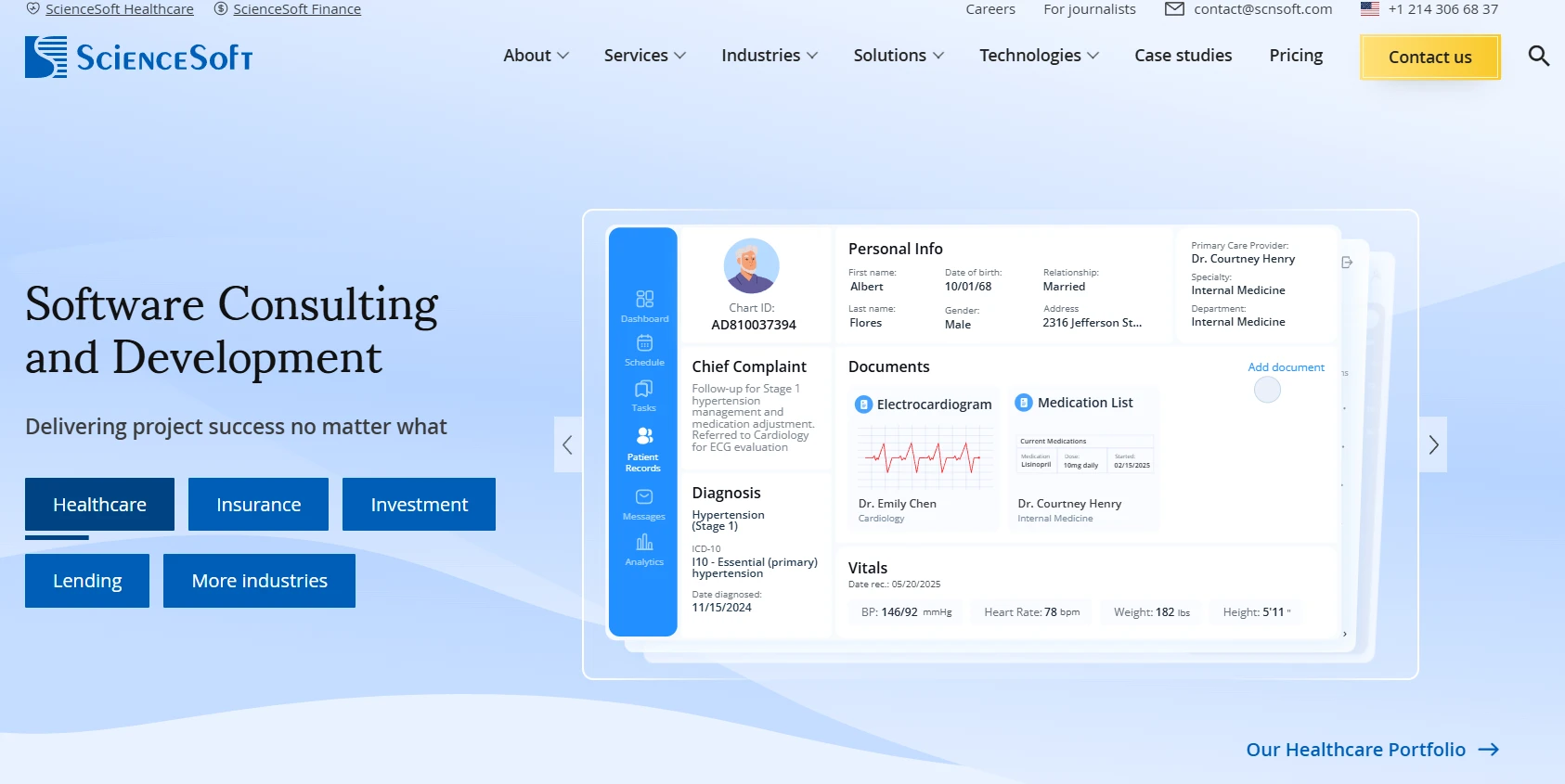
| ScienceSoft | A Series B+ company that needs the audit-ready credibility of a 35-year ISO-13485-certified healthcare IT firm |
| Intellectsoft | A healthtech startup that wants a named senior architect accountable for technical direction from discovery through deployment |
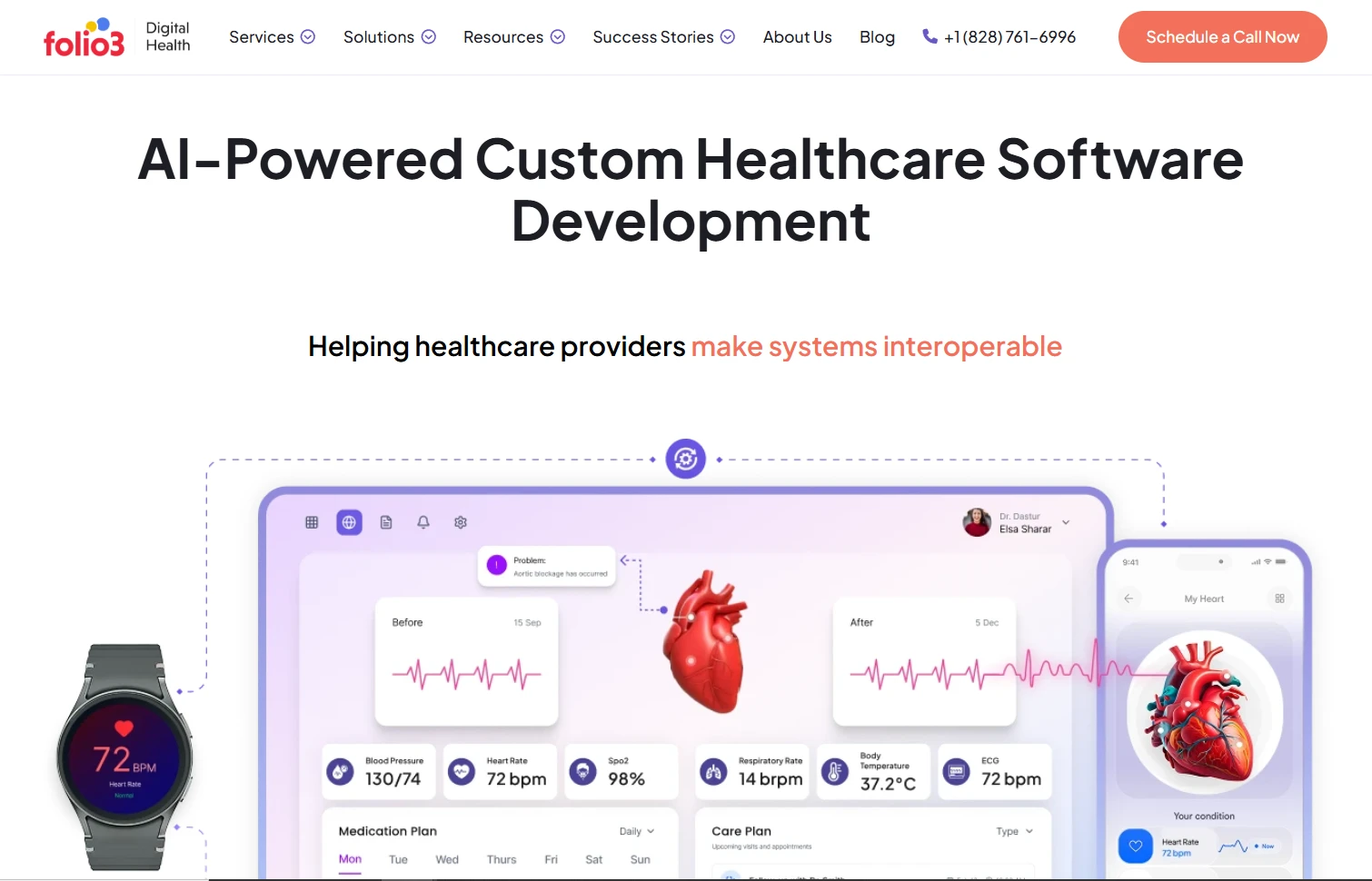
| Folio3 | A digital health company building Epic-integrated tools that needs a Vendor Services Member with a proven medical AI portfolio |
| Andersen | A startup that needs large-team capacity across both AI engineering and cloud infrastructure under one partner |
| Itransition | A company undergoing broader digital transformation that needs healthcare AI alongside EHR and telehealth modernization |
Full Comparison
|
Company |
Base |
Est. |
Best For |
Clients |
Tier |
| MindK | San Francisco, CA |
2009 |
Clinical AI for startups, HIPAA from sprint one | ISC, lactation EMR platform |
Mid-Market |
| Innowise | Warsaw, Poland |
2007 |
Large-team FHIR integrations, Life Sciences practice | NTT DATA, InterSystems, Topcon |
Full-Service |
| ScienceSoft | McKinney, TX |
1989 |
Regulated AI with 35+ years & ISO 13485 | IBM, Ford, Walmart, NASA |
Full-Service |
| Intellectsoft | Palo Alto, CA |
2007 |
Architecture-first AI for enterprise health systems | National Health Service, Qualcomm |
Mid-Market |
| Folio3 | San Mateo, CA |
2005 |
Epic-credentialed digital health AI | EHR platform and medical AI clients |
Mid-Market |
| Andersen | Minsk / Global |
2007 |
AI engineering + cloud infrastructure at scale | Enterprise healthcare clients |
Full-Service |
| Itransition | Greenwood Village, CO |
1998 |
Full-cycle delivery across healthcare and telehealth | Global healthcare organizations |
Full-Service |
Provider Profiles
1. MindK — Clinical AI Built for Startup Speed Without Compliance Shortcuts
MindK has been building healthcare software since 2009 and has developed a clinical AI practice specifically suited to the gap most startup teams fall into: moving from a compelling demo to a production system that clinicians trust and regulators approve. Recognized on the Inc. 5000 Regionals: California 2021 list with a 4.9/5 Clutch rating, MindK operates as a full-product partner with HIPAA compliance architecture, EHR integration across 10+ major systems, and production-tested AI building blocks for eligibility, prior authorization, clinical NLP, and remote patient monitoring — reducing typical delivery timelines by 25–40% compared to building from zero.
| Base | San Francisco, CA + Czech Republic engineering offices |
| Founded | 2009 |
| Best For | Startups and digital health companies needing production-ready clinical AI with HIPAA compliance from sprint one |
| Services | Clinical NLP, EHR integration (Epic, Oracle Health, athenahealth, MEDITECH, eClinicalWorks), predictive AI, RPM, HIPAA architecture, medical billing AI |
| Compliance | HIPAA (BAA on every engagement), GDPR, AWS Well-Architected, ISO 27001 |
| Tier | Mid-Market |
Case Study: EMR for Lactation Consultants
MindK built the first EMR purpose-built for lactation consultants — handling charting, revenue cycle management, and insurer document flow. The result: the platform grew from 3,000 to 30,000+ monthly visits and scaled to handle hundreds of thousands of insurance claims per month, saving thousands of administrative hours annually.
Where MindK excels
MindK’s production-tested healthcare AI building blocks — reusable components for the most common clinical workflow integrations — let startup teams ship a compliant, integrated system faster than building each component from scratch. The engagement model keeps senior architects accountable post-deployment with defined model monitoring and retraining cycles, not informal support until the next retainer. For startups that can’t afford to rebuild compliance infrastructure at Series B, MindK’s compliance-first architecture approach removes that risk at the start.
2. Innowise — 3,500+ Engineers with a Dedicated Healthcare Life Sciences Practice
Innowise was founded in 2007 in Warsaw and has grown to 3,500+ engineers across five continents, with a dedicated Life Sciences competency center where healthcare business analysts and FHIR-native engineers are embedded in every clinical AI engagement. Their portfolio spans ML-powered diagnostic tools across radiology, cardiology, and oncology, with ISO 27001 and ISO 13485 certifications and IAOP Global Outsourcing 100 recognition from 2021 through 2024. Named clients from primary sources include NTT DATA, InterSystems, and Topcon.
| Base | Warsaw, Poland (+ delivery centers across Europe, North America, Asia) |
| Founded | 2007 |
| Best For | Startups needing large-team capacity for complex multi-EHR integrations or multi-system healthcare AI programs |
| Services | Healthcare AI/ML, FHIR R4 integration, diagnostic imaging AI, RPM, telehealth, clinical data engineering |
| Compliance | ISO 27001, ISO 13485; HIPAA, GDPR, MDR-compliant delivery |
| Tier | Full-Service |
Where Innowise excels
Innowise’s scale gives startups access to specialist depth — radiology AI engineers, FHIR architects, healthcare compliance analysts — without the resource constraints that limit smaller firms. Their dedicated Life Sciences practice means clinical AI projects draw from a pre-trained team, not a generalist pool. The limitation: Innowise’s enterprise structure means more process and communication overhead than boutique firms, which can slow early-stage iteration if not managed deliberately.
3. ScienceSoft — 35 Years of Healthcare IT Credibility, ISO 13485 Certified
ScienceSoft has been building healthcare IT since 1989 and holds ISO 9001, ISO 27001, and ISO 13485 certifications — the triple stack that enterprise health system procurement teams look for. Headquartered in McKinney, Texas, with 750+ engineers across US, Gulf, and European offices, ScienceSoft has completed 150+ healthcare IT projects covering telehealth, EHR systems, FDA-compliant SaMD, and AI-powered clinical tools. Named primary-source clients include IBM, Ford, Walmart, and NASA. ScienceSoft has been recognized as a Top Healthcare IT Developer by Black Book Reports and appeared on the IAOP Global Outsourcing 100 list from 2022 through 2025.
| Base | McKinney, Texas, USA (+ Saudi Arabia, UAE, Poland, Latvia, Lithuania, Finland) |
| Founded | 1989 |
| Best For | Startups targeting enterprise health system customers that need ISO 13485 credentials and FDA SaMD regulatory experience from their development partner |
| Services | Healthcare AI, EHR integration, telehealth, medical device software, FDA/HIPAA/MDR compliance |
| Compliance | ISO 9001, ISO 27001, ISO 13485; HIPAA, GDPR, HITECH, FDA SaMD, MDR/IVDR |
| Tier | Full-Service |
Where ScienceSoft excels
ScienceSoft’s ISO 13485 certification and 35-year healthcare track record make it the right choice when a startup’s credibility with enterprise health system customers depends partly on the credentials of their development partner. The limitation for early-stage startups: ScienceSoft’s structured delivery model optimizes for regulatory rigor over iteration speed, which suits a scale-up phase better than a rapid MVP build.
4. Intellectsoft — Architecture-Led AI with a Named Senior Engineer from Day One
Intellectsoft was founded in 2007 and operates from Palo Alto, New York, and 10 global offices with 150+ engineers. Every engagement is led by a named senior architect who maps the full system before a line of code is written — a model that catches architectural mistakes before they become compliance or integration problems downstream. Named clients include the National Health Service, Qualcomm, and Clinique. Intellectsoft holds ISO 27001 certification and delivers healthcare AI across remote patient monitoring, patient-facing mobile applications, and HIPAA-compliant data architectures.
| Base | Palo Alto, CA, USA (+ New York and 8 additional offices) |
| Founded | 2007 |
| Best For | Healthtech startups that want a senior architect accountable for technical direction — not just a development team — across the full project lifecycle |
| Services | Healthcare AI, RPM, EHR integration, patient portal development, medical imaging AI, HIPAA architecture |
| Compliance | ISO 27001; HIPAA, GDPR-compliant delivery |
| Tier | Mid-Market |
Where Intellectsoft excels
Intellectsoft’s architecture-first model prevents the most expensive failure mode in healthcare AI startups: a technically working system built on a data or compliance architecture that has to be rebuilt before Series B due diligence. The limitation: at 150 engineers, Intellectsoft suits focused AI modules and defined clinical scopes better than massively parallel enterprise programs with simultaneous multi-site deployments.
5. Folio3 Digital Health — Epic-Credentialed Partner for Digital Health Startups
Folio3 Digital Health has been building healthcare software since 2005 from its San Mateo, California base and holds Epic Vendor Services Member status — a credential that requires passing Epic’s technical assessments and maintaining ongoing compliance with Epic’s interoperability standards. Their AI portfolio includes computer vision models for breast and skin cancer detection, telemedicine platforms, EHR-integrated practice management software, and patient engagement applications. With a 501–1,000-person team, Folio3 operates across US and Pakistan delivery centers.
| Base | San Mateo, California, USA (+ Pakistan) |
| Founded | 2005 |
| Best For | Startups building AI tools that need to live inside or alongside Epic’s ecosystem, or that are building medical imaging AI with regulatory documentation awareness |
| Services | Healthcare AI/ML, Epic integration, medical imaging AI (CV), telemedicine, practice management, digital therapeutics, EHR connectors |
| Compliance | HIPAA; Epic Vendor Services Member; FDA SaMD awareness |
| Tier | Mid-Market |
Where Folio3 excels
For startups whose go-to-market runs through Epic health systems, Folio3’s vendor credential shortens the technical integration timeline and removes the credibility gap that comes from being an unknown integration partner. The limitation: the nearshore delivery model — US leadership with Pakistan-based engineering — suits startups comfortable with asynchronous collaboration and doesn’t suit teams that need daily in-person or same-timezone synchronous development.
6. Andersen — Large-Team AI Engineering Across Healthcare and Cloud Infrastructure
Andersen was founded in 2007 and has grown to 3,500+ engineers across the US, Europe, and Asia. Their healthcare vertical covers custom AI/ML development, intelligent process automation, cloud infrastructure for clinical platforms, and legacy modernization — the combination that matters for startups building AI on top of complex existing health system infrastructure. Their engagement models span staff augmentation, dedicated teams, and full project delivery.
| Base | Minsk, Belarus (+ offices across US, Europe, Asia) |
| Founded | 2007 |
| Best For | Startups that need both the clinical AI layer and the surrounding cloud or data infrastructure built by the same partner |
| Services | Healthcare AI/ML, intelligent process automation, cloud architecture, custom healthcare software, data engineering, staff augmentation |
| Compliance | HIPAA, ISO 27001; engagement-specific compliance frameworks |
| Tier | Full-Service |
Where Andersen excels
Andersen’s scale suits startups whose AI initiative requires significant underlying infrastructure work — cloud migration, data lake architecture, legacy EHR connector development — alongside the AI components themselves. The limitation: as a multi-sector firm, Andersen’s healthcare AI expertise is distributed across a broad portfolio rather than concentrated in a specialist practice, which means niche clinical AI requirements may require more ramp-up time than firms with dedicated healthcare competency centers.
7. Itransition — 25 Years of Full-Cycle Delivery Including Healthcare and Telehealth
Itransition was founded in 1998 and operates from Greenwood Village, Colorado with delivery centers across Eastern Europe. With 3,500+ professionals and 25 years of enterprise delivery history, Itransition’s healthcare practice covers EHR modernization, telehealth platforms, patient portal development, healthcare analytics, and AI-augmented clinical workflows. Their engagement model supports both fixed-price and dedicated team structures, giving startups flexibility across product stages.
| Base | Greenwood Village, Colorado, USA (+ Eastern Europe delivery centers) |
| Founded | 1998 |
| Best For | Startups undergoing broader platform modernization where healthcare AI is one component of a larger technology transformation program |
| Services | EHR modernization, telehealth, healthcare AI, patient portals, clinical analytics, mHealth, legacy modernization |
| Compliance | HIPAA, GDPR; engagement-specific compliance documentation |
| Tier | Full-Service |
Healthcare AI has the potential to improve not only operational efficiency but also equitable access to care. Intelligent clinical workflows, better diagnostics and streamlined administrative processes can reduce healthcare waste, improve patient outcomes and support more resilient healthcare systems. When developed responsibly, AI can become an important tool for strengthening healthcare accessibility and long-term system sustainability.
Where Itransition excels
Itransition’s 25 years of delivery experience across multiple technology generations gives it the breadth to handle healthcare AI alongside the legacy integration and infrastructure work that often surrounds it. The limitation: for startups focused exclusively on clinical AI, firms with dedicated healthcare AI practices deliver more pre-built clinical components and domain-specific expertise out of the box than a generalist firm of equivalent size.
Editor’s Note: The opinions expressed here by the authors are their own, not those of impakter.com — In the Cover Photo: Clinicians collaborate using AI-powered healthcare software and clinical dashboards, illustrating the importance of secure AI healthcare solutions development, HIPAA-compliant architecture and EHR integration for modern healthtech startups. Cover Photo Credit: DC Studio
Source link