


Roy Bick was a heavy user of public transportation in the 1990s, a high school student who traveled to judo practice without missing a session. His efforts eventually paid off: Bick became an Israeli judo champion, a member of the national team and part of Israel’s Olympic squad.
That also earned him outstanding athlete status during his military service in Unit 8200, though he did not serve in a computing role.
Nir Erez and Roy Bick, founders of VIMI
(Photo: Hila Gvir)
Fast-forward to 2011, when Bick and Yaron Evron began brainstorming ideas for a startup. Bick recalled the difficulties faced by public transportation passengers, and the idea for Moovit was born.
Nir Erez later joined the company’s founders, while Evron eventually left. Moovit went on to become one of the world’s leading public transportation platforms, with more than 1 billion users in about 100 countries.
Fast-forward again to 2020, when Moovit was sold to Mobileye, then owned by Intel, for about $1 billion.
Bick and Erez then began considering ideas for their next startup. As before, Bick looked at what was happening around him. The most prominent issue in his life was his daughter, who was in sixth grade and needed private math lessons.
That is how the idea for Vimi was born.
“It was very clear that we would look at the experience we had accumulated at Moovit and search for a place where we could make a global impact,” said Bick, Vimi’s CEO. “We were looking for what we call a ‘quarter to readiness,’ a market that is about to change and offers a major opportunity. Then it suddenly clicked for me that AI technology could transform education.
“Research has shown that children who study with a private tutor perform much better academically, but it was never possible to do that on a large scale because there are not enough teachers and parents cannot afford it. Artificial intelligence makes that possible.”
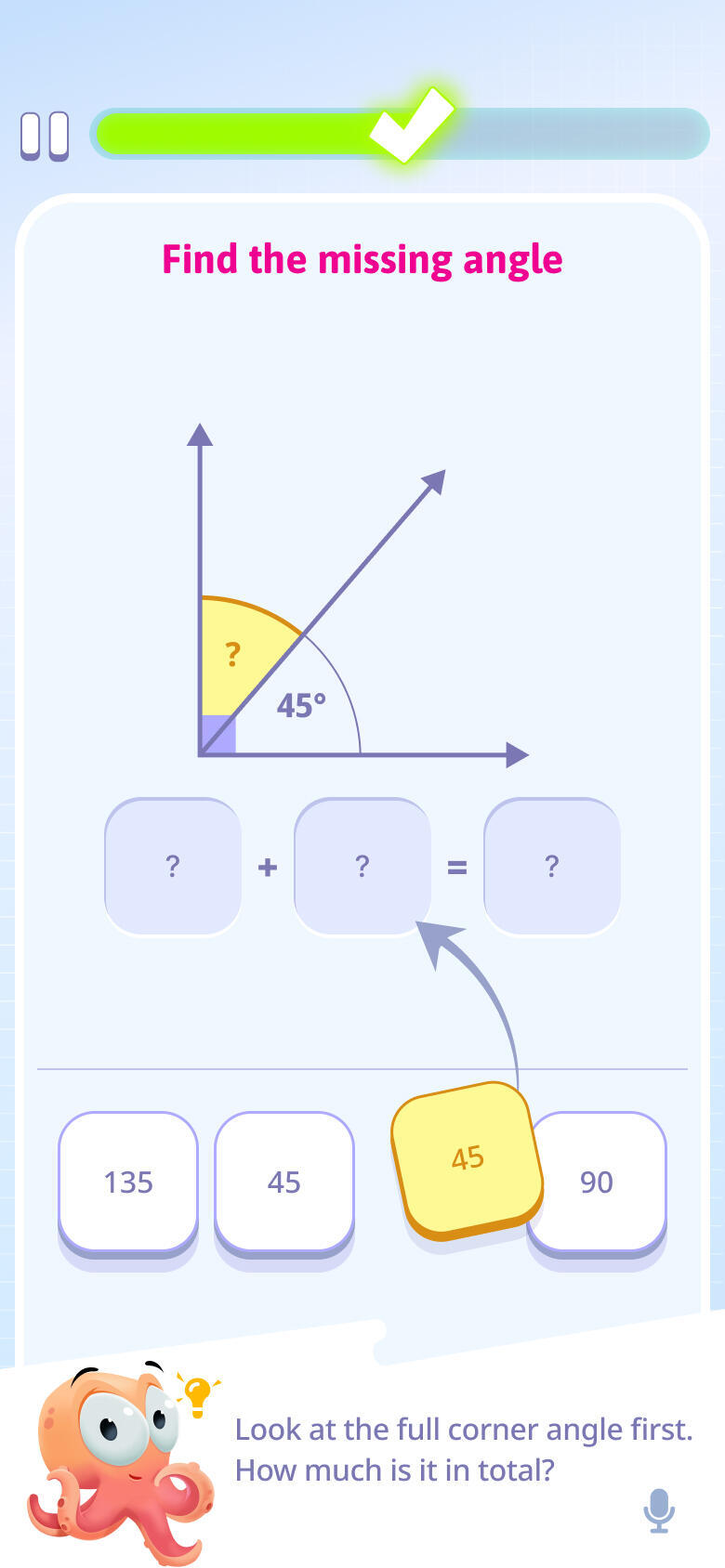
The Vimi app teaches children math. Vimi is a friendly octopus that presents them with challenges and games lasting several minutes at a time.
Behind the octopus is a sophisticated artificial intelligence system that gets to know each child and what motivates them individually. It understands the curriculum and what is expected of the student and works to improve the child’s math grades.
A little octopus that promises to teach children math
(Photo: PR)
The company’s approach offers an intriguing solution: an AI tool that adapts both to each child’s math curriculum and to their interests and attention span.
A good private tutor can do all that, but charges hundreds of shekels an hour. Vimi says its AI can provide the same functions and improve students’ grades for $20 a month.
At first glance, the idea appears destined to fail for one reason: ChatGPT, Gemini, Claude and similar tools. Any of them can teach mathematics at a level comparable to Newton or Einstein, and at no cost.
The problem, according to Vimi, is that those tools do not know a child’s curriculum and cannot adjust the pace of progress to the student’s abilities.
Vimi has developed what it calls a pedagogical AI model. It responds to the child, teaches in individually tailored segments and uses a game-like format designed to maintain a positive experience. It also continuously gathers data to train itself to become a better teacher.
The early results appear promising. The first version released by the company generated interest, and tens of thousands of users who tried it gave it high ratings.
A new version was released about two months ago in the United States and Australia, offering both a free plan and a paid subscription.
The app has already been downloaded hundreds of thousands of times, and its annual recurring revenue has reached hundreds of thousands of dollars.
“It validates our sense that this is a market with tremendous demand,” Bick said. “It is very encouraging and gives us momentum. These are better results than we experienced during Moovit’s early days.”
Learning math with the VIMI app
(Photo: VIMI)
How long can a child sit in front of an app and study math? After 10 minutes, won’t the child already be on TikTok? “If my daughter sits with a private math tutor for 60 minutes twice a week, she will have even less attention and concentration,” Bick said. “With us, the length of the learning session is very precise and highly personalized, and we know how to guide progress in a very pleasant way. Children today are adopting AI even before we are, so it fits naturally with the way they learn.”
How do you make math interesting enough that children will want to study on their own? “First, the child has to study. That is the beauty of it,” he said. “There is no question of whether the child ‘wants’ to. They have to study math if they want to succeed in school.
“Second, the child is already on screens, on TikTok, YouTube and games. So you have to build something that creates the same sense of success and enjoyment, and that differs from one child to another. It is personalized gamification. You have to know how to generate motivation because there are so many different kinds of children.”
How can a system teach a child math while also offering the encouragement needed to help the student feel successful?
Vimi’s software engineers work with advisers to address pedagogical challenges such as motivating children.
One of the advisers is professor Houman Harouni, a lecturer at the Harvard Graduate School of Education.
According to his critical theory, mathematics education in schools today, which is based on memorization and practice, does not allow students to develop deep mathematical thinking. He argues that the model originated in the need to train workers and administrators to perform precise, obedient work.
Harouni proposes an alternative approach that turns mathematics education into a tool for empowerment, understanding the world and promoting social justice. That approach closely matches the outlook of Vimi’s founders, who say they want to create a significant social impact.
“Harouni is Jewish and of Iranian descent, and his family immigrated to the United States,” Bick said. “He tells us: ‘I will give you all the research. Start integrating it, start teaching. But the beauty is that once you generate large amounts of data, I will eventually ask you for a favor and conduct my research using your data.’
“And just so you understand, we already have several hundred thousand lessons. There is a feedback loop that returns data, and we constantly see how the child is improving and where the child is struggling.”
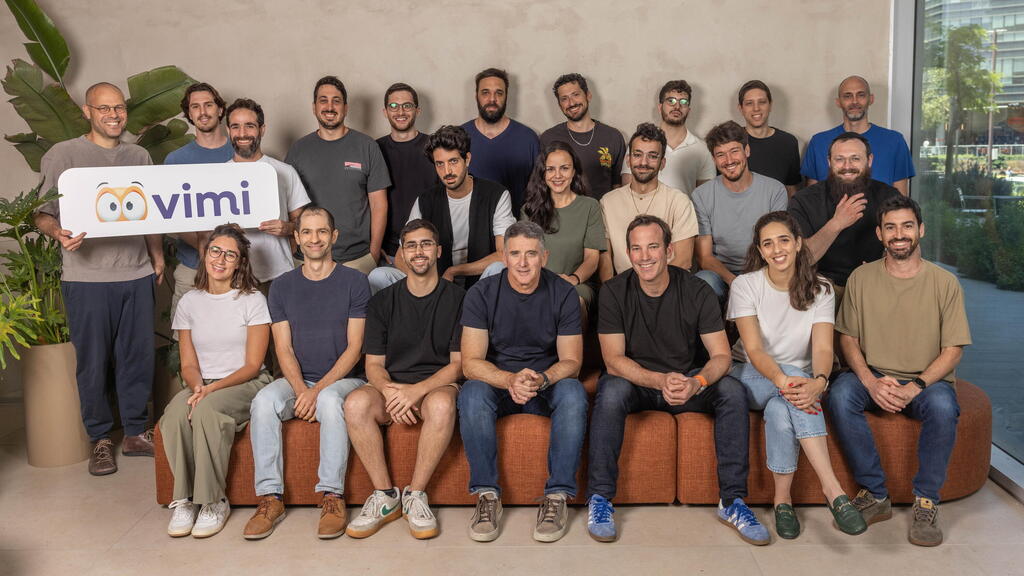
The VIMI team
(Photo: Tomer Appelbaum/TheMarker)
How do you make sure the AI does not make mistakes or invent facts? “Standard large language models make mistakes even in math problems, in 15% to 20% of cases,” Bick said. “But a private tutor cannot afford to make mistakes, so how do you prevent that?
“You may be surprised, but we brought in some of the strongest people from Unit 8200, top cybersecurity experts who no longer wanted to work in cyber and wanted to do something useful.
“They are very strong AI professionals with expertise in all the architectures and development tools. That is the only way to win, with all the data and the creation of unlimited content.
“We have taken on a major mission, but we want to do something bigger than what we did with Moovit. And it is fun. I come here every morning and genuinely enjoy myself tremendously, working with good people in an interesting field.”
Vimi Adaptive Learning was founded in 2024. After operating below the radar, it emerged from stealth a year ago with $12 million in funding.
That is a substantial amount for an initial funding round and particularly unusual for an education technology company, a sector in which startups often struggle to raise meaningful sums.
The round was led by venture capital firms Viola and BRM, which do not typically invest in education but knew Bick and Erez from previous investments.
There is little doubt that the founders’ identities were a major attraction. After building a company and selling it for about $1 billion, investors tend to believe you may be able to do it again.
The two companies founded by Bick and Erez have little in common, apart from the fact that both target consumers rather than business clients.
That is far from standard in the education technology sector. Many companies that develop education platforms target schools and education ministries in the hope of securing a share of public funding.
Vimi is targeting parents instead. How much would parents be willing to pay to help their child succeed in math? That is precisely the point.
The private tutoring market is estimated to be worth $150 billion a year.
The problem with a business-to-consumer model is that reaching potential customers is very expensive. It requires advertising on platforms such as Google and Facebook and promoting the app in Google and Apple’s app stores.
The challenge is even greater when the app is not entirely free, as is the case with Vimi.
But Bick and Erez have done it before and are confident they can do it again.
“We are a company building a consumer product in education,” Bick said.
Even the monthly subscription price was determined according to demand.
“Our expertise is on the consumer side, so what we think does not matter very much,” he said. “Ultimately, the wisdom of the crowd matters. The market will give us the real answer.”
You are entering a market with many competitors. Beyond that, there is the tangible threat posed by major large language models, which could enter your field at any moment. How do you plan to compete? “As I said, AI systems are built broadly, meaning they teach general mathematics,” Bick said. “I do not believe they will begin collecting the curriculum from every school. They also teach passively. We are not a company that merely builds a wrapper around AI.
“Just as at Moovit we collected GPS data, maps, route-planning information and mobile data, we are collecting the data here as well. In the end, what wins is the combination of everything.
“At Moovit, we competed with Google from the beginning, as well as 400 other public transportation apps. We beat them there, and we want to beat them here too.”
Source link