
Two years after launching, AI startup Stan was profitable. Three years in, the company—which operates an e-commerce platform for social media content creators—had hit US$30 million in annual recurring revenue. It did it with a single US$5-million seed round and fewer than 30 employees.
Those numbers would have been unusual for a software startup only a few years ago, when success was judged on venture capital round sizes and expanding headcounts.
Talking Points
- AI is letting startups reach meaningful revenue with far fewer employees and before raising big venture capital rounds once required to fuel early growth
- That’s changing how startup founders define success, with some prioritizing revenue per employee and delaying fundraising
But Vitalii Dodonov has little interest in such conventional milestones. The Toronto-based Stan co-founder said the company has rejected investment offers from venture capitalists eager to participate in its success. And while Stan—now generating US$40 million in annual recurring revenue—has grown to 60 employees, Dodonov said the startup plans to keep its headcount relatively low, with employees expected to use AI to write code, create and test products and generally move faster with what they have.
The goal is to build what Dodonov calls “the highest talent-density organization in the world,” where a small team can produce the output and income of a much larger one. That mindset has helped propel the five-year-old startup, which has dual headquarters in Toronto and Los Angeles, to nearly $1 million in revenue per employee.
Related Articles
Dodonov is among a growing group of founders reimagining what it means to build a successful tech startup. They’re generating revenue before making a single hire. They’re delaying fundraising or avoiding it altogether. And they’re rejecting the old Silicon Valley formula of raising ever-bigger rounds and hiring fast—an increasingly outdated approach when AI tools can perform work that once required millions of dollars and dozens or even hundreds of staff. Ottawa-based AI startup Turbopuffer, which says it’s on track to hit US$100 million in revenue this year with just 37 employees, is perhaps the most striking example of this.
“There’s a fundamental misconception that in order to grow your business, you need to increase the number of people,” Dodonov told The Logic. “We’re not trying to optimize for how many people work here or how much money we’ve raised.”
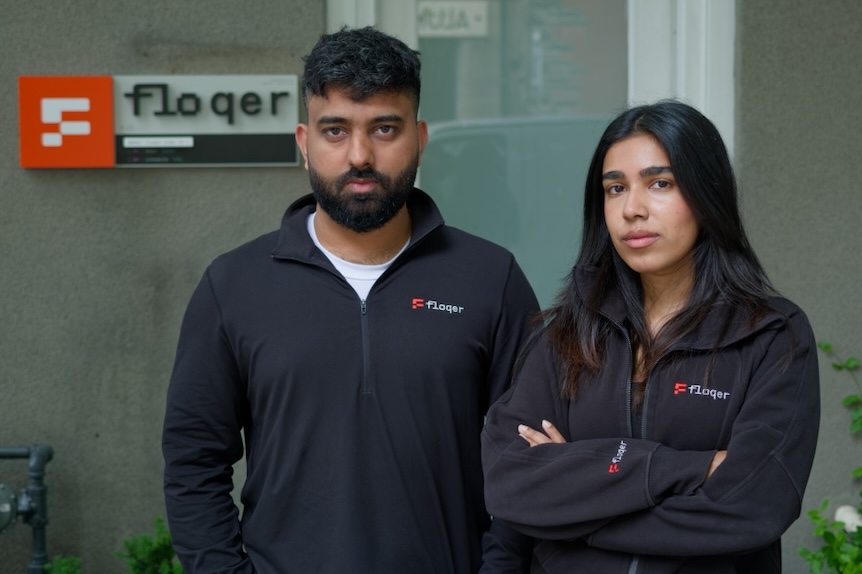
Halifax-based Floqer has adopted a similar philosophy. The startup, which builds AI software to organize customer data, has reached seven figures in annual recurring revenue in less than two years, with a team of nine. Co-founder Shivam Mahajan said his goal is to build a billion-dollar company with fewer than 20 employees.
Like Dodonov, Mahajan uses AI in nearly every aspect of its business. Floqer’s software automatically collects and organizes clients’ customer information from emails, meetings and other business systems, as well as from the internet, that sales teams and AI agents can use. Internally, employees use AI to write code and take on routine tasks.
Since launching in October 2024, the company has grown much faster than Mahajan expected. The business, fuelled by customer revenue, felt stable, he said, and the founders didn’t see the need to raise money. But investors—including Perplexity co-founder Denis Yarats, whose company was already a Floqer customer—began approaching them. In September 2025, the company closed a $2-million pre-seed funding round.
Mahajan said that while Floqer is cash-flow positive and doesn’t need more venture capital, he expects the team will eventually raise a Series A to help speed up growth and stay ahead of the competition, which, he acknowledged, is also moving much faster than before.
Fatima Khamitova, who leads startup programming at Toronto’s Vector Institute, can attest to the new pace at which founders are operating. Many of the early-stage companies she works with are making revenue—in some cases more than $1 million—well before approaching investors. That’s in large part because they’re using AI agents to prepare financial models, create pitch decks and write marketing materials, she said, which would have taken far more time, money and people just a couple years ago.
Khamitova said that doesn’t mean startups will never have to raise capital or grow their headcount, but that they can get much further before needing to. When they do eventually raise, she said, they often need more money to get past the initial startup phase than a typical early-stage investment would have required just a couple years ago.
Joshua Dorsey is one founder in that position. His company, Hivelighter, trains AI agents to be better researchers by giving them a “cognitive identity,” what Dorsey describes as their own expertise and perspective. The tool went viral on Moltbook, an online forum where AI agents interact with one another. Dorsey said an “ask me anything” post drew more than 4,000 comments (a typical AMA on Moltbook might get 15 interactions, he said) and prompted widespread downloads by AI agents themselves. From there, the business took off.
Dorsey wouldn’t disclose Hivelighter’s revenue, but said it’s on track to triple this year and reach $13 million in annual recurring revenue by 2028. The company has nine employees, and plans to keep the team lean—“we’re certainly not looking to double or triple,” Dorsey said—and has gotten by on grants and a handful of investments from family offices. The team is now planning its first VC round, targeting between $3 million and $5 million.
Khamitova, who has worked with Dorsey at Vector, said that’s big money for a startup’s first venture capital investment. “A $3-million VC pre-seed is not a typical round by any means in the Canadian market,” she said.
Startup investor Isaac Souweine, who’s helping launch a new early-stage fund for AI startups, said the trend toward bigger first rounds at later stages of growth isn’t always by choice. Many investors, he said, want to see companies hit more milestones by the time they raise money. “There have been raised expectations because AI allows you to build faster,” he said.
It’s also not every founder that aspires to stay perpetually small. Stephen Southin, founder of Toronto-based automotive imaging startup Halo Eye, has built several companies over his career and said creating jobs is one thing he loves about the role. His last company, Pave, grew to roughly 200 employees, and he plans to eventually do the same with Halo Eye. “We’re just going to get a whole lot more done with each person,” he said. The volume of work his four-person team at Halo Eye is doing today, he said, would have required 20 people at Pave.
For Dodonov, however, maximizing revenue per employee is the priority. He said he’s not opposed to raising venture capital if it helps Stan reach growth targets it can’t achieve on its own. “We are in a very comfortable position of not needing capital,” he said. “As our goals evolve, that might require additional capital… so we’ll use it as a tool as needed.”
Source link