




Maternal deaths remain one of our nation’s most significant failures, with U.S. mortality rates leading the industrialized world and people of color bearing a larger share. Despite increased government support, many birthing people feel unheard and poorly served, with complaints ranging from maltreatment to a lack of attention between visits.
One hopeful development has been the rise of venture capital-backed startups filling gaps in pregnancy care. A new study from LDI Fellows identified 172 startups that raised nearly $1 billion from 2014 to 2022, focusing largely on virtual and wraparound care for pregnancy.
The team’s JAMA Health Forum paper —with lead author Madeline Perry and senior author Scott Lorch—marks one of the first studies to analyze the role of VC-backed startups in pregnancy care.
Venture capital is flowing into maternal health, but doing it unevenly. Three startups accounted for roughly half of all investments.
Among firms whose services could likely be covered, fewer than half accepted insurance, and only 34% took Medicaid, which covers 40% of all U.S. births.
Also concerning: Fewer than one in five startups even mentioned health equity or maternal mortality on their websites.
The study didn’t look at outcomes. Startups could improve care in this area, the authors say, but may not reach many of the people most affected by the crisis.
For more, we talked to Madeline Perry below:
Can you update us on the current state of maternal mortality, how disparities and poverty factor in, and how VC-backed firms might help?
Perry: Maternal mortality rates in the U.S. are higher than in other high-income countries and significant disparities exist. Black and brown birthing people are at an increased risk of significant medical complications or death related to pregnancy. People with low incomes also experience worse pregnancy outcomes.
Until recent years, prenatal care had remained largely unchanged for decades. VC-backed startups are often innovators and have a history of thinking of novel solutions to problems. This is what really drove my interest in startups.
As a Maternal-Fetal Medicine fellow in the Department of Obstetrics and Gynecology at the Perelman School of Medicine, I see firsthand the barriers that people face during pregnancy care. I was interested in how startups were thinking about solutions.
What are your main findings on maternal health startups and their significance?
Perry: Maternal health startups are increasingly present in the U.S., and the most common type of care they provide is virtual and hybrid wraparound care. This can be thought of as the “in-between” care that happens before and after a prenatal visit with an OB provider.
This finding makes sense. Many birthing people feel that the current prenatal care model does not meet their medical and psychosocial needs. Notably, very few startups mention health equity or disparities in perinatal outcomes. This is important because adverse pregnancy outcomes are disproportionately concentrated in Black, brown, and low-income populations and are driven by systemic and structural factors like racism.
Improving perinatal outcomes in the country requires prioritization of populations who may have more limited access to comprehensive, high-quality pregnancy care.
From a funding perspective, we also found that although the number of startups and startup funding increased annually, most of the funds raised were concentrated in a few companies.
How did you get involved in studying maternal health startups?
Perry: I’ve always been interested in innovative models of pregnancy and maternal health care, especially for people who face barriers to accessing care. That is what drew me to startups: their ability to innovate not just “outside the box,” but outside the existing framework for a problem. Turning a problem upside down and thinking about a solution completely differently is very exciting. Startups have always played a role in health care, but we had no idea how they were contributing to maternal health.
Can you describe what types of maternal health startups got most of the money and why that’s significant?
Perry: Biotechnology companies generally receive the most funding. These companies often are trying to make advances in prenatal diagnosis, which generally includes maternal blood tests that evaluate the risk of certain genetic differences in a pregnancy.
This makes sense because the resources needed for biochemical research and design are significantly greater than those needed to set up a company based on software as a service (SaaS), for example. It is possible that one reason there are so many virtual wraparound health care companies is that the financial barrier to entry is relatively low, especially compared with a biotech company that will need a lab, experiments, and often FDA approval of their product.
There are a few wraparound care companies in the top 20 in total funds raised, and some of those actually prioritize populations insured by Medicaid. About 40% of births in the U.S. are covered by Medicaid. Not only is investment in this population important for perinatal outcomes, but also because it represents a significant portion of the birthing population.
Focusing on pregnancy care is important not only for improving pregnancy outcomes, but also for health beyond pregnancy. Adverse pregnancy outcomes, such as pre-eclampsia and gestational diabetes, increase the risk of heart disease and type 2 diabetes outside of pregnancy. Pregnancy is a unique window during which people interact with the healthcare system often. We have the opportunity to impact health not just now, but in the future.
What should policymakers do about the finding that VC-funded firms may not be focused on the core of the problem?
Perry: I’m not sure if it’s policymakers as much as academic institutions. Health-related VC-backed startups can gain credibility, brand awareness, and partnerships if they partner with a major academic institution.
Academic institutions and groups like the Society of Maternal-Fetal Medicine are in a unique position to potentially raise awareness for certain startups. Importantly, there needs to be a way to evaluate startups and establish a set of standards for them. How can we discern a startup that has the potential to improve perinatal outcomes from one that does not have much added value or even has a risk of harm?
Where is your research into VC funding for maternal health going next?
Perry: This study demonstrates that there are a lot of VC-backed companies in the maternal health space. The next big question is: Are they meaningfully improving outcomes?
This can be hard to study because health care outcomes related to VC-backed startups are not as readily available to study in publicly available datasets, like claims data. That said, evaluating outcomes for these companies is important because so many of them advertise directly to consumers. If there are startups that can reduce maternal morbidities and preterm birth and improve perinatal outcomes, we want to be able to expand access to them.
What should reporters and policymakers watch for going forward in the maternal health space?
Perry: Along with VC in maternal health, policymakers should also be watching how private equity is permeating into maternal and women’s health care. This is an emerging area of research I am focusing on. We know that more hospitals and clinics are being purchased by private equity, but we don’t yet know the impact on costs, quality of care, and health outcomes.
The study, “Venture-Backed Maternal Health Startups and the Maternal Health Crisis,” was published in JAMA Health Forum on July 24, 2026. Authors include Madeline F. Perry, Kristan Scott, Diana Montoya-Williams, Leah Blum, Sindhu Srinivas, David Grande, and Scott A. Lorch.
Author
More on Health Care Access and Coverage
“High-Deductible Health Plans Are Not the Answer”
They Cut Health Spending at First but Don’t Slow Long-Term Growth Rate, LDI Fellows Say
Understanding CMS’s Proposed Rule Regarding Prior Authorization For Drugs
LDI Expert Considers Cost, Quality, and Access Implications
Congress is Fighting the Wrong Pharmacy Battle
Better Plan Choices Would Lower Drug Costs, Not PBM Breakups, LDI’s Mark Pauly Says
Why Some Family Health Insurance Is Now Much Pricier
LDI Expert Proposes Fixes to Keep Marketplace Plans Within Families’ Budgets
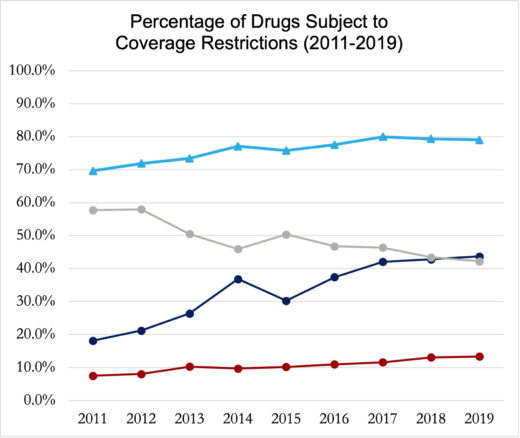
Despite Coverage Requirements, Insurers Added Barriers to Access for Drugs
Chart of the Day: Medicare, Medicaid, and Insurers Replaced High Costs With More Hurdles, LDI Expert Finds
The State of LGBTQ+ Health in Philadelphia
Testimony: Delivered to Philadelphia City Council’s Committee on Public Health and Human Services by Amy Hillier
Source link