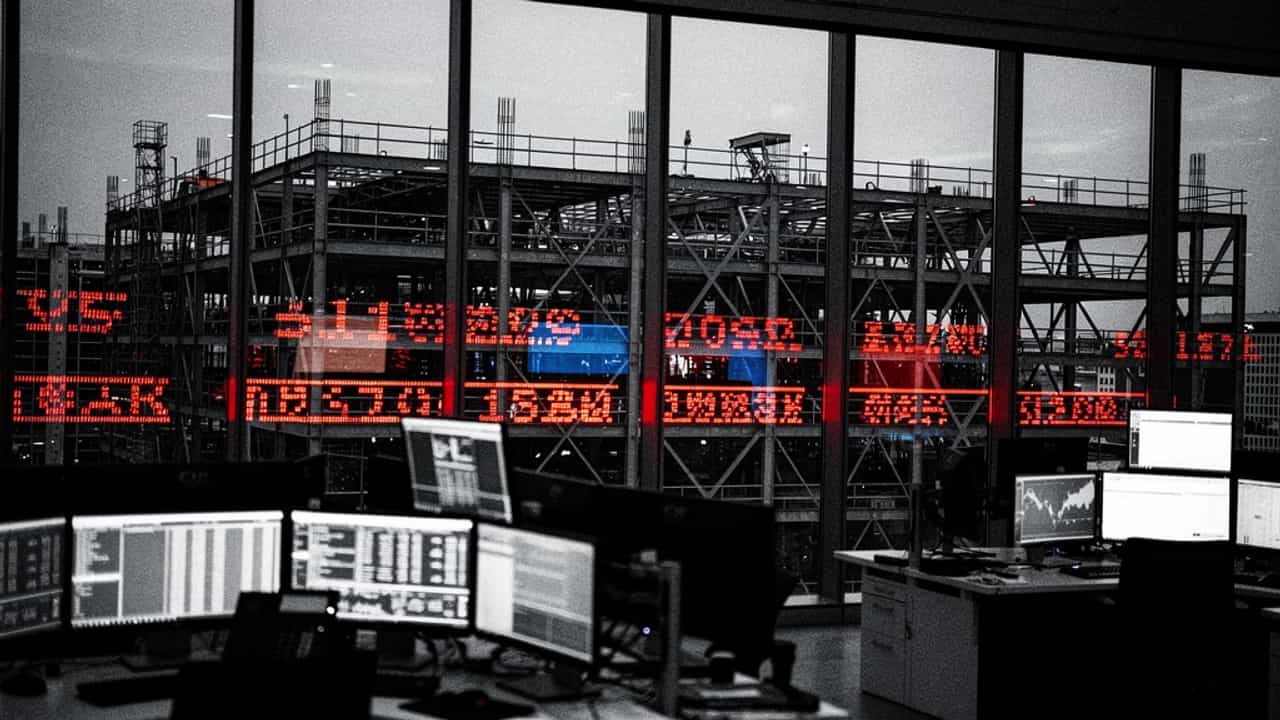
CoreWeave’s bonds are pricing in a default that wasn’t supposed to happen this soon. Nearly $1 trillion came off the biggest AI and chip stocks this week as a hot inflation print collided with a credit market losing faith in the AI buildout.
CoreWeave sank 12% on Friday alone. Its five-year credit default swaps, the contracts traders buy to insure against a company defaulting, blew out from roughly 368 basis points on October 6 to nearly 643 basis points by the end of the week, according to Bloomberg data. Its bonds are behaving the same way: yield on CoreWeave’s 9.625% senior notes due 2032 climbed from about 13.42% at the start of the month to roughly 15.06%, levels that typically signal a borrower in real trouble, not a growth stock having a bad quarter.
That’s the story everyone was already watching. What changed this week is that it stopped looking like a CoreWeave problem and started looking like a market problem.
The Nasdaq Composite fell 2.14% on Friday to close out its worst week since June, down roughly 4.5%, and strategists are calling it the steepest tech-sector slide since the April 2025 tariff shock rattled markets. The Philadelphia Semiconductor Index had it worse: down 11.4% on the week, its weakest stretch since that same April 2025 selloff, after chipmakers fell for six straight sessions, their longest losing run since May 2025. Put those two numbers side by side and you get a sector that’s been bleeding for longer than it bled during “Liberation Day.”
Wednesday was the inflection point. The Bureau of Labor Statistics released the September CPI report on October 14, and it came in hotter than Wall Street wanted. The S&P 500 fell 1.11% and the Nasdaq dropped 1.88% that day, each posting their worst single session since July. According to CME’s FedWatch tool, traders went from pricing a 22% chance of a Fed rate hike this month on Tuesday to 37% by Wednesday close. That’s not a cut getting delayed. That’s a hike getting priced in, and for a sector that has spent two years borrowing heavily to build data centers on the bet that money would stay cheap, a hike is the nightmare scenario.
The names that moved hardest on Wednesday tell you exactly where the fear concentrated. Oracle lost 7.3%. CoreWeave fell 15%. Nebius dropped 10%. Dell sank 12% and Hewlett Packard Enterprise lost 7.6% after Barclays cut both AI server makers to “equal-weight” from “overweight.” Nvidia slid 3.2% that day, part of a slide that’s left it down roughly 7.5% from the record high it hit earlier this month. Broadcom, Marvell and Micron all fell alongside it, and Marvell alone dropped 8.7% on Wednesday.
You don’t sell off Oracle and HPE and CoreWeave on the same day for the same reason unless the market has decided these are all the same bet. They are. Every one of them is borrowing against the idea that AI spending keeps growing faster than the cost of capital, and this week the cost of capital stopped cooperating.
Capital, not chips, is now the constraint
Broadcom CEO Hock Tan said something this month that’s aged fast: capital, not chips or memory, could become the AI industry’s next real constraint. He wasn’t talking about CoreWeave specifically, but the market reaction this week reads like confirmation. When your business model depends on borrowing billions to build data centers years before the revenue shows up, a Fed that might hike instead of cut changes the entire math, not just the stock price.
CoreWeave’s own numbers make the stakes concrete. Its debt load stood at roughly $14 billion at the end of September. The company then came to market with a $2 billion convertible note offering, a reasonable move in calmer conditions, but one that landed right as bond yields on its existing notes were already climbing toward distress territory. Frankly, that’s a tough tape to raise fresh debt into.
None of this means the AI buildout is finished. Nvidia is still shipping every chip it can make, and the hyperscalers haven’t pulled back their capital expenditure plans. But the bond market has started asking a question equity investors mostly ignored for two years: can these companies actually pay back what they’ve borrowed if rates don’t fall the way everyone assumed? This week, for the first time since the tariff shock, the stock market started asking it too.
Also read: AI Startups Now Take 82.7% of US Venture Capital Dollars • UK Trader Sues BitMEX’s Operator for £20 Million After Exchange Shut Down • Self Labs Launches Agent Vault as Banks Lock AI Agents Out of Accounts
This article is posted in Financial Markets News, check it out for more related stories.
Almost there. Sign in and your reply posts straight away.