


With the Victorian election weeks away, the Opposition has proposed winding up Innovation Victoria’s investment function and selling its early-stage portfolio to help finance a $1.27 billion healthcare plan.
The proposal deserves greater scrutiny because it treats health funding and innovation investment as competing priorities, when Victoria’s future healthcare capacity depends partly on the companies, technologies and jobs that patient capital helps create.
To a voter stuck on a multi-year waiting list for surgery, it sounds like common sense: close down a $2 billion venture capital fund that most Victorians have never heard of and put that money towards reducing the surgery waiting list.
I understand that frustration. More than 30 years ago, my father finally reached the top of the waiting list for surgery at the same hospital where he had died nearly a year earlier. It was an unforgettable telephone call.
Long waiting lists are not abstract or new. They affect real families every single day.
The proposal conflates two different policy challenges: the urgent need to improve Victoria’s healthcare system today, and the long-term investment architecture needed to grow the economy that funds it tomorrow, including medical innovations that can strengthen the system and improve people’s lives.
Solving the first by dismantling the second would trade long-term capability for short-term budget relief.
What patient capital builds
VC often conjures images shaped by Hollywood. For many people, it calls to mind the excess of The Wolf of Wall Street or Gordon Gekko’s “greed is good” swagger in the 1980s filmWall Street: sharp suits, wasteful lifestyles, penthouses, fast cars, private jets and abstract financial engineering that ultimately harms ordinary people.
I once saw it that way too. It felt galaxies away from my daily life as a farmer and a low-paid sessional university academic. Yet those caricatures bear little resemblance to Victoria’s innovation economy, where founders work in warehouses, laboratories and small manufacturing facilities to turn research and technical expertise into products that improve people’s lives.
Innovation Victoria’s investment mandate covers health, climate resilience, advanced manufacturing, agriculture, water and sovereign capability. Companies in these sectors often face a long path from research and development to commercial scale, particularly in the missing middle of manufacturing, medtech and deep tech.
The fund provides patient capital and commercial guidance through that period while crowding-in private capital. Investment remains inherently risky and commercial progress is rarely linear, but successful companies can create durable industries and capabilities while generating a return for the state.
I have spent my career across both worlds. As a former lecturer and researcher, I have seen universities act as incubators for discovery every day, not just within formal accelerator programs.
In funds management today, my job is to give investors access to the best innovations and to give innovators the capital they need to take their ideas global.
Closing the funding gap
From that vantage point, one thing is clear: Australia does not have an innovation problem. It has an investment architecture problem, which means companies employing everyday people across our cities and regions miss out on the funding they need to grow and expand.
Innovation Victoria was created to address that funding gap through the consolidation of Breakthrough Victoria and LaunchVic. Its investment function carries forward an important element of Breakthrough Victoria’s mandate.
Breakthrough Victoria was launched in 2020 with an initial $2 billion fund, at a time when COVID-19 had profoundly disrupted life and the economy in Victoria. Against that backdrop, creating a fund built on optimism, patient capital and confidence in the state’s long-term future was remarkable. It signalled an active approach to economic recovery by seeding fund managers in target sectors and providing long-term capital directly to industries that traditional financiers routinely overlook.
These sectors cannot be built on short funding cycles or quick commercial wins: they require long, uneven and expensive paths to scale, but they are also areas in which Victoria has established strengths.
According to the Victoria Venture Capital Report 2025, the state is now home to 4,400 startups, 4.4 times as many as in 2017. The report also attributes 63,900 jobs created since 2004 to the sector.
In 2025 alone, Victorian startups raised $2.2bn across 134 deals, overtaking NSW for the first time and cementing Victoria’s position as one of Australia’s most dynamic innovation hubs. As custodian of the Breakthrough Victoria fund, Innovation Victoria can help those startups reach their next phase and, ultimately, become globally competitive.
Victoria already has a strong early-stage ecosystem with excellent support for founders.
Jobs behind the numbers
These are not abstract numbers. They represent warehouse workers, engineers, designers, technicians and logistics staff whose wages pay mortgages, school fees and grocery bills. Their livelihoods matter just as much as those of Victorians waiting for hospital care.
Removing the fund from Innovation Victoria would also risk reducing the agency to another advisory or ecosystem-support service, stripping it of the distinctive investor signal that government participation sends to private capital. Although my firm could look, at a glance, like a competitor, we deeply value Innovation Victoria’s role in demonstrating institutional confidence in the long, capital-intensive development cycles of deep tech and hard tech.
If, under the Opposition’s plan, the Victorian Government will not back strategically important innovations from its own state, it becomes harder to persuade private investors elsewhere to do so.
A closer look at Innovation Victoria’s current portfolio shows what is at stake. The agency backs locally founded companies that employ Victorian workers and develop practical technologies addressing health, manufacturing and environmental challenges across the state.
Planet Protector Group manufactures sustainable thermal packaging from waste wool and insulation from waste denim in Victoria, employing dozens of local workers. Its products replace plastics and polystyrene while keeping valuable waste fibre out of landfill. The company is doing exactly what policymakers say they want: creating local jobs, building Victorian capability and producing goods that reduce environmental harm.
The state’s investment in the company is also among the portfolio holdings the Opposition proposes selling before they have had time to mature.
Investing in better healthcare
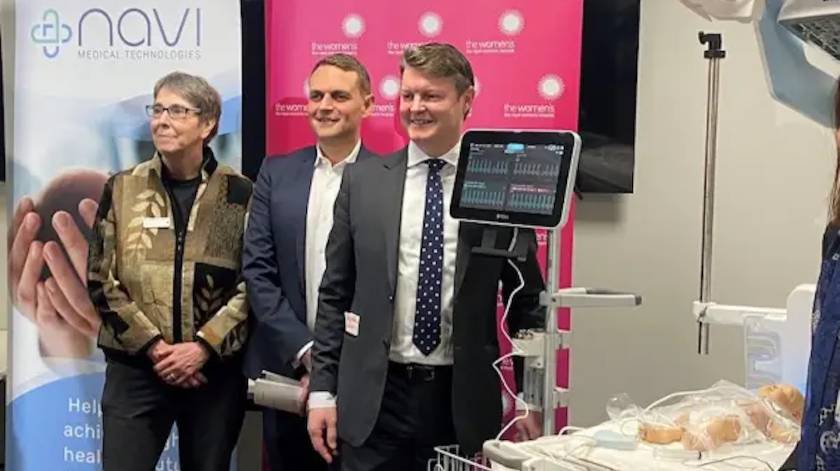
Navi Medical Technologies shows what local innovation looks like in practice. Its founders met in Melbourne and built the company within Victoria’s clinical and research ecosystem. Navi now employs engineers and clinical specialists developing devices for critically ill newborns and premature babies in intensive care, where clinicians must position life-saving tubes accurately in very small bodies.
With just under 10% of babies in Victoria born prematurely, the company’s work connects local talent, research and investment with a significant healthcare need. Selling the portfolio would therefore withdraw support from the same kind of medical innovation the healthcare proposal is intended to benefit.
SmileyScope offers another glimpse of what is at stake. Founded in Melbourne by doctors who saw firsthand how distressing medical procedures can be for children, the company now employs software developers and clinical support staff building VR tools that reduce children’s pain and anxiety.
SmileyScope is more than a startup: it shows how locally developed innovation can contribute to a stronger healthcare system by reducing clinical risk, improving patient outcomes and easing pressure on frontline staff.
The cost of retreat
Victoria’s overstretched balance sheet requires urgent attention, and its healthcare system needs structural reform.
The Opposition has pointed to portfolio companies entering administration as evidence of unacceptable volatility. Yet of roughly 100 active investments, one company, epilepsy medtech Seer Medical, entered voluntary administration. A collaborative $40 million rescue package backed by private capital subsequently preserved local technology jobs and critical medical intellectual property in Victoria. That outcome does not eliminate the risks of public investment, but it shows how public and private capital can work together to preserve valuable capabilities when a portfolio company experiences financial distress.
None of this diminishes the urgency of fixing Victoria’s healthcare system. Elective surgery waiting lists are unacceptable.
But funding healthcare by gutting the very industries required to pay for it is an illusion. You cannot build a world-class health system by shrinking the economic base that sustains it.
The Opposition’s proposal may attract short-term support by presenting venture investment as money that can be redirected without consequence.
But selling an early-stage portfolio before its investments have had time to mature would leave founders and workers exposed, weaken the signal that draws private capital to Victoria, and reduce the state’s capacity to build the industries that will support future public services.
Healthcare reform and innovation investment should be judged on their own merits, not forced into a false choice.
- Kate Gaffney is the cofounder and director of partnerships, engagement, and research at AxleTree Capital.
Source link