ATLANTA, October 22 (Hypepotamus) – One question I regularly ask investors and tech leaders: Which startups in Atlanta are you most excited about?
The answers come with predictable caveats. Investors name companies they’ve backed. A recent Demo Day pitch is still fresh in someone’s mind and they’ll name a founder they heard on stage.
It’s hardly a scientific poll. But one name keeps coming up recently: Tractian.
The company has built plenty of buzz among Atlanta’s tech insiders, even as its biggest investors sit on the West Coast.
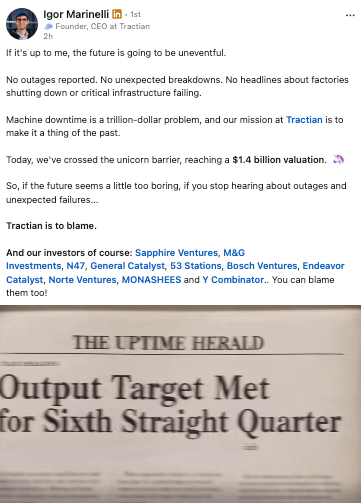
This week, Tractian gave the wider tech community a lot to talk about, becoming Atlanta’s latest unicorn.
Tractian raises $130M Series D
Tractian announced on Thursday it raised a $130 million Series D round.
The round, first announced by The Information, was led by Sapphire Ventures. Other notable funds involved in the round include General Catalyst, Y Combinator, Bosch Ventures, and N47.
The investment takes the company to a $1.4 billion valuation. That makes it the latest unicorn tech company headquartered in Atlanta (and one of the first AI-focused startups in the city to reach that tech distinction).
Tractian’s ARR crossed the $100 million mark last month, according to reporting from The Information.
Tractian in Atlanta
This spring, Hypepotamus caught up with CEO Igor Marinelli as Tractian was preparing to move into its new Midtown Atlanta HQ and was expanding its prominent internship program.
At the time, Marinelli shared with Hypepotamus that he moved the company from the Bay Area to Atlanta in order to be closer to engineering talent and customers, who are all in asset-heavy industries and looking for physical AI solutions.
“I grew up around people who work with their hands,” he told Hypepotamus at the time. “Those jobs keep the real economy running, but the technology supporting them has historically been terrible. When I started visiting factories, it became obvious that the machines producing billions of dollars in output were still being maintained with spreadsheets and reactive maintenance. That gap between the importance of the work and the lack of modern tools is what pulled me in.”
—
