Despite numerous high-profile success stories, launching a profitable technology startup remains difficult, and a viable exit is unlikely, especially in the US.
According to a new academic study by researchers from the Wharton School and the University of Zurich, roughly nine in ten founders end up with a zero exit value, reflecting the substantial risk in venture capital (VC)-backed entrepreneurship.
The study, which analyzed nearly 250,000 founders, reveals that while the individual founder exit value is, on average, high, it is extremely uneven. Though the average founder exit value stands at US$5.6 million, 88% of founders actually receive nothing.
According to the research, this outcome stems from two mechanisms. First, founders are collectively wiped out in 81% of cases, either because the company fails outright or because of “bad exits” where VCs claim all proceeds.
Other research have noted high failure rates among tech startups. An analysis by Louis Bouwer, a deeptech positioning strategist, product marketer, and innovation specialist, suggests that a staggering 90-95% of startups with pre-seed funding fail to reach Series A.
Meanwhile, during a bad exit or moderate acquisition, the sale price may be near or below the total amount of VC raised. In this case, most or even all of the proceeds may go to satisfying investor priority because contractual rights grant them preferred stocks with a legal right to be paid back before anyone else. As a result, founders and employees holding common shares may receive little or nothing from the sale.
The second mechanism involves the reality that even among startups achieving successful exits through acquisitions or initial public offerings (IPOs), there is a 39% chance that an individual founder departs before exit and receives no payoff.
Individual founders may leave before an exit because venture boards choose to replace early-stage entrepreneurs with professional executives. Internal co-founder friction may also force a breakup. When founders depart early, they typically forfeit any unvested shares. Furthermore, “bad leaver” clauses may force them to sell their remaining stake back at a heavily discounted price.
Replacing early-stage entrepreneurs with professional executives occurs fairly often. A study by academics from Rice Business and the University of Beirut examined data on more than 1,000 VC-backed US IPO between 1995 and 2013, and found that 472 firms, or 40.8%, changed CEOs between the first round of VC financing and the IPO.
Extreme concentration
The academic study from the Wharton School and the University of Zurich also shows that outcomes are highly concentrated, with even greater spread among positive values. When an exit yields a positive value, the average is US$47.3 million, and yet the median stands at just US$4.8 million.
The 90th percentile reaches US$65.6 million, while the 99th percentile climbs to a staggering US$661.2 million. Overall, 89% of individual founder exit value derives from the top 2% of founders (including zeros), and the top 1% account for 79%.
Compared to exit patterns in the US, Swiss entrepreneurs show stronger results, largely due to support from the country’s extensive higher education institutions, universities, and research labs.
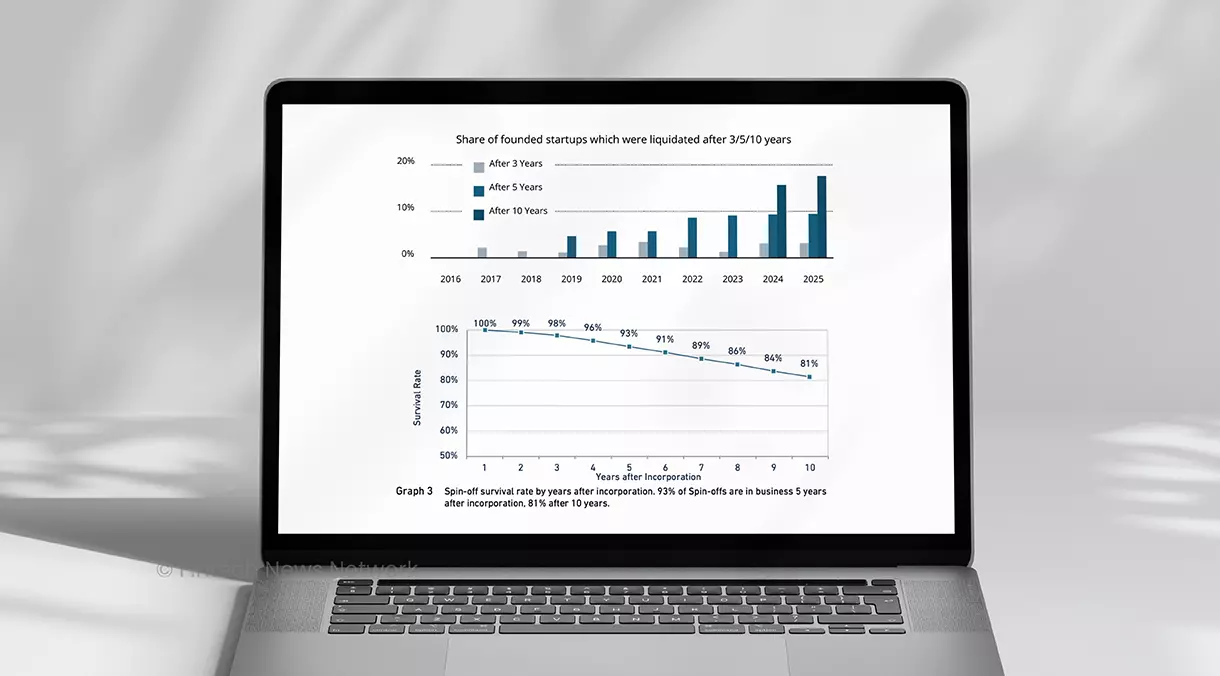
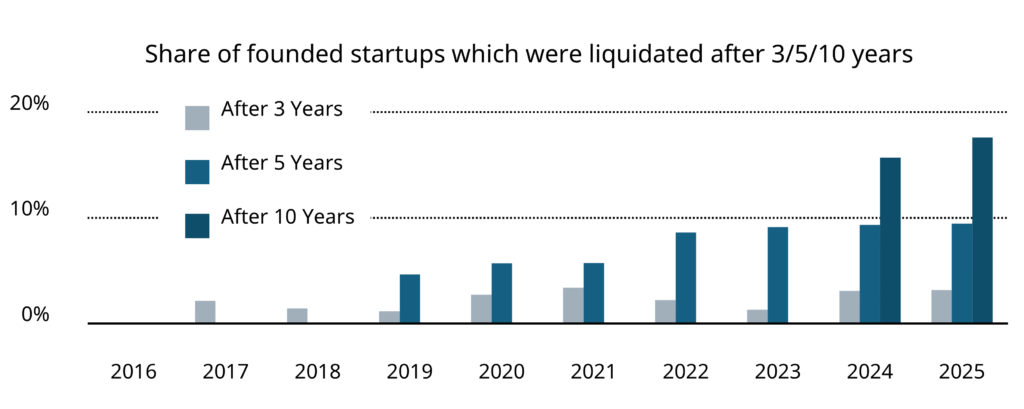
According to research by Startupticker.ch, a Swiss news portal focused on the startup and innovation ecosystem, the current ten-year failure rate for startups in Switzerland is 17.6%. This means that 82.4% of startups founded in 2016 still operate today. For those in their fifth year, the current failure rate is 9.5%, while the three-year failure rate sits at 3.2%.
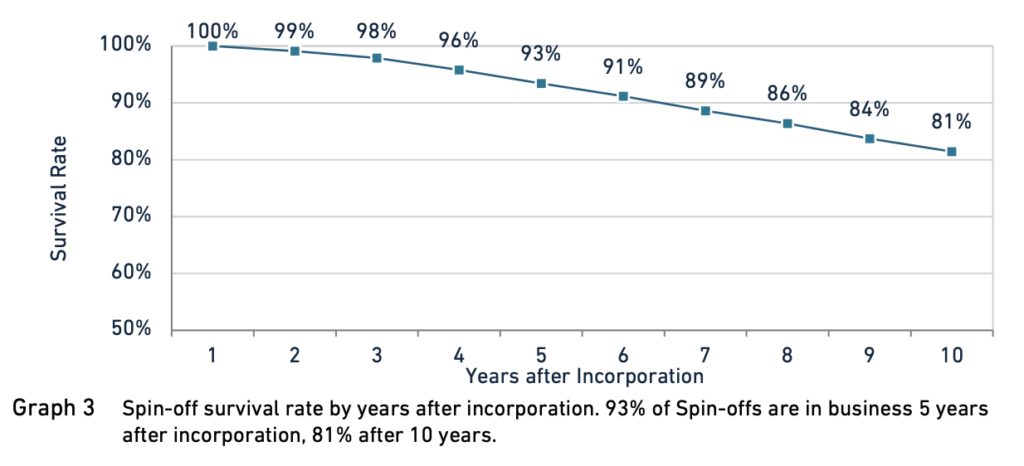
Survival rates rise a little for spin-offs from universities. For example, 93% of all ETH Zurich spin-offs were active in 2024 five years after launch, while the ten-year survival rate stood at 81%.
Breaking down the data by sectors shows an increase in liquidations in capital-intensive sectors in 2025. According to the Startupticker.ch research, 14 were liquidated in the biotech sector in 2025, up 250% from four startups in 2024. In the hardware sector, the number increased by 100% to eight liquidations in 2025, while in the cleantech sector, it increased by 66.6% to 15 liquidations.
Other sectors saw online a mild rise or even a drop. The number of liquidations in the ICT sector increased by a modest 3%. In healthcare IT, fintech and medtech, the liquidation numbers all decreased between 12.5% and 35%.
Featured image: Edited by Fintech News Switzerland, based on image by jawadexpert via Magnific
Source link