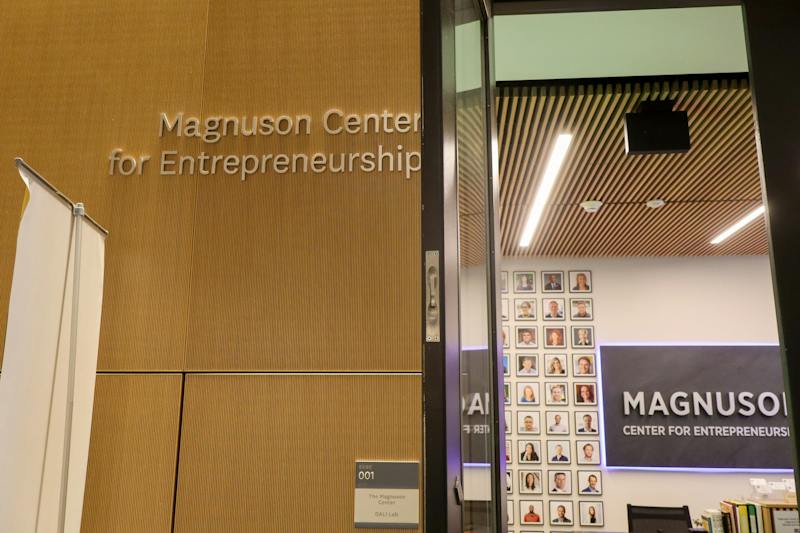
From the woods of Hanover to the bustling streets of New York City and San Francisco, Dartmouth students are thoroughly engaged in entrepreneurship. Between The Magnuson Center for Entrepreneurship, the Center for Career Design and an accessible alumni network, Dartmouth has endless opportunities for anyone wanting to take their idea to the next level.
Take Cooper Weissman ’27. The first funding he received for his college counseling company NerdApply was from the Magnuson Center. Now, after suspending his time at Dartmouth since his junior fall, he works full-time from a penthouse office in the heart of Times Square. He’s currently developing NerdApply, which provides college applicants with personalized “opportunity guides” made with anonymized student admissions data and outcomes, helping them tailor their applications to specific schools based on prior applicants’ information.
Seeing Dartmouth alumni in entrepreneurial fields and speaking to professors gave him the confidence that he could do something big and create a change in the world, Weissman said.
“That’s what led us to say, ‘Hey, we want to put all opportunity in the hands of every single student in America, we want to change the education system, and make it work better for all students,’” Weissman said. “That type of big vision was only possible because Dartmouth gave me the confidence to dream that big.”
Weissman appreciates Dartmouth’s academic instruction and liberal arts focus.
“Looking back, at the time, I didn’t appreciate how valuable the actual experience in classroom time is at Dartmouth,” Weissman said. “In the world that everything is moving to, all the hard skills are kind of being commoditized because artificial intelligence is able to do coding and do math. But it’s really the critical thinking, problem solving ability that Dartmouth does a really good job setting kids up.”
Jack Beecher ’27 founded his startup Denta in 2025 to provide an alternative to dental insurance through a payment card companies can give to their insured employees. He was inspired by his father, who is runs a dental company, he said.
“He was telling me about a problem with one of his dentists and I’m like, oh, I’m pretty sure I can build some software to help you out with that,” Beecher said.
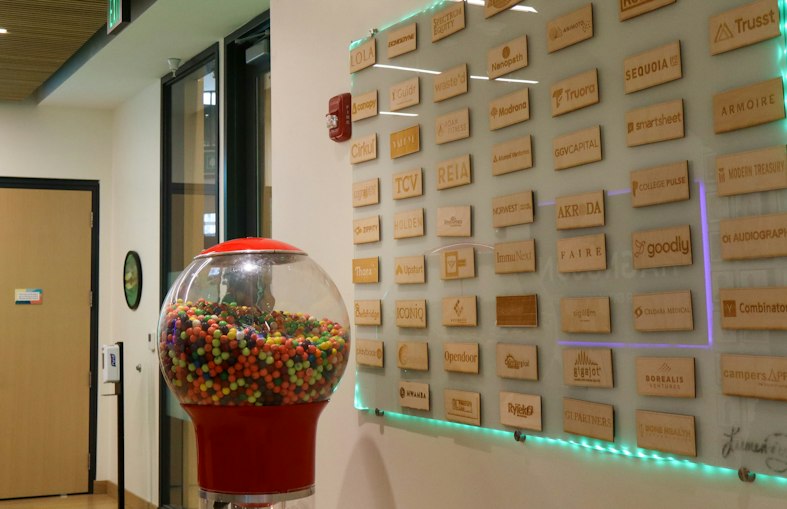
Over the summer, Beecher was awarded an investment of $500,000 from Y Combinator, a startup accelerator in the Bay Area, in summer 2026. As a result, he decided not to continue as a student at Dartmouth.
“This is one of the craziest times in the history of the world right now in San Francisco,” Beecher said. “I kind of felt like there was no other option: I just needed to be in San Francisco where the cool stuff was happening.”
Denta now employs three people.
Denta has “grown to be an obsession in my brain where there’s not much else I like to think about,” he added. “So, spring of last year, I’m sitting in my classes and I’m taking notes in front of me, but not about the class, but about Denta.”
Beecher acknowledged the popularity and importance of Dartmouth’s resources, but pointed out the importance of his community to helping him develop Denta.
“All you really need to do is find a lot of really close friends and build cool things with them,” Beecher said. “Whether you want to build things individually or build things with friends, that’s all it is.”
While entrepreneurship involves heavy self-motivation, Dartmouth has resources for students who are interested in starting their own business.
Aren Carlson ’27, who worked at a startup in New York City this summer, said he became interested in entrepreneurship after participating in the TuckLAB entrepreneurship program. TuckLAB is a 40-hour certificate course that teaches students how to create a startup, and culminates in a startup competition judged by alumni and MBA students that is offered through the Tuck School of Business and the Magnuson Center.
With a group of fellow TuckLAB participants, Carlson built a shoe company his freshman year that he is still involved in as a senior.
“The Magnuson Center has been such a bountiful resource,” Carlson said. “There’s a lot of funding and programming that is constantly happening, like this TuckLAB program, that is really accessible to students. I would argue Dartmouth’s education is a little bit more liberal arts oriented, and so they really emphasize how any student of any background or interest can learn how to make a business, and create value for other people, and that’s just something I’m really grateful for, being a Dartmouth student.”
In comparison to other colleges, Beecher noted that he appreciates that Dartmouth’s startup culture isn’t pervasive.
“I also enjoy Dartmouth because it’s not all just tech and startups, and I think that actually gives you sort of an advantage in startups and having the liberal arts education,” Beecher said. “Obviously Stanford is its own identity, but a lot of the kids from Stanford, it’s like either ‘drop out or bust’ and that is not the point of Dartmouth. It’s just such a good balance and such a good strong culture for whatever you want to do, including startups.”
Since putting his academic life on pause, Weissman said he understands student-entrepreneurs’ anxiety about balancing an education with their business ventures, but recommended that they slow down and “milk all the resources of Dartmouth before you leave because there’s so much that you can get for free and office space and people and ideas.”