More than 300 venture capital partners, angel investors, serial entrepreneurs and innovation leaders gathered Thursday for the annual “Trends & Forecasts” conference, which reviewed the performance of Israel’s high-tech sector during a challenging year marked by ongoing uncertainty, and sought to anticipate how the industry may be affected in the coming year amid the rapid acceleration of global AI developments.
Now in its eighth year, the conference is initiated by Guy Katsovich, co-founder and managing partner of the pre-seed fund and accelerator Fusion, together with the law firm Pearl Cohen, with the aim of convening Israel’s startup ecosystem leaders once a year for a discussion on key entrepreneurial trends.
2 View gallery
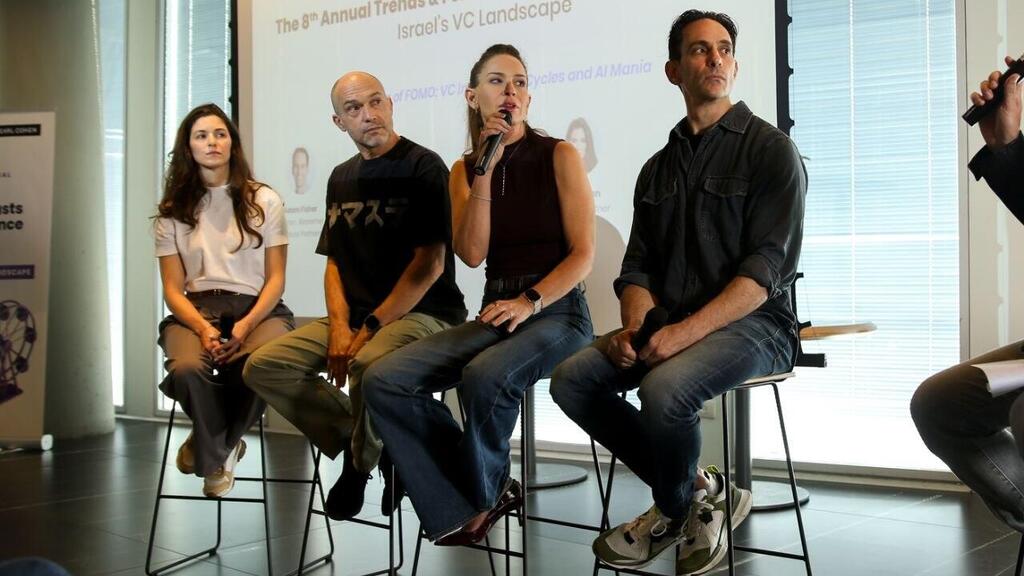
Investor panel includes, from left, Lior Simon, Gigi Levy-Weiss, Yifat Oron, Adam Fisher
(Photo: Courtesy of Maysa)
In a survey conducted by Fusion ahead of the conference, with the participation of more than 200 investors, respondents were asked to identify the most significant challenge currently facing the venture capital industry. The data shows that 29% cited intensifying competition for investments in the hottest sectors as the primary challenge. Ranked second was the difficulty faced by local funds in competing with foreign funds, cited by 23% of respondents, up sharply from just 10% last year. The third-ranked challenge was raising new funds, which declined to 20% this year compared to 38% a year ago.
Investors were also asked which three sectors are expected to lead the industry in the coming year. Nearly all respondents (98%) believe cyber will continue to lead, while 96% also pointed to artificial intelligence. Quantum technologies ranked third with 23%, replacing fintech, which fell to fourth place this year with 20%.
Asaf Horesh, co-managing partner at Vintage Investment Partners, presented a report at the event summarizing the performance of venture capital funds and startups over the past year. According to the report, the majority of capital invested in startups is increasingly concentrated in a smaller number of VC funds and directed toward fewer companies.
Venture capital fundraising in the U.S. is expected to exceed $61 billion this year, raised by 376 funds—a sharp decline compared to last year, when 832 funds raised capital. Unless a fund is among the highly sought-after managers able to close quickly, the time required to raise a fund has lengthened, with the median time to close now standing at approximately 18 months, compared to 15.8 months last year.
The majority of capital invested in startups is increasingly concentrated in a smaller number of VC funds and directed toward fewer companies
The report further shows that total investments by U.S. funds in startups exceeded $250 billion, with approximately 58% directed toward AI companies during the first three quarters of the year. In addition, around 50% of all investments were funneled into just 1% of companies, most of them AI growth-stage companies.
At the same time, company valuations have been on an upward trend between 2023 and 2025. In global markets, valuation increases are relatively moderate at early stages and rise sharply thereafter. In Israel, however—particularly given the high proportion of repeat entrepreneurs—intense competition is driving valuation increases already at early stages. Accordingly, during this period in Israel, average company valuations rose by 43% in Series A rounds, 35% in Series B, 29% in Series C, and 36% in Series D.
“Global investment behavior around AI closely resembles what we saw in 2021–2022, but this can be explained by the unprecedented technological leap humanity is experiencing, accompanied by rapid adoption and significant value creation,” according to Horesh.
2 View gallery
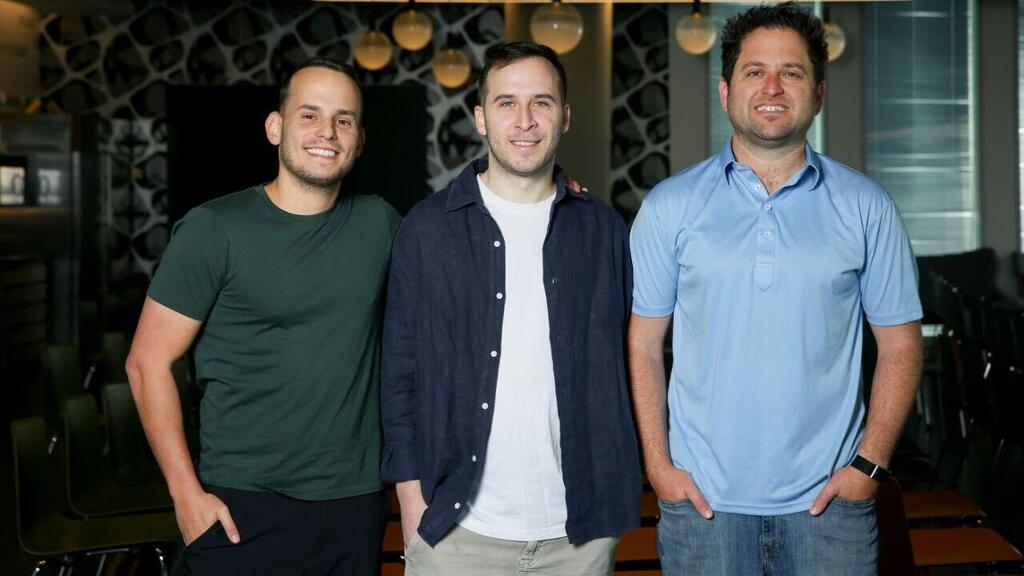
Fusion Fund founders, from left, Guy Katsovich, Amit Shechter, Yair Vardi
(Photo: Courtesy of Maysa)
The report also indicates that while the M&A market in the U.S. and Europe continues to show only modest recovery, Israel presents a markedly different picture. The year 2025 is shaping up as a record year for local M&A activity. Even excluding the landmark Wiz acquisition, the volume and pace of deals in 2025 position it as a standalone record year, underscoring the Israeli ecosystem’s consistent ability to produce companies of high strategic value for global acquirers.
“The Fusion survey also shows that optimism is returning among investors,” said Guy Katsovich. “When asked to define the state of Israel’s venture capital industry on a scale ranging from ‘excellent’ to ‘poor,’ including the option ‘complex,’ 20% of respondents rated it as ‘excellent,’ compared to just 1% who did so last year. 42% defined the situation as ‘good,’ a sharp increase from 24% last year. At the same time, negative assessments declined significantly: ‘bad’ fell from 16% to 5%, and ‘poor’ from 5% to 1%. A similar trend was seen regarding optimism about Israel’s future—74.5% of respondents expressed optimism, compared to just 57% the previous year.”
“We are seeing a reawakening in the formation of new funds, something we haven’t seen in quite some time, alongside a renewed entry of non-U.S. foreign investors whose investments are not driven by Zionist considerations,” said attorney Guy Lachmann, senior partner in the High-Tech Department at Pearl Cohen.
“Assuming there is no geopolitical deterioration that halts this trend, the sense is that the market is about to loosen up,” he also said, adding: “There is currently an abundance of attractive acquisition targets that, after about two challenging years, have transitioned to lean and efficient operating models. At the same time, many are under pressure to sell, in part because existing investors have pulled back or lack the resources to continue investing.
“After the holidays, a shift in sentiment is expected, with an increase in reports of fundraising activity—except in cyber, which creates an optical illusion of an especially strong market,” according to Lachmann. “Sectors that were significantly affected by the geopolitical situation, including digital health, fintech, agri-tech, foodtech, and construction-tech, experienced prolonged stagnation and drawn-out investments, but it now appears that these barriers are beginning to ease.”
Source link