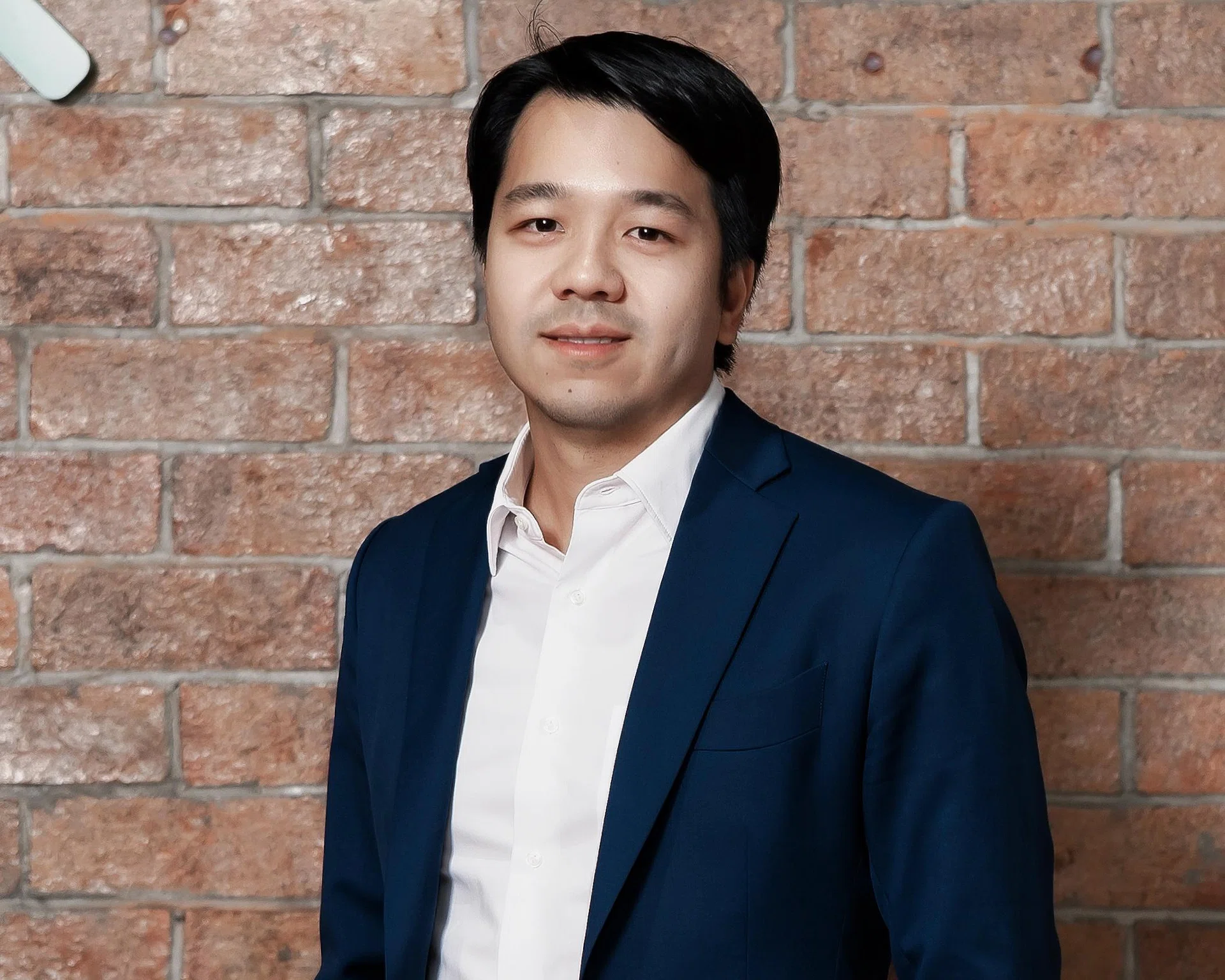
Korawad Chearavanont from Thailand’s CP family is riding the GenAI wave as he tries to turn Amity into an AI powerhouse
Inside Asia’s family empires: How they are transforming to seize the next stage of growth
[SINGAPORE] When you think of tech startups in South-east Asia, consumer tech names such as Singapore’s Grab, Sea, or Indonesia’s GoTo are more often than not top of mind for many people.
Tech startups often find themselves setting up a base in either of those two countries, either due to the size or the connectivity of their respective economies. Indonesia and Singapore are the largest and second-largest economies in South-east Asia.
Yet in the current wave of artificial intelligence (AI) startups, there is one company from Thailand. Its founder and chief executive hails from one of the country’s richest and most established family conglomerates. Like all AI startups, Amity Group is also aiming to make its mark as South-east Asia’s foremost AI company.
“I was always encouraged to go into tech,” Amity’s 31-year-old founder and executive chairman Korawad Chearavanont told The Business Times.
One of his earliest exposures to the industry: a meeting with Jack Ma when he was 10 years old.
Navigate Asia in
a new global order
Get the insights delivered to your inbox.
“My grandfather sent me with a team in 2004 to the Alibaba headquarters to learn from Alibaba and to visit Jack Ma. That was an amazing experience,” Korawad recounted.
A couple of years later, he spent time at his family’s data centre business, and those experiences probably gave him enough education to decide that he could drop out of Columbia University in 2015 to focus on his tech startup.
Korawad explained that he started his own tech company partly due to the family rule that each generation had to “build out their own business from scratch”. This rule was created to counter a Chinese saying that wealth does not last three generations, Korawad said.
SEE ALSO
Korawad is the grandson of Dhanin Chearavanont, the patriarch of the Charoen Pokphand (CP) Group, one of the world’s largest agri-food empires. His dad, Suphachai Chearavanont, is the current chief executive of the CP Group and chairman of the board of True Corporation, a Thai telecom giant.
The CP Group, while arguably best known for its agri-food business, is a diversified conglomerate with interests that include retail, telecommunications, finance and automotives. The conglomerate, which started as a small seed trading company in 1921, is now Thailand’s largest multinational company. According to Bloomberg’s data from December 2025, the Chearavanont family has a net worth of around US$53.3 billion.
“I cannot imagine entrepreneurs that built [a company] without being so close to people who’ve done it and can give you advice on it,” he said.
Korawad is working towards creating a South-east Asia-based tech company that can compete globally in the B2B space.
“There hasn’t really been a global technology company that’s come out of South-east Asia (in the B2B space),” Korawad said. He argued that the size of the region’s economy and demographics pose a challenge to building a global B2B tech player compared to large single markets such as the US or China, and that only the consumer tech sector in South-east Asia has global-level players, such as Sea.
Korawad started Eko in 2012. Eko subsequently became Amity in June 2020 when he acquired ConvoLab, an enterprise chat management platform.
That was arguably the first key moment in Amity’s journey. Touchapon Kraisingkorn, co-founder and CEO of ConvoLab, joined Amity as its chief technology officer and is now the chairman of Amity’s AI Research and Application Center. His work at Amity, particularly on Amity’s generative AI (GenAI) solutions, was highlighted by Microsoft CEO Satya Nadella at Microsoft’s Build Conference in May 2024.
The second key point was the advancements in GenAI developments.
“To be very candid, it took us 10 years to reach US$10 million in revenue,” Korawad revealed. Yet, it took Amity only about two years – from the beginning of 2023 until 2025 – for Amity’s revenue to grow more than 10 times to cross the US$100 million mark. This was in large part powered by GenAI, which became widely accessible to a mainstream audience in late November 2022, when OpenAI launched ChatGPT.
Since then, businesses have clamoured to incorporate GenAI applications in their workflows to boost productivity, or even reimagine workflows with GenAI applications.
Korowad jumped on this opportunity to tweak Amity’s strategy. The group does not look to build the newest AI application; instead, it leverages AI applications to build software and services for companies.
Amity’s strategy
That strategy means Amity looks to acquire companies that deal with a lot of data but may not be fully leveraging it. It can then come in and provide relevant GenAI-driven solutions to optimise that data.
To help execute this strategy, Korawad roped in Keng Teik Koay, who has an operational AI background along with mergers and acquisitions experience. Keng is currently Amity’s group CEO.
One of the more notable acquisitions after Keng joined was Tollring, a UK-based call analytics company which specialises in providing business communications analytics, call recording services, telecoms expense management and fraud detection to over 20,000 businesses across the UK, Europe, the US and Australia.
Both Keng and Korawad, who spoke to The Business Times in separate interviews, said the Tollring acquisition has been win-win.
Amity has been able to integrate its advanced GenAI-backed applications to help Tollring power its voice analytics software solutions, while also bringing software solutions in customer engagement such as an AI-powered chatbot/voice platform. These solutions have resulted in greater insights, enabling Tollring to reinvent its product offerings while addressing customer acquisition and retention challenges.
Amity sees an opportunity to acquire and consolidate complementary software companies in Europe and the UK that are well-run and profitable but whose businesses are at risk of being disrupted by GenAI. It is a core component of Amity’s growth strategy that is expected to deliver at least an incremental 100 million euros (S$150 million) in revenue over the next 12 months.
“Our view is we could buy them at a reasonable valuation and then use the data as well as the customer base to reinvent the solution and bring in a GenAI angle,” Keng said.
He added that Amity is now doing a pre-initial public offering (IPO) round to “clean up” its balance sheet and raise funds for such acquisitions in Europe. The group is currently in the process of acquiring a company with 250 million euros in revenue and 50 million euros in Ebitda (earnings before interest, taxes, depreciation and amortisation); the acquisition is set to happen before Amity goes public.
“What we like about this company is that it has decent profitability and has been well-run, and secondly, it has a great customer base and a lot of data. This company provides communication software to about 250,000 small and medium-sized enterprises across different markets in Europe,” Keng said.
He declined to reveal further details on the company, but added that Amity’s plan is to do an IPO filing in 2026 with a view to listing in 2027.
A US$20 billion tech company
Going public would be an exit for some investors who have been with Amity for a long time, but would not represent an exit for Korawad.
He said an IPO would be an efficient way of raising capital for Amity to then acquire more companies. A successful listing would also arguably bolster Amity’s image by indicating that it is not only succeeding because of a famous founder. Keng, the co-CEO, said that less than 20 per cent of Amity’s revenue comes from CP-related companies.
When asked about what an exit would look like for Korawad himself, he adamantly said that he has never thought of an exit.
“My family has been running an agribusiness for 104 years, so we don’t think about exits. I have the same mindset. We just keep going,” Korawad said.
He hopes that Amity – currently not part of the CP Group – could eventually contribute to it. This would give the conglomerate – which already has interests in tech, telecoms, finance and food – an AI business unit.
He explained that doing so would help the conglomerate to remain “relevant” in the decades ahead. Korawad noted that since 2010, the bigger companies in the world have been tech companies, pointing out that Grab’s market capitalisation is currently bigger than some of the larger conglomerates in South-east Asia.
Yet Korawad acknowledged that such a scenario is still perhaps some way off. He revealed a measure of success suggested by the family patriarch Dhanin: “Little funny tidbit. When I was speaking with my grandfather, he said: ‘You know, if you’re not worth at least US$20 billion, you’re not a real AI company.’”
“And that’s kind of true if you look at OpenAI’s (valuation). So that’s kind of the minimum to qualify as a serious AI company.”
Explore our new series Behind the Name, which looks at how some of Asia’s most influential family empires are evolving to stay relevant.
Decoding Asia newsletter: your guide to navigating Asia in a new global order. Sign up here to get Decoding Asia newsletter. Delivered to your inbox. Free.
Source link