The University of Nebraska System, in partnership with Omaha health care strategy and entrepreneurship support firm CQuence Health, has launched the Steel Works Health Accelerator to help medtech startups grow and stay in Nebraska.
The accelerator is a joint venture between CQuence Health, the tech transfer organization UNeMed and the startup incubator UNeTech Institute. Applications are open until the end of January, with spots for up to six startups. The startups do not have to be affiliated with the university.
Participants will be announced in late February for the 16-week program, meant to take pre-seed incubated companies and prepare them for sales and raising seed funds in the complex world of health care. A second cohort will open for applications in the summer.
“We’ve seen a real need to help develop organizations locally that don’t end up going away and growing somewhere else,” said Kyle Salem, CEO of CQuence Health. The Steel Works accelerator is an attempt to “make sure we can create a strong ecosystem … that will ultimately feed into (Nebraska).”
Tyler Scherr, the licensing specialist and business development manager at UNeMed, said Steel Works came from ongoing conversations between the university and CQuence Health. The accelerator is being piloted with a $75,000 grant from the U.S. Small Business Administration.
“We have a lot of these startups who, they’ve done some business strategy, they have an initial draft of a business plan, they have an initial draft of a pitch deck,” Scherr said. “But they kind of need to put all these pieces together and firm them up.”
The three partners are contributing to the accelerator in complementary ways. UNeMed brings its intellectual property and licensing knowledge, CQuence Health its wide-ranging strategy expertise and UNeTech its prototyping and business development experience.
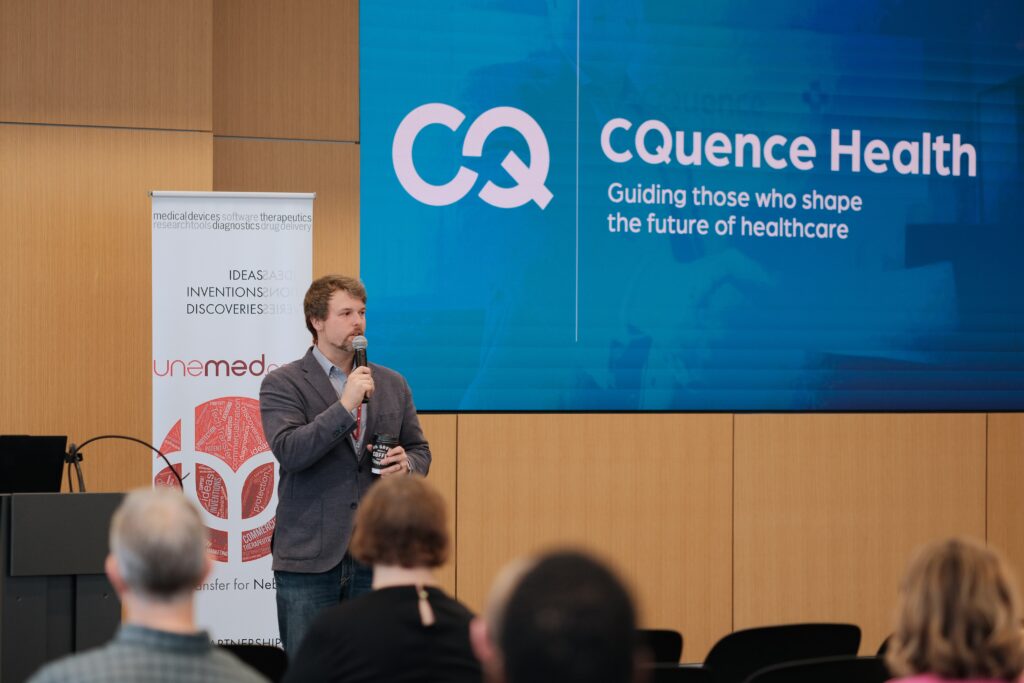
As part of its incubator process, UNeTech has seen the value of outside partners like CQuence to help new companies get off the ground. “Our vision here is, once you get through the incubator, we now are collaborating with more specialized training,” said Stephen Hug, the entrepreneur in residence at UNeTech.
Steel Works will also work with other Nebraska resources, like the Nebraska Startup Academy and the Nebraska Business Development Center. As part of the accelerator, startups are expected to apply for a Small Business Innovation Research grant.
The SBIR program, often called “America’s seed fund,” is a federal program supporting innovation in the country. While dealing with funding uncertainty and the need for congressional reauthorization, advocates are still encouraging Nebraska companies to apply.
By the end of the accelerator, “we want (startups) to feel very solid and then be able to present (business plans) to investors with confidence, and not have as many holes that need poked at that time,” said Katie Paladino, director of growth at CQuence Health. “So they can show up for investor opportunities and gain capital.”
That’s especially difficult for health and medtech startups, Salem said. Solutions that seem easy to implement for startups can be insurmountable for health care providers. And selling a product is not straightforward, as health care is a complex system where potential customers need approval to buy anything.
“You do not have somebody at the other end that is choosing your product … in a lot of cases, you have a solution, and somebody else has to agree to pay for it,” Salem said. “The person in front of you is the one saying it should happen — so who have you sold to … They all have to buy into your product.”
Lev Gringauz is a Report for America corps member who writes about corporate innovation and workforce development for Silicon Prairie News.