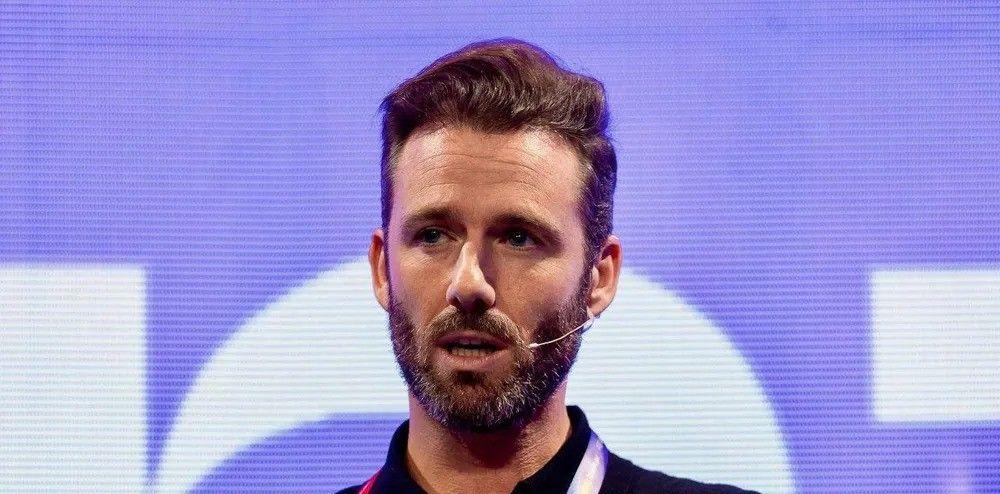
Tiago Costa Rocha (Photo courtesy of maisfutebol.iot.pt)
You can love it or hate it, you can run from it or embrace it…whatever you choose, there is no denying that the artificial intelligence (AI) era is well and truly upon us. And one man who is racing to the forefront of the sports AI industry is Tiago Costa Rocha.
Leaving the Portuguese FA for FULLVENUE
Born and raised in Porto, Rocha saw the Portuguese national team transform from a perennial laughingstock into a European powerhouse over the course of his childhood, and he also watched his boyhood club win the treble in 2004. While Rocha never had much aptitude for playing football, he remained actively interested in working in the football industry. He graduated with his Master’s degree in Porto before heading to Lisbon to work as an IT consultant for Novabase, where he conducted projects for Vodafone’s British, Irish, Turkish, and Ghanaian franchises. This earned him a move to the Federação Portuguesa de Futebol in 2017, where he went from purely technical engineering and business analysis to transforming the Portuguese Football Federation’s digital landscape and breaking into the sports world. And at the end of 2020, Rocha decided to walk away from his job and launch a startup company: FULLVENUE.
“FULLVENUE started after a very interesting period that I had with the Portuguese Football Federation. I was hired as a consultant to manage the digital area and construct all the B2C platforms internally after we won the European Championships in 2016. I was building the e-commerce platform and the ticketing platform, implementing the CRM program, and creating fan websites. All those projects, together with data analysis, showed the huge value that sports properties had on their side that they could then analyze, understand, and monetize,” stated Rocha in an exclusive RG interview.
“FULLVENUE came from this opportunity that I had as a professional on the sports side. It was born with the idea of leveraging the capacity that brands have, looking into their data with technology, in this case, artificial intelligence, and building audiences that will monetize more in terms of merchandise sales, ticket sales, and fan acquisition, all of these kinds of things. The rationale is the first-party data that the brands already own, injecting AI signals to audiences on advertising channels, and monetizing. By increasing the fan base and increasing B2C revenues, everyone gets happier.”
“It was pure uncertainty at first. My mother got totally insane when I told her that I was going to leave the Portuguese FA to launch my project; she was not capable of understanding what it was, while my father just told me, ‘I think that the best solution would be keeping your job in the Portuguese FA, you’ve grown a lot in the past 3 years, but if you decide to go through this, I’ll support you.’ But at the same time, my girlfriend and closest group of friends gave me the confidence to do this, saying, ‘We’ve seen you working, we know that you can do this. We don’t have any guarantee that this will work, but at least you have the work rate and capacity to try to achieve it.’
You need to have huge resilience to manage all the nos that you get from investors and brands, but at the same time, if you say this, if you say that, then you need to refine what you are saying for the next day.”
After founding the company alongside fellow Porto natives Nuno Tavares and Miguel Ribeiro, Rocha initially bided his time sending constant emails to companies, filling out forms, and applying to be a part of startup accelerator programs, meeting with investors, and refining his pitch. He was forced to deal with rejection after rejection until finally getting interest from five different sporting franchises a mere five months after founding FULLVENUE. One of those was a basketball team – 2021 NBA Finals champions Milwaukee Bucks – whilst another was one of the most successful rugby union teams in France: Stade Français Paris. The other three, meanwhile, were all football-related: the Royal Belgian Football Association, Premier League outfit Wolverhampton Wanderers, and Argentine behemoths River Plate in Argentina. Ultimately, only Belgium ended up giving them the green light to go ahead with a Proof of Concept in order to showcase FULLVENUE’s feasibility and validate its approach to AI segmentation.
“All five teams that we spoke to were interested in the product, but we needed to have something from their side: they needed to give us access to all the data that they had from their customers.
From those five, the one that went through with us was the Royal Belgian Football Association. They gave us access to all the information they had on the data side, and we had to spend a month and a half trying to close the deal in terms of data privacy agreements, data processing agreements, non-disclosure agreements, and contracts. We needed to guarantee that we were not making any mistakes, because in this startup world, you need to be fast.
You cannot fail the steps that you are making; you need to do the minimum in case of any breach or problem that can arise. The big brands are often protected because it’s really easy to close a company if you don’t have at least the minimum procedures in terms of Global Data Protection Rules that are running here in Europe. It was the first time for all these things, but having one client was exactly what we needed, because we focused on this case, and worked on it, and transformed this free trial into a paid customer. We went through Belgium to reach other football associations, other clubs, and to start the path that we are on today.”
“We needed to prove value, so we decided to accept the challenge and work on a specific match – a World Cup qualifier, Belgium vs. Estonia – the first match with fans since the COVID-19 pandemic. The idea was that the Belgian Federation would send two sets of emails for two different groups, one of which was generated by FULLVENUE, and the other by the Belgian FA, and measure what happened in each group in order to decide whether or not to continue our partnership. It was really clear that, in terms of the results and the tickets sold, we saw a huge increase with FULLVENUE’s group. Those were the foundations to build this partnership that just kept going, and we kept doing the same thing. Every match, they were telling us which email workflows they had, and we were generating the segmentation. They were telling us which meta campaigns they were launching, we were generating the segmentation, and we continued our partnership through the following years with Belgium.”
Breaking into the Sports AI Industry
Just like that, FULLVENUE had its foot in the door of an increasingly crowded sports AI industry. One and a half years after launching it, Rocha generated his first revenue with FULLVENUE; by 2023, his company was generating around $100,000-$120,000 in earnings. And in January 2024, FULLVENUE announced the completion of a successful seed round that saw it generate €2 million in investment funding, enabling it to expand its personnel. Focused on integrating AI solutions in marketing and consumer optimization solutions, FULLVENUE has utilized its avant-garde software to help businesses monetize their digital presence by spotting high-potential customer groups and targeting their sales outreach to them.
Five years after leaving his stable job with the Portuguese Football Federation to launch his own AI startup, Rocha is now working with a number of federations from Wales, Belgium, Romania, Albania, as well as LaLiga club Villarreal and Liga Portugal outfit Famalicão. However, he’s also branched out from sports, collaborating with the Primavera Sound music festivals in Porto and Barcelona, as well as a number of Portuguese clothing companies like PlayUp and 8000 Kicks. When it comes to maximizing his customers’ sales potential, the proof is in the pudding.
“We are an AI company, we are the audience intelligence powerhouse for brands. Everything related to the audiences that the brands have internally, all the data that they have internally, we will give the companies the capacity to segment, to understand, to activate, to monetize these audiences with a couple of clicks, and this is the difference for a lot of platforms. Everything is automated, whether that’s bringing the data automatically, generating segmentation automatically, integrating automatically in the advertising channel, or managing all the results automatically in the platform itself.”
“We want to be the tool that democratizes the audience’s intelligence for brands selling their products online. At the same time, we want to do it in a really simple way where the outcome of the product is not only determined by increasing the return on investment that we are delivering on the advertising space, but also the time that the marketing team is saving by having this tech tool on their end. They can build and use AI segmentation with a few clicks, which, for a marketer, as you can imagine, is not easy, because they probably don’t know how to use AI or build an AI model to use their data.”
Keen to improve the profitability of Meta Ads campaigns without increasing ad spend, MacStore adopted Clustie, an AI platform developed by FULLVENUE, which specializes in building high-performance audiences for eCommerce. By connecting its Shopify store and Meta Ads account, FULLVENUE was able to leverage Clustie AI and create predictive audiences based on first-party data, identifying customers with the highest purchase propensity and value potential. As a result, MacStore was able to invest more efficiently in high-intent segments, resulting in a 70% increase in Return on Ad Spend (ROAS), a 90% increase in conversions, and an 11% increase in Average Order Value (AOV).
Eyes on the Prize
The Football Association of Wales (FAW), meanwhile, was looking to boost matchday attendance for the women’s Euro 2025 qualifiers in the face of two mitigating factors: a lack of investment and visibility compared to the men’s game. They needed to target high-intent fans, reduce acquisition costs, and drive record-breaking attendance numbers, and with FULLVENUE, they were able to do just that. By analyzing purchasing behavior and engagement trends, FULLVENUE built lookalike audiences based on FAW’s best customers and generated hyper-targeted campaigns on Google and Meta. Together, they reached a historic milestone, setting a new attendance record for women’s football in Wales with over 15,500 match tickets sold, in addition to a 32% decrease in Customer Acquisition Costs (CAC). Last but not least, they achieved the first-ever profitability for women’s football matches in Wales with a positive ROAS.
“In 2023, we were rounding €100/120k in revenue and needed to multiply by 10. After January 2024, when we three raised €2 million to go for at least €1 million in revenue and reach the next investment round – Series A – we’ve gone through two huge processes. The first one was constructing a team that is able to build a product, because when we are talking about venture capital (VC) investment and startups, we are talking about scalable products, we are not talking about consultancy or projects, but products.
We had projects with federations and clubs, and we needed to create a product and a software as a service that everyone can subscribe, test, use, and pay for. During 2024, we were building the team and increasing the revenues at the same time, not multiplying by 10 but by 1.5, growing around 50%, before growing around 70% in 2025. 2024 was building the team, 2025 was building the product, and in the last quarter of 2025, the product went live.”
“Since launching in October, we’ve gotten around 60 app installations, and our goal is to end 2026 with 300 active Shopify stores using our Clustie software as a service. If we are able to do this, we will multiply our Annual Recurring Revenue (ARR) by 3 and will be ready to raise the Series A. This is the journey, and it needs to be clear to everyone, which is why we try to have monthly catch-ups with the entire team, apart from the ones we have with the management, where we say clearly where we are in terms of the revenues that we are generating, and where we need to go. It has been a crazy journey, but really, really interesting, and really good for those who like to embark on these risky journeys.”
“There’s a lot that we need to improve on in terms of the perceived value from the user’s experience when they’re using the product. In terms of the outcome, it’s clear that we’re increasing sales and returns, but the value when you are using the product needs to be much better, so we need to develop our product a lot. We evolved from a project company to a product company between 2024 and 2025, so it was a full transformation in the mindset of everyone. I believe the problem with all the brands is the scalability, the way that you transform the leads that your marketing team is generating into sales that you are creating for your product, so this kind of internal process needs to be refined.”
“In terms of the product itself, right now, we are integrating with Shopify and Meta. You have these two platforms, one on the left side, one on the right side, and Clustie in the middle, but we want to go for more. We want to go for Google, and we are already developing this integration and testing with some customers, and it’s going live in February.
We want to go for TikTok, we want to go for Snapchat, we want to have more e-commerce platforms than just Shopify integrated with our product. There is a vision of expansion that we want to bring to the product, but only after proving that the product itself is working. If it works with Shopify, the fastest growing e-commerce platform in the world, if it works with Meta, the platform where most brands are investing in terms of paid social media, it will work with any other platform.”