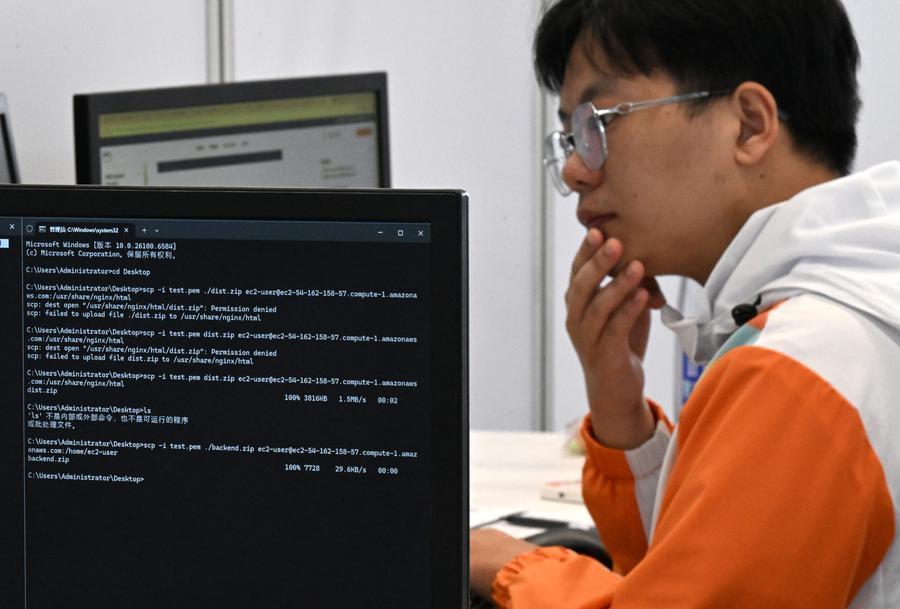
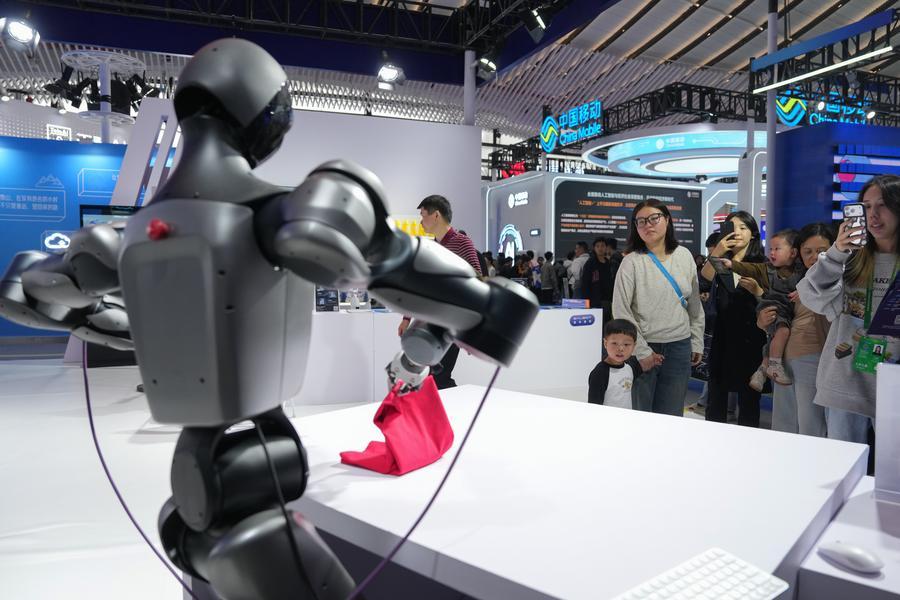
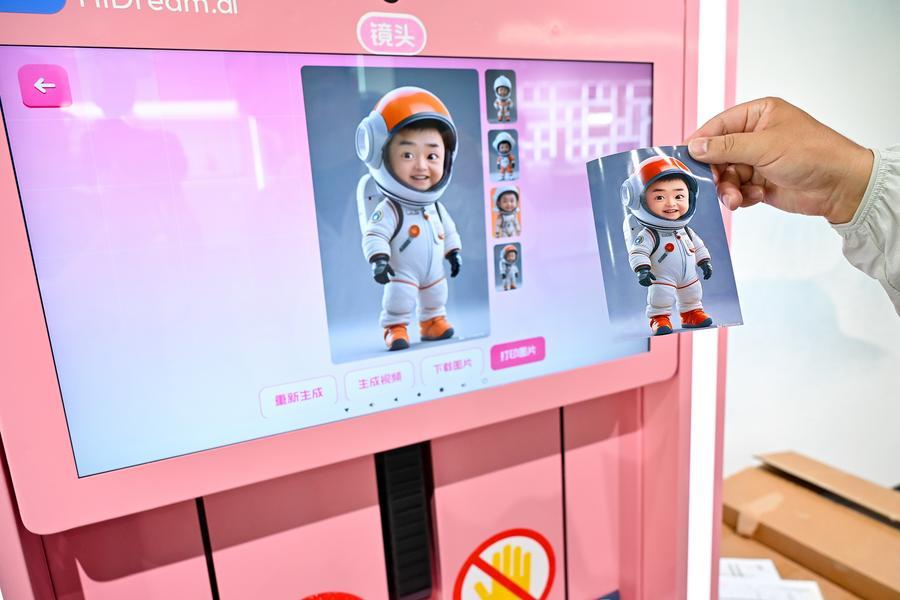
BEIJING, Feb. 4 (Xinhua) — The widespread rise of AI is modifying China’s labor market in ways that go far beyond job replacement or creation. It has generated new professions, lowered the threshold for starting a business, and empowered employees to upgrade their skills in a bid to stay competitive.
At Xunfei Healthcare’s office in Hefei, capital of east China’s Anhui Province, Hu Pingping, a former doctor specializing in stomach and gut diseases, spends her days analyzing how a medical large language model diagnoses complex cases. Having transitioned into an AI trainer five years ago, her new profession merges clinical expertise with cutting-edge AI technology.
This shift also mirrors a broader evolution within China’s professional landscape. As AI integrates into every sector, there has been a rapid emergence of new roles like AI content annotator, AI product manager and AI-assisted animator.
According to PwC’s 2025 Global AI Jobs Barometer, nearly all AI-related positions are increasing globally, and workers with AI skills command a wage premium of 56 percent, up 25 percent from the previous year.
Data from online recruitment platform Zhaopin shows that in the fourth quarter of 2025, job openings in China’s AI sector grew by 19 percent year on year, led by algorithm engineers, machine vision specialists and robotics algorithm developers.
“AI is pushing the labor force toward higher value-added roles centered on human-machine synergy and intelligent augmentation,” said Liu Cong, head of the Chinese AI firm iFLYTEK’s research institute.
With humanoid robots joining production lines, smart equipment running through farmlands, and AI models increasing work efficiency in newsrooms, there are also concerns about AI being a potential job killer.
The fast iteration of AI technology is shortening career lifecycles and challenging the traditional idea of “mastering one skill for a lifetime,” with some workers finding it hard to transition into new professions.
Industry experts say in this context, accelerating the renewal of knowledge and skills to meet the demands of new technologies and changes in the labor market has become crucial.
This wave is reaching the legendary Hanzheng Street, a 500-year-old commercial center located in central China’s Wuhan, known as the first small commodity market run by self-employed and private businesses after China’s reform and opening up in 1978. An AI training session in January this year attracted over 50 local apparel business owners to this area in the capital city of Hubei Province.
“The enthusiasm was incredible,” said Wang Ruijue, the AI training program organizer, pointing to late-night sign-ups in his WeChat group. Attendees ranged from post-00s designers seeking to update their traditional craft to veterans born in the 1970s, one of whom brought a postgraduate daughter along to assist with learning how to use this new tool.
Yang Jian, a fashion designer-turned AI entrepreneur, served as their instructor. He sees AI a “super tool” in revolutionizing the apparel chain, from design and manufacturing to marketing.
Since large apparel enterprises are already mature in terms of AI adoption, Yang has dedicated his efforts to helping small and medium-sized firms use AI to improve their businesses.
On this old street in Wuhan, both tech-savvy youth and middle-aged business owners are now joining the AI learning journey, embracing not just a new tool for work but a new culture of lifelong learning.
AI, notably, is also lowering entrepreneurial barriers in China.
An example is the rise of One Person Companies (OPCs), where individuals leverage AI tools for content creation, operations and service delivery. Cities like Suzhou in east China’s Jiangsu Province are promoting themselves as OPC-friendly hubs.
Industry insiders believe that this OPC rise is mainly driven by widespread adoption of AI technology, supportive local policies and platforms, and a growing talent pool.
Wei Qing, Microsoft China’s chief technology officer, said that as AI becomes as commonplace as electricity and the telephone, using it to launch ventures and solve real-world problems is turning into an essential skill. Also, evolving applications like AI agents are making it possible for “one person to function like a full team.”
With AI generating content at a staggering speed, one could be tempted to question if anything remains uniquely human in today’s workplace. Experts respond to such musings by pointing to imagination, aesthetic sense, critical thinking and emotional intelligence as irreplaceable human advantages.
A “slash career,” which refers to a working life revolving around multiple professions, will be important for future employment, said Zhang Junping, a professor at Shanghai-based Fudan University.
“Employees must avoid relying on a single skill or a single profession,” Zhang explained, adding that since AI shortens the path from novice to expert, people have to develop comprehensive capabilities to enhance their capacity to withstand risks in terms of employment.
Zhang suggested including “AI thinking” in youth education, but at the same time also cautioned against “over-reliance on AI,” stressing that priority should be given to exercising independent learning and cultivating unique imagination.
China’s national initiative, known as “AI Plus,” proposes support for AI skills training to stimulate innovation and entrepreneurship, while also boosting the potential to secure re-employment. Departments including the Ministry of Industry and Information Technology also issued a document outlining measures such as conducting forecasts for talent demand in the AI industry, releasing talent demand forecast reports, and supporting higher education institutions in planning and optimizing relevant disciplines and programs.
Minister of Human Resources and Social Security Wang Xiaoping said China will accelerate efforts to build a monitoring, early-warning and response system for AI’s impact on employment and follow an employment-friendly technology development path. ■
Source link