Prediction
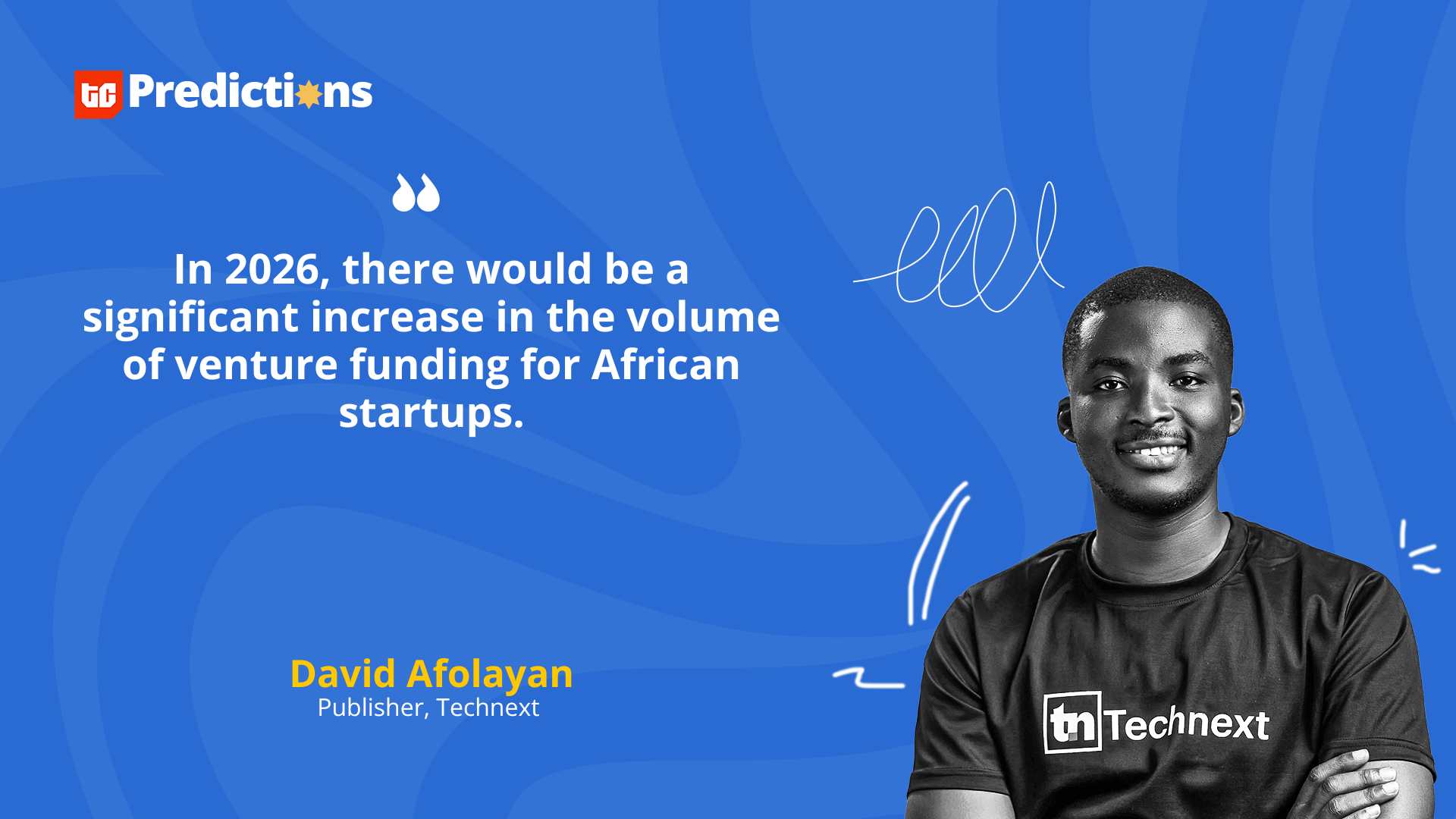
There would be a significant increase in the volume of venture funding for African startups in 2026. Last year, startups on the continent raised a total of $3.2 billion, the highest the continent has seen in the last three years and a significant 40% increase from the total of $2.2 billion raised in 2024.
Supporting Evidence
My prediction is predicated on the fact that the upward trend succeeds two consecutive years of decline (-35% YoY in 2023, -25% YoY in 2024). The trend suggests that the funding dip of the previous years is much more about market correction rather than a definitive decline for the ecosystem, especially for fintech.
Notably, the funding announcements that constitute the bulk of the total sum were raised by startups that operate in non-fintech sectors.
Leading the pack is Spiro with a $100 million raise, one of the continent’s two largest e-mobility raises (alongside Moove’s $100 million Series B in 2024). Similarly, Egypt’s cleantech startup, Tagaddod, raised $26.3 million in a Series A round. The startup uses technology to collect, trace, and certify renewable waste-based feedstocks such as used cooking oil, acid oils, and animal fats.
Similarly, South African startup Ctrack raised $23.4 million in equity funding. And, Mawingu, a Kenyan internet service provider (ISP) focused on connecting underserved communities, secured $20 million in a Series C round in October.
And, the list goes on. Terra’s $11.75 million seed fund announcement punctuates this new wave of foreign investors’ backing startups that play in previously less visible markets.
Nigerian fintech raised $230 million in 2025. On paper, that’s a 44% drop from the $410 million raised in 2024. Yet, the fintech sector has, in response, adopted an M&A-led consolidation trend, as seen with Paystack’s acquisition of Brass and Flutterwave’s acquisition of Mono.
This trend will enable the ecosystem to recycle talent and assets into more efficient models.
Risk Factor
First, the ecosystem significantly depends on large cheques from foreign VCs. Going forward, it requires a blend of multiple funding sources, especially local players that have the privileged capacity to prove value at every stage. As Tomi Davies, CiC at TVC Labs, said: “The ecosystems that thrive will be the ones that learn how to finance growth with multiple tools, not just one cheque size.”
Secondly, founders must outgrow the youngster phase and live up to investors’ trust. What we have witnessed is a pattern where a new batch of funds discovers African founders who sell the dream, raise money on the promise of the continent, but spend the capital in a questionable manner.
The next cohort of investors will likely seek founders who have answered harder questions about genuine value creation. The shift from vanity metrics to profitability is no longer optional; it is now a necessity.
In all, what is certain is that the companies that figure out the right answer won’t just survive 2026. They will thrive and define what African fintech becomes for the next decade.
Who is David Afolayan?
David Afolayan is the cofounder, publisher, and content chief at Technext.ng, one of Africa’s leading technology news platforms. He co-founded Technext in 2017 to amplify African tech stories and has overseen its growth into a widely read outlet covering tech policy, startups, innovation, and industry analysis.
Afolayan is a tech journalist and digital communications strategist with nearly a decade of experience in content strategy, branding, and media production. His work spans reporting, editorial leadership, and consulting for technology, banking, and corporate organisations.