PlayerData, a lower-cost option for athlete load monitoring, has released the smallest indoor/outdoor tracking unit just a few months after raising a seed round led by Darco Capital and Bolt Ventures, the family office of serial sports owner David Blitzer.
Other strategic investors in the Techstars-backed company include Pentland Ventures, Accelerate Ventures, Hiro Capital, and angels who previously invested in Strava and Revolut.
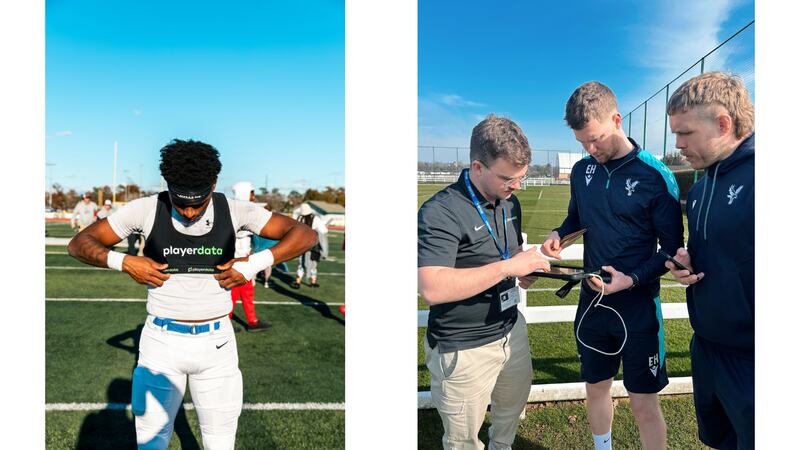
PlayerData’s new product, the Edge Air Tracker, is about half the size of competitors, and it combines GPS and LPS tracking, the latter an indoor alternative when satellite coverage is not available. The LPS system uses portable beacons that the company says can be set up in less than an hour. The Edge Air Tracker received the higher-standard FIFA Quality certification this summer.
“We had to build it in a PlayerData way: easy to use, fits in a backpack, mobile and affordable,” said CCO Jess Brodsky. “What gets us going is we get to give something to people that is just as elite quality — we don’t sacrifice on data quality — but to everybody.”
The founding story is that, a decade ago, University of Edinburgh student Roy Hotrabhavanon had fashioned his own training tech to compete in archery by taking parts from consumer box retailers. Realizing there was little business upside in a niche sport, he sought to build for soccer instead, discovering there was a market gap particularly for grassroots, academy, university and women’s clubs who didn’t have the budget for an incumbent system such as Catapult or StatSports.
PlayerData is ubiquitous in the UK, where it records data from 94% of the country’s soccer pitches, Brodsky said, noting that the total includes the Premier League because its officials wear the monitoring devices during matches. The startup moved into the US market about two years ago, and Brodsky said the company has doubled or tripled its ARR (annual recurring revenue) in each of the past five years, building up to about 60,000 sensors in the market.
One of the biggest recent additions to the client roster is IMG Academy, where nearly 1,000 student-athletes will use the technology. The soccer program will install solar-powered beacons around all 15 soccer fields, and PlayerData and IMG will collaborate on developing and soft-launching sport-specific experiences in the app for volleyball and softball.
Abi Goldberg, an assistant strength and conditioning coach at Rutgers, supports the men’s and women’s soccer program whose seasons are concurrent, meaning she is balancing the training needs of both with little overlap. The use of PlayerData with both teams, Goldberg said, is helpful because the hardware and software systems are “incredibly user-friendly,” allowing her to review the data and communicate it the coaches even if it’s just a short window between their practices.
Often, each team’s director of operations will be tasked with overseeing PlayerData use at road games, but Goldberg said the tech doesn’t require an S&C professional to manage. She has even loaned devices to a few of the athletes for use in the offseason.
“Most GPS systems are in a big heavy briefcase-looking thing — I think there’s some been security nightmares in the airport — but these are way more compact,” she said. “They can put it in their backpack.”