Hospitals are cautious buyers. Clinicians are stretched thin. Regulators move at their own pace. And investors, understandably, want to see traction before they commit.
This is the wall healthcare innovation typically runs into. And, it is the wall that ISB DLabs built I-HEAL to dismantle.
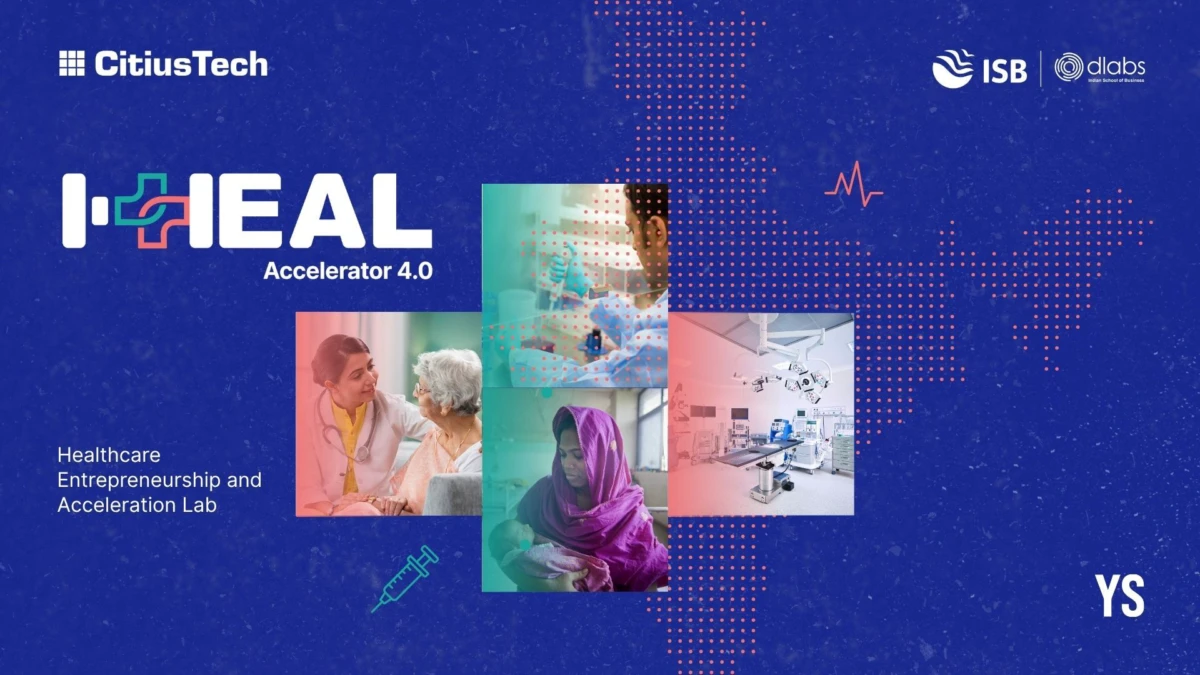
The I-HEAL (Healthcare Entrepreneurship Acceleration Lab) program, an initiative of ISB DLabs, powered by CitiusTech, has become one of the more serious bets on healthtech entrepreneurship in the country. Startups that entered with a product, and no clear path to market have left with hospital introductions, investor meetings, and, in several cases, cheques.
Over 4 years, I-HEAL has worked with more than 60 startups across digital health, women and child healthcare, disease diagnostics, healthcare infrastructure and management, and geriatric care. Collectively, they have raised upwards of Rs 190 crore, met with over 180 investors across more than 900 meetings, and, in many cases, made it past the hospital gate.
Those are the numbers. But numbers in healthcare, more than most sectors, need context.
The funding reality
Healthcare is one of the harder sectors to raise money in. Sales cycles are long, clinical validation is non-negotiable, and investors who do not know the space well tend to stay away. The ones who do know it want to see a startup that has moved beyond the pilot stage and can show a credible path to a paying customer.
That is the cohort I-HEAL has consistently worked with, and it is part of why the funding numbers have held up across four cohorts. Not every meeting converts, and not every startup that raises capital will make it. But the breadth of investor engagement the program has built, across digital health, disease diagnostics, women and child healthcare, healthcare infrastructure, and geriatric care, points to a pipeline that is increasingly taken seriously by the people writing cheques.
Solving the hospital access problem
Funding is one thing. Getting a healthcare startup through the doors of a hospital is another problem entirely. Procurement cycles are long, clinical buy-in is hard to secure, and the distance between a product that works and one that actually gets deployed inside a healthcare system can stretch into years.
More than 60 startups have found their way to real market opportunities through I-HEAL, with the program facilitating introductions between startups and hospital partners that go beyond pitch meetings into the harder question of deployment.
CitiusTech’s involvement matters here. As one of India’s leading healthcare technology companies, with roots in clinical systems and hospital infrastructure, it gives startups access to a partner that knows, from experience, how healthcare organizations actually evaluate and adopt new technology. That kind of access is not something most accelerators can offer.
“Healthcare innovation doesn’t fail because of a lack of ideas-it stalls at the point of adoption. With I-HEAL, our focus has been to help startups cross that last mile, where clinical validation, hospital workflows, and real-world deployment intersect. Market access, in this context, isn’t introductions-it’s integration,”said Saumya Kumar, CEO, DLabs and Director, ISB I-Venture
Bridging the gap
Perhaps the least visible part of what I-HEAL has done is the work beyond the startup itself. More than 300 healthcare professionals, including over 150 doctors, have been trained through the program’s digital training sessions across Hyderabad and Bengaluru, with the focus squarely on AI in healthcare and care delivery. These are areas where the gap between what technology can do and what clinicians feel comfortable using is still very wide.
Thirteen digital health solutions have been put in front of the practitioners who would actually have to use them, in real clinical settings rather than on a conference stage. The feedback that comes out of those interactions shapes products in ways that investor meetings simply cannot. A clinician pointing out that a workflow integration does not hold up in practice is, at that stage, more valuable than another introduction.
Building the ecosystem, not just the cohort
Running an accelerator addresses one part of the problem. But innovation ecosystems do not get built through accelerators alone; they need platforms that create visibility at the top and surface new ideas at the bottom.
The Healthcare Conclave, now in its second year, is I-HEAL’s bet on the former. It brought together 2,300+ attendees, 97 speakers, 64 startups, 18 panel discussions, and 15+ product launches. It is, by most measures, one of the larger healthtech gatherings in the country, and one of the few that puts founders, investors, clinicians, and policymakers in the same room – at the same time.
HackFest, I-HEAL’s annual healthcare hackathon, works at the other end. Problem statements come directly from doctors and hospital partners, which keeps the exercise grounded in actual clinical need. 320+ applications came in. Fourteen solutions were identified as worth developing further, some of which will likely find their way into future cohorts. It is, in effect, how I-HEAL keeps its own pipeline honest.
What four cohorts really prove
What ties it together is a fairly straightforward approach. Healthcare startups need capital, guidance, and a real path into the market, and none of these work well in isolation. Four cohorts have tested that idea against reality. The results suggest it holds, at least well enough to matter.
The gap between healthcare innovation and healthcare adoption in India is not going to be closed by any single program. I-HEAL has not claimed otherwise. What it has done, across 102 startups and four years, is give a growing number of founders a more credible shot at crossing it.