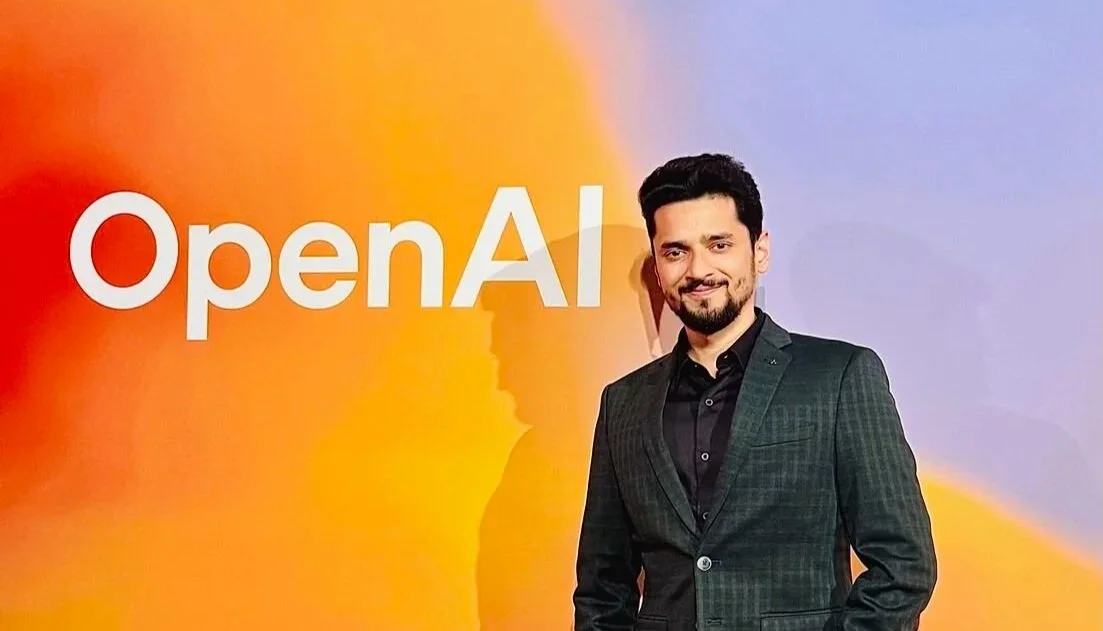
OpenAI has appointed Arjun Gupta as its first Solutions Architect in India, marking a formal expansion of its on-the-ground support for startups building with GPT, multimodal systems, and agent-based AI.
Gupta, formerly Co-Founder and CTO at AuraML, announced the move on LinkedIn, where he said he has joined OpenAI’s go-to-market team to help founders move from prototype to production. The appointment reflects growing demand in India for architectural guidance as AI adoption shifts from experimentation to scaled deployment across enterprise and startup ecosystems.
“I’m starting a new chapter. I’ve joined OpenAI as the first Solution Architect in India (GTM team),” Gupta wrote in his post.
From Founder to Solutions Architect
Gupta previously led AuraML, a generative robotics simulation and synthetic data startup that raised $1.23 million in funding and worked with partners including NVIDIA, AWS, and GCP. His background includes building cloud-native infrastructure, training models, and deploying production pipelines across AI and machine learning systems.
In his announcement, Gupta emphasized experience building end-to-end systems. “Over the last few years, I’ve built AI systems from 0 to 1. Scaling infra, training models, deploying production ready pipelines, working with real customers,” he wrote.
He added that his role at OpenAI will focus on helping startups do the same using OpenAI models. “I get to help startups do the same but with OpenAI models at the core.”
Focus on scaling beyond prototypes
Gupta outlined priorities that center on practical execution rather than experimentation.
“What excites me most:
• Working closely with founders building real AI products, not just demos
• Helping teams move from prototype to production reliably
• Designing architectures that actually scale with usage
• Bridging deep technical capability with business outcomes”
The comments align with a broader shift in the AI ecosystem. As access to large language models becomes more widespread, differentiation increasingly depends on deployment strategy, infrastructure design, cost management, and system reliability. “India is in a unique position right now. Talent is strong. Ambition is high. The tooling has never been better,” Gupta wrote.
He also invited founders building with GPT, multimodal systems, agents, or applied AI workflows to connect for deeper discussions on architecture and scaling.
A deeper regional play for OpenAI
OpenAI has expanded its global presence through enterprise partnerships and developer programs. Establishing a dedicated Solutions Architect in India signals a more localized approach to supporting high-growth teams navigating production deployment. India’s developer base and startup density create distinct scaling challenges, particularly in cost-sensitive and infrastructure-heavy environments. The role suggests OpenAI is positioning itself closer to execution, not just model access.
As applied AI matures across sectors including education, workforce skilling, and enterprise automation, the focus is shifting toward operational readiness. Gupta’s appointment places OpenAI directly inside that transition.
ETIH Innovation Awards 2026
The ETIH Innovation Awards 2026 are now open and recognize education technology organizations delivering measurable impact across K–12, higher education, and lifelong learning. The awards are open to entries from the UK, the Americas, and internationally, with submissions assessed on evidence of outcomes and real-world application.