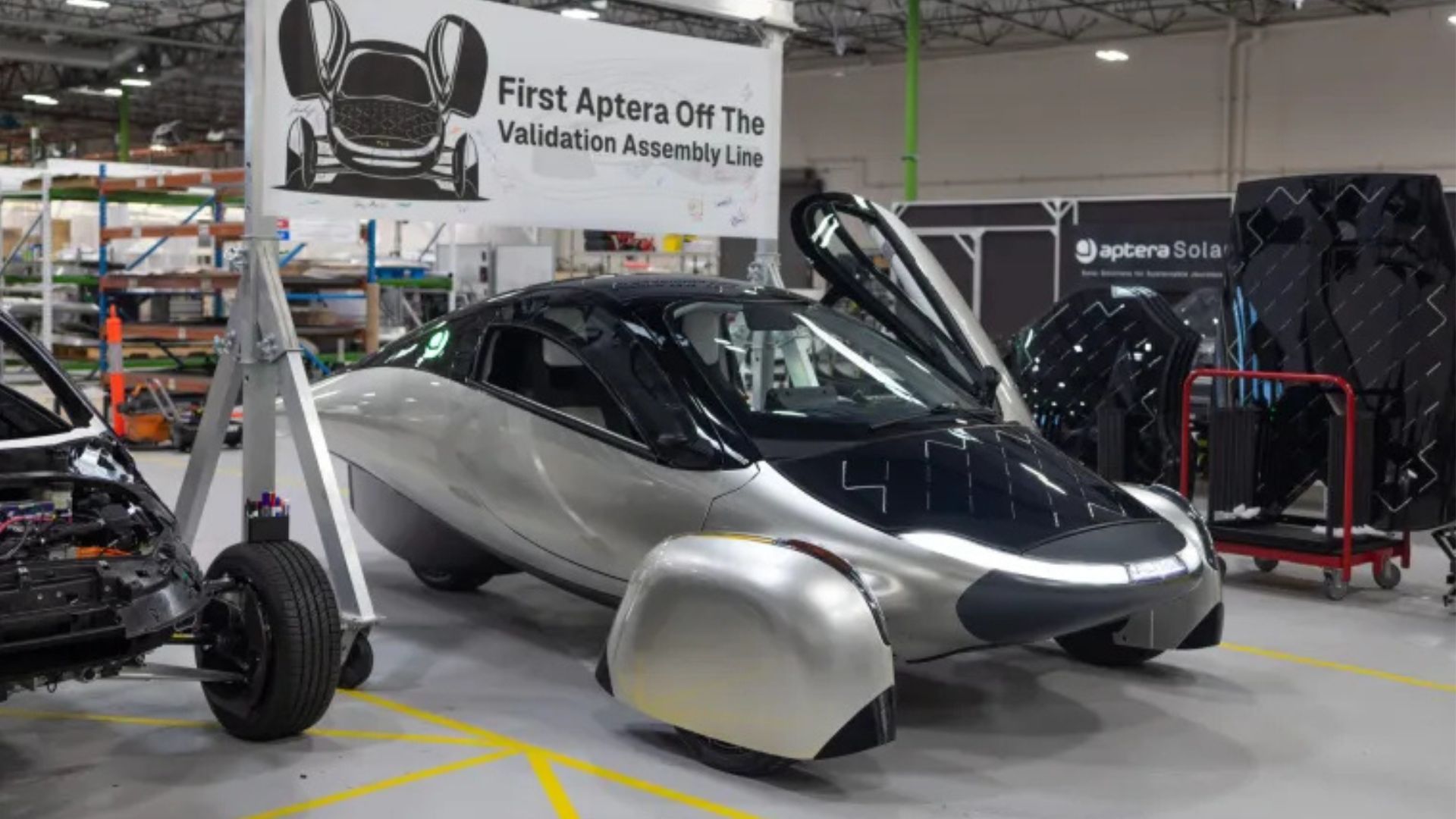
US solar mobility startup Aptera has rolled out the first solar-powered electric vehicle (sEV) of its assembly line in California.
According to the San Diego-based company, the milestone marks a key step toward regulatory certification and initial customer deliveries.
The milestone signals the company’s shift from hand-built prototypes to a structured, 14-station production process designed to ensure repeatable builds and quality control.
Vehicles from the new line will undergo thermal, brake, and destructive testing as Aptera advances toward self-certification, EPA approval, and the launch of its ultra-efficient solar electric vehicle.
In March 2025, Aptera completed the first round of real-world validation testing for its solar electric vehicle, evaluating efficiency at a Mojave Desert proving ground.
From prototype production
Aptera’s start of production on its low-volume validation assembly line marks its shift from hand-built validation vehicles to a structured manufacturing process.
The new line includes 14 dedicated stations staffed by vehicle line technicians to enable repeatable builds, process verification, and production optimization. Vehicles produced on the validation line are assigned to testing programs, including thermal validation, brake performance evaluation, and destructive testing. These activities support the company’s progress toward regulatory self-certification and EPA certification required for customer deliveries.
“These first vehicles will be used to complete the key tests and optimization required to sell our first vehicles to customers,” said Steve Fambro, Co-CEO of Aptera, in a statement.
The validation line is also being used to verify and refine installation procedures for major vehicle systems. The process allows the company to optimize build sequences, improve assembly methods, and adjust station layouts ahead of planned series production.
According to the firm, it has also expanded hiring in assembly and integration roles, making manufacturing its largest functional team as it transitions from engineering development to testing and production execution. Additional vehicles are scheduled to be produced in the coming weeks to expand the validation fleet and advance certification milestones.
Decade-long journey
Aptera has spent more than a decade pursuing its vision of transforming electric mobility, facing repeated delays and technical setbacks.
The company first unveiled its Typ-1 electric vehicle concept in 2007 and began an initial production attempt in 2009, which later stalled. The project was revived in 2019 with plans to launch production in 2022, but further challenges delayed progress.
During 2025 testing, the sEV required more than three minutes to coast down from 60 mph (97 km/h) to a complete stop while traveling uphill, highlighting its low aerodynamic drag. The company said the coast-down performance exceeds that of conventional gas and electric vehicles. Engineers also conducted tuft testing on wheel fairings and panel gaps to validate real-world airflow against computer simulations, refining aerodynamic efficiency and vehicle fit.
Extended highway drive tests covering hundreds of miles showed the firm’s simulation models predicted real-world energy use within a few percent. Integrated solar panels can generate up to 24 miles (38 kilometers) of daily range under ideal sunlight. The vehicle offers up to 400 miles (643 kilometers) of range with fast charging in under an hour, with a 1,000-mile (1609 kilometer) variant planned. Top speed is rated at 101 mph (162 km/h).
The company reports nearly 50,000 vehicle reservations, representing more than $2 billion in potential revenue, and is targeting initial customer deliveries later this year.