In March 2021 I sat on national television and said we were at the precipice of a quantum shift.
AI was removing task-based roles. The organisations that would survive were the ones with leaders who had already learned to deliver results in chaos and constraint.
The interviewer moved on. The segment ended. The world kept going.
I had started my business five years earlier on a single conviction: that the operators building startups from nothing were a different calibre of leader entirely, and that the conditions they worked in were not a startup quirk but a preview of how every organisation would eventually have to operate.
Last week, that prediction arrived. Not gradually. All at once.
Five days that changed the conversation
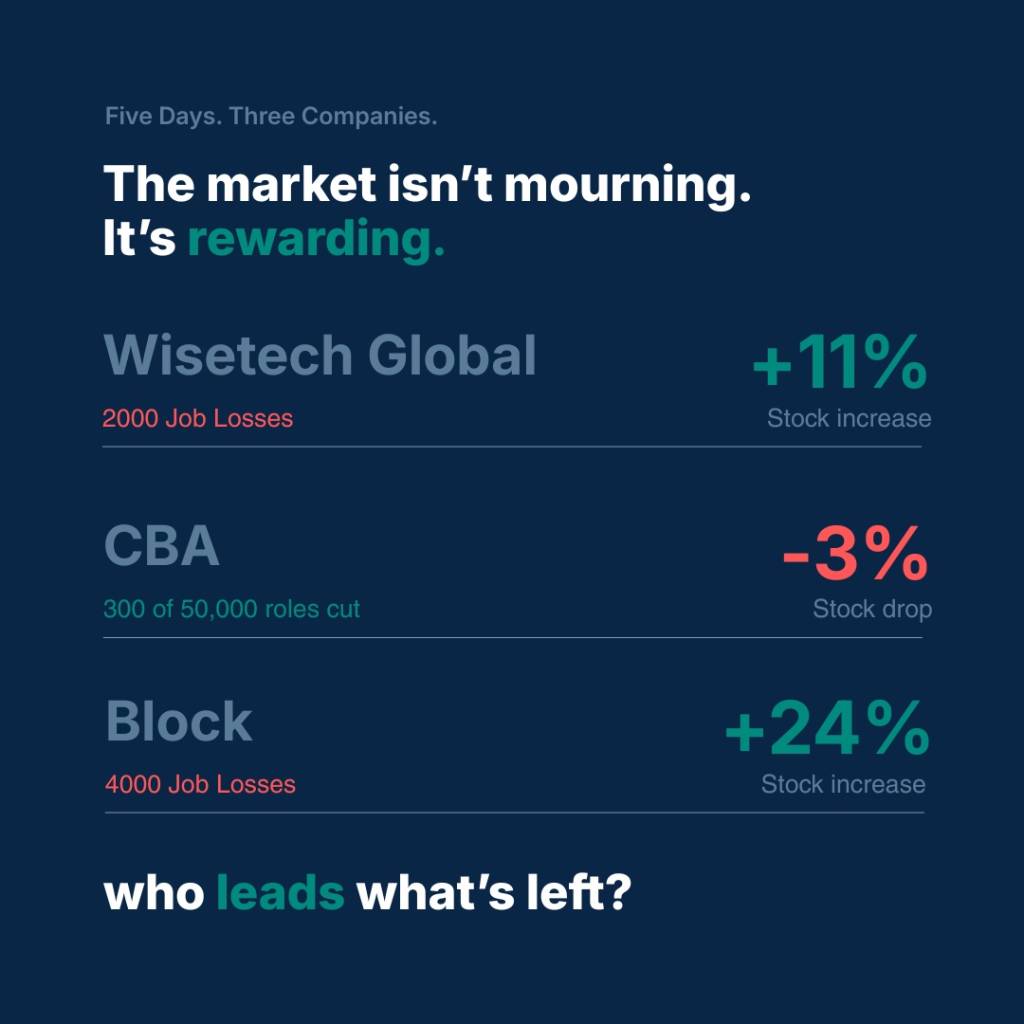
On Tuesday, WiseTech Global, the Sydney-based logistics software company, announced it was cutting 2,000 jobs, nearly a third of its global workforce across 40 countries, as part of a two-year AI-driven restructure. Some teams, including its recently acquired US cloud division E2open, face cuts of up to 50%.
The same day, Commonwealth Bank confirmed 300 technology roles were being eliminated. WiseTech’s stock rose 11%. CBA’s investors barely flinched.
On Thursday, Block announced it was reducing its workforce from just over 10,000 to under 6,000. More than 4,000 people told to leave. Stock up 24%.
In his letter to shareholders, Block CEO Jack Dorsey was unambiguous about the reason. “Intelligence tools have changed what it means to build and run a company. We’re already seeing it internally. A significantly smaller team, using the tools we’re building, can do more and do it better.” He was equally direct about why he acted decisively rather than gradually: “Repeated rounds of cuts are destructive to morale, to focus, and to the trust that customers and shareholders place in our ability to lead.”
WiseTech CEO Zubin Appoo was just as plain. “The era of manually writing code as the core act of engineering is over.”
These are not euphemisms. They are executives stating, on the record, that their previous headcount was a legacy of how organisations used to have to operate, and that AI has made that model obsolete. The market agreed, loudly, both times.
The Substack post that broke the SaaS market
Before Block and WiseTech made headlines, something else happened that most people outside financial markets missed.
Over the weekend of 22-23 February, a 5,000-word Substack post by Citrini Research went viral.
Titled “The 2028 Global Intelligence Crisis,” it was written as a fictional retrospective from two years in the future, laying out a scenario in which AI adoption triggers a cascade of white-collar job losses that eventually crashes the S&P 500 by 38%.
Co-authored by James van Geelen and Alap Shah of Lotus Technology Management, it described itself as a thought exercise, not a prediction. The market treated it as something closer to a diagnosis.
On Monday 23 February, enterprise software stocks were obliterated. Salesforce, ServiceNow, Adobe, and Workday each dropped 7% or more. Intuit fell nearly 11%.
The Dow Jones shed 800 points in a single session. The iShares software ETF hit a new 52-week low, down nearly 30% year to date. Michael Burry amplified the post on X with three words: “And you think I’m bearish.”
The mechanism Citrini described is worth understanding because it is not theoretical. It is already playing out. AI reduces human headcount. Fewer humans means fewer seat licences. Fewer seat licences means SaaS revenue contracts. SaaS companies cut their own staff to defend margin.
That compounds the white-collar job losses across the broader economy. The companies that built the software economy are being disrupted by the same force that is disrupting their customers.
WiseTech’s CEO confirmed the loop is real when he announced they were abandoning seat-based pricing entirely, moving to a transaction model so that their revenue is tied to throughput, not headcount.
“For SaaS businesses that monetise on seats or users,” he said, “AI will disrupt them.”
He said the quiet part out loud, on an earnings call, in front of investors. The share price went up.
What last week actually means
Taken individually, each of these events can be explained away. Block had over-hired during the pandemic years. WiseTech had specific structural pressures. CBA is a bank making incremental efficiency decisions. The SaaS selloff was partly driven by a fictional scenario in a finance newsletter.
Taken together, they describe something that is no longer possible to dismiss as a series of isolated incidents.
US companies announced 108,000 layoffs in January 2026 alone, up 118% from a year earlier, the highest figure for any January since 2009. At the current rate, 2026 is on track to produce 270,000 tech job losses, outpacing 2025 significantly. And unlike the post-pandemic correction of 2023 and 2024, which was primarily about reversing over-hiring, this wave is structurally different.
Organisations are not cutting to get back to normal. They are cutting to operate in a way that was not previously possible.
The share price data makes this distinction clearly. When a company cuts staff because it is in financial distress, the market punishes it.
When it cuts because AI is enabling it to produce the same or better output with fewer people, the market rewards it.
Block was not in distress. Its gross profit grew 24% in the quarter it announced the layoffs. WiseTech reported a first-half profit 6% ahead of market consensus on the same day it announced 2,000 redundancies.
These are not companies retreating. They are companies accelerating by removing what AI has made redundant.
The decade that built toward this moment
To understand where we are going, you have to understand what the last ten years were producing.
While the corporate world ran innovation labs and debated digital transformation roadmaps, the startup ecosystem was running a live experiment in what organisations look like when you strip away every layer of process, every committee, every role that exists because it has always existed.
Startup founders had no choice but to operate this way. You hire for outcomes because you cannot afford to hire for credentials and find out later the outcomes are not there.
You make decisions fast because slow decisions are fatal. You run lean not as a philosophy but as a survival condition.
You become AI-native not because it is a strategic priority but because it is the only way to close the resource gap between a twenty-person company and an incumbent with a thousand.
That environment, compounding over a decade, produced a specific kind of executive. Someone who can run a function without a team behind them.
Who makes irreversible calls with incomplete information. Who does not need conditions to stabilise before they can perform. Who treats the absence of process as an advantage to be exploited rather than a problem to be solved.
The corporate world largely dismissed all of this as the chaotic behaviour of companies that might not survive. Some did not.
But the ones that did produced a generation of operators that every restructuring organisation now needs and most have no idea how to find.
The question nobody is answering loudly enough
The restructuring decision is easy. A board can make that call in an afternoon.
The hard question is what comes next. When you take headcount from a thousand to five hundred, when you collapse three functions into one, when you rebuild around AI as infrastructure rather than AI as a feature, the people who remain need to operate at a level that most of them have never been asked to reach.
They need to make decisions that committees used to make. Lead teams at a pace that large organisations were never designed to move at. Deliver results without the systems and structures that their entire careers were built around.
AI does not eliminate the need for exceptional leaders. It eliminates the buffer that average leaders used to hide behind.
The layers of process, the large teams, the slow cycles that kept organisations running despite mediocre leadership at the top. All of that is being stripped away.
What remains is a direct line between the quality of the person at the top and the performance of the organisation below them.
In a restructured organisation with no redundancy built in, that line is not a margin question. It is an existential one.
What the next decade looks like
The last decade was the startup ecosystem proving a different operating model was possible. The next decade is every other sector being forced to adopt it.
The organisations that thrive will not be the ones with the most sophisticated AI stack. Those tools are a commodity now. Every competitor has access to the same models, the same infrastructure, the same capability.
The differentiator is the human who knows how to use it: who has already built in the conditions that AI restructuring creates, who has the instincts that come only from having operated without a safety net, who does not need a playbook because they wrote the last one themselves.
That person exists. They have been forged by a decade of startup conditions that the corporate world spent ten years either ignoring or dismissing as too risky.
In 2016 I believed that the people building startups were building the future of leadership, not just for startups but for every organisation that would eventually have to operate the way startups already did. In 2021 I said the shift was coming. This week, across five days in February 2026, the numbers arrived.
Block. WiseTech. Commonwealth Bank. A Substack post that moved markets. A decade of slow-motion change, and then all at once.
The next ten years will be defined by which organisations understand what those numbers were actually saying and move fast enough to act on it.
- Dexter Cousins is the founder of Tier One People, Australia’s leading executive search firm for fintech.