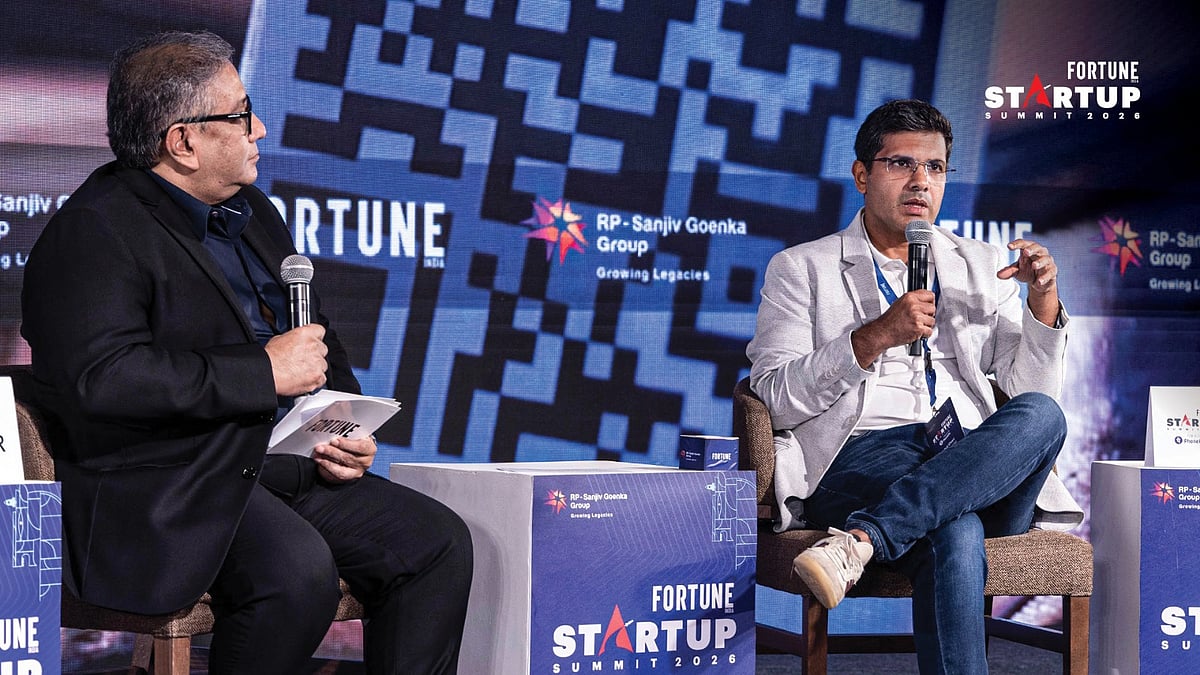
India’s digital payments success story may be celebrated globally, but the journey is far from complete, according to PhonePe co-founder Rahul Chari, who cautions that both payments penetration and fintech monetisation models remain works in progress.
Speaking with Fortune India Editor-in-Chief Sourav Majumdar at the Fortune India Startup Summit in Bengaluru on Thursday, Chari said the narrative that payments in India are “solved” is misplaced, even as UPI adoption scales rapidly.
Chari stressed that while a large segment of users has become digitally native, the depth of usage remains limited.
“Payments itself is not done. If you look at a macro level, we probably have two sets. One large set of users who are now digitally native on payments, but there’s still a huge opportunity to deepen that relationship.”
He pointed to everyday use cases such as informal transit systems in smaller towns that are still in the process of digitisation.
“You go into Tier-II and beyond… the number of shared tuk-tuks and buses… making that much more formal than the informal model of it… there are many such opportunities where you can deepen the relationship of payments itself.”
At the same time, a large portion of India’s population has yet to fully enter the digital payments ecosystem.
“There is the other set that has still not come out to payments… They continue to use feature phones. It’s our responsibility to bring them into digital payments irrespective of whether they will go into smartphones or not.” PhonePe dominates India’s UPI market with a roughly 50% share by transaction volume, processing over 10 billion transactions a month.
Chari outlined PhonePe’s long-term vision through what he described as a consumer journey framework—moving from payments to broader financial services. “We’ve this consumer journey principle: it’s called ‘send money, spend money, manage and grow’… This goes towards true financial inclusion.”
This includes expanding access to insurance, credit and investments, but with a clear caveat: products must be introduced at the right stage of a user’s lifecycle.
In one of his strongest remarks, Chari pushed back against the dominant fintech strategy of relying heavily on lending as the primary monetisation engine. “There is normally this approach… of saying let’s make lending the holy grail of monetisation, and everything else is basically customer acquisition.”
He warned that such an approach creates pressure to scale lending rapidly, often at the cost of sustainability. “It puts immense amount of pressure to lend fast and grow from there.”
Instead, PhonePe’s model focuses on monetising across multiple touchpoints. “In every use case is there an opportunity to directly monetise that, however small… from every user’s interaction on the platform… at scale makes massive sense as a business,” he said.
Chari also highlighted the company’s deliberate choice to avoid the traditional venture capital route in favour of long-term strategic backing.
“To build what we want to build… population-scale payments infrastructure… is a long game. It requires patient capital.”
PhonePe eventually aligned with Flipkart and later Walmart, a move Chari said allowed the company to focus on long-term execution rather than short-term fundraising cycles.
“Building sometimes takes a backseat… we preferred… a strategic model.”
Chari also pointed to regulatory constraints as a key hurdle for the payments ecosystem.
“If we’re able to have a merchant discount rate (MDR) that we can charge merchants…it could become a direct business line of payments…you would see significantly more Indian capital backing us.”
He added that while Indian capital participation is rising, there is still a need for greater conviction. “There are still a lot of followers than leaders. Taking a view of leading is important.”
Chari’s comments stress a critical reality: while India has built a world-class payments infrastructure, the ecosystem is still evolving.
The next phase, he suggests, will be defined not just by adoption, but by depth of usage, sustainable monetisation, and the ability to extend financial services responsibly across the population.