

Dear subscriber,
Good morning! This week brings another wave of encouraging developments across Indonesia’s digital ecosystem. Several homegrown companies are showing stronger maturity across Indonesia’s digital ecosystem. Fintech players like Kredivo are expanding regionally with its move into Vietnam, while digital banks such as Bank Jago and Superbank continue to gain momentum. Platform companies are also evolving their business models, with Bukalapak leaning into gaming-driven growth and GoTo progressing toward sustainable profitability. Meanwhile, sectors like beauty commerce, digital lending, proptech, and retail investing, represented by Sociolla, Akulaku, ERA, and Bareksa, continue to gain traction as Indonesia’s digital economy becomes increasingly diversified.
Alongside this growth, the ecosystem is also entering a new structural phase. New leadership at the financial regulator signals continued support for financial innovation, while cross-border capital from Korean investors and Southeast Asian venture funds reinforces Indonesia’s position as a key regional market. At the same time, the government is starting to reshape the youth internet through policies regulating AI use in schools and social media access for minors, pointing toward a more responsible and future-ready digital landscape.
Thanks for reading RISE by DailySocial! Subscribe for free to receive new posts and support my work.
CRM, project management, financial tracking, AI-powered campaigns, automated reporting & more — 10+ modules, fully interconnected. Projects link to tasks, contacts link to deals, transactions link to budgets. Nothing exists in isolation. Take control today at Blacksite!
Stay ahead,
DailySocial Team
Kredivo expands deeper into Southeast Asia.
Fintech platform Kredivo is strengthening its regional footprint after acquiring Vietnamese digital bank Timo, signaling a strategic push beyond Indonesia’s borders. The deal gives Kredivo access to Timo’s digital banking infrastructure and user base, allowing it to combine lending, payments, and banking services into a more integrated ecosystem. The move reflects a broader trend of Indonesian fintech companies scaling regionally as they mature. For Indonesia’s tech ecosystem, it highlights how local fintech players are evolving from domestic disruptors into regional financial platforms. The expansion also underscores growing investor confidence in Indonesian fintech models that can be exported to neighboring markets.

Korean tech investors continue betting on Indonesia’s growth story.
South Korean companies are increasing their investments in Indonesia as part of broader expansion into Southeast Asia’s digital economy. Korean firms are eyeing opportunities across sectors including digital infrastructure, manufacturing, and consumer technology. The continued inflow of capital from Korea reflects confidence in Indonesia’s large consumer base and rapidly digitizing economy. Cross-border partnerships like these often accelerate technology transfer and ecosystem development. For Indonesia, the trend reinforces its position as one of the region’s most strategic markets for global investors.
Bukalapak’s gaming segment drives strong revenue growth.
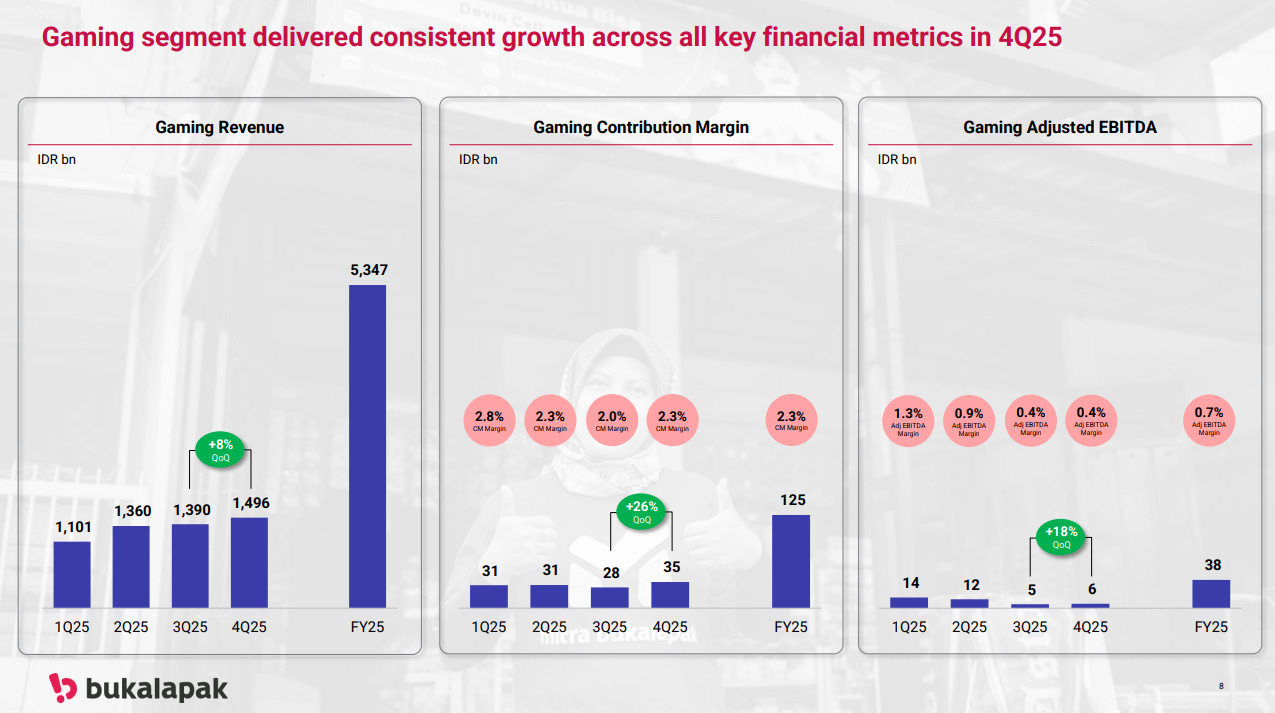
Bukalapak posted strong revenue expansion in 2025 as its strategy around digital goods and gaming continued to gain traction. The company recorded total revenue of about IDR 6.5 trillion, up 46% year-on-year, reflecting the growing contribution of its digital gaming marketplace and other online services. Gaming has become the largest revenue contributor, generating around IDR 5.3 trillion in FY2025 and highlighting the platform’s shift toward high-frequency digital transactions. This pivot toward digital goods has helped Bukalapak strengthen monetization while diversifying beyond traditional ecommerce.
Bank Jago continues to build momentum in Indonesia’s digital banking landscape.
Digital lender Bank Jago delivered another year of steady growth in 2025, driven by its ecosystem-based banking strategy and continued product innovation. The bank expanded its customer base to over 18 million users while strengthening engagement through the Jago App, which offers personalized financial management features such as customizable “Pockets” and foreign currency savings. Strong partnerships with digital platforms and financial institutions also supported loan growth and broader service adoption across Indonesia’s digital economy. Alongside rising deposits and lending activity, the bank reported net profit of Rp276 billion, more than doubling from the previous year, reflecting disciplined risk management and healthy asset quality.
GoTo shows profitability progress amid strong transaction growth.
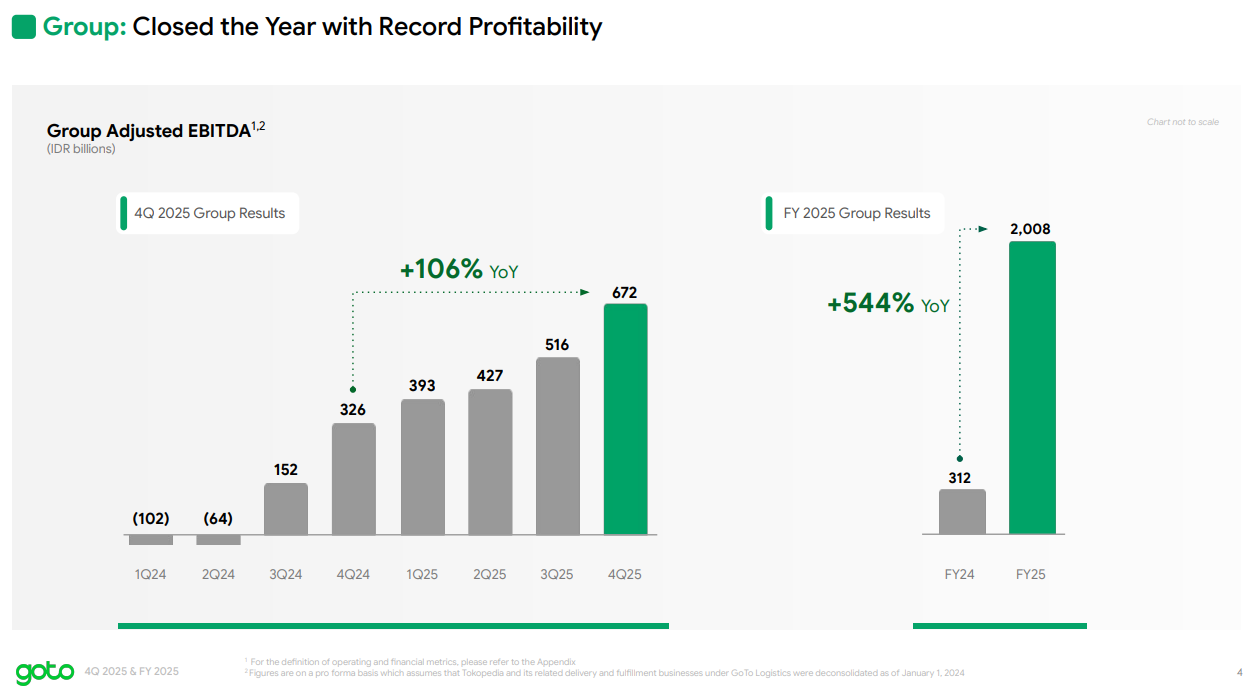
GoTo Group continues to demonstrate stronger financial discipline as its ecosystem scales. In its latest earnings, the company reported a significant profitability milestone with adjusted EBITDA rising to around IDR 2 trillion for the year, marking more than fivefold growth year-on-year. The improvement was driven by stronger monetization across its on-demand services, ecommerce, and fintech segments, alongside more efficient operations. Growth in transaction activity across the platform also reflects deeper ecosystem integration between its services. For Indonesia’s tech ecosystem, the results highlight how large platform companies are gradually shifting from aggressive expansion toward more sustainable and profitable growth
Superbank reaches a new milestone in Indonesia’s digital banking sector.
Digital lender Superbank recorded a profit of Rp143.3 billion in 2025 and officially moved up to KBMI 2 classification, signaling stronger capital and operational scale. The upgrade places the bank in a higher regulatory tier within Indonesia’s banking system. The bank’s growth reflects rising demand for digital financial services across the country. Achieving profitability at this stage is also notable for a relatively new digital banking player. It shows how digital-native banking models are gradually gaining regulatory recognition and market trust.
Sociolla’s beauty commerce strategy continues to mature.
Beauty retailer Sociolla reported improving financial performance as it strengthens its omnichannel retail strategy across Southeast Asia. By combining ecommerce, offline stores, and private-label products, the company has built a strong brand presence among young consumers. Revenue growth and operational efficiency have helped the company move closer toward sustainable profitability. The development highlights the resilience of Indonesia’s beauty and lifestyle sector within the broader digital economy. It also demonstrates how niche vertical platforms can thrive alongside large general marketplaces.
Akulaku posts strong profit growth in digital finance.
Fintech firm Akulaku reported solid profit growth in 2025, reflecting rising demand for digital credit and installment services. The company’s platform combines consumer financing, payments, and digital banking services across several Southeast Asian markets. Improved risk management and stronger loan performance contributed to the positive results. The growth indicates how digital lending continues to play an important role in expanding financial access. It also reinforces Indonesia’s position as a leading market for fintech innovation.

Indonesia prepares for new leadership at the financial regulator.
Indonesia’s parliament selected Friderica Widyasari Dewi as the new chair of the Financial Services Authority (OJK), marking an important transition for the country’s financial oversight. Her appointment signals continuity in regulatory stability while supporting the growth of fintech and digital banking sectors. The leadership shift comes at a time when financial innovation is accelerating across the country. Strong regulatory leadership will be crucial in balancing innovation with consumer protection. The decision is expected to provide clarity and confidence for investors and industry players alike.
Bareksa strengthens Indonesia’s mutual fund ecosystem.
Investment platform Bareksa is expanding its mutual fund offerings as retail investor participation continues to rise in Indonesia. By providing easier digital access to investment products, the platform has helped introduce more Indonesians to capital market instruments. The company is focusing on diversifying product offerings to meet growing investor demand. The development reflects increasing financial literacy and interest in wealth management solutions. It also signals a broader shift toward digital investment platforms within Indonesia’s financial ecosystem.
ERA secures new funding to scale property technology solutions.
Property technology company ERA has raised new funding to expand its digital real estate platform and services. The company aims to enhance property transactions through technology-driven tools and improved customer experiences. Investors are increasingly interested in proptech as the real estate sector modernizes. The investment highlights how traditional industries are gradually embracing digital transformation. For Indonesia’s growing urban population, technology-enabled property platforms could play a key role in improving market transparency and accessibility.
Digital fraud reports highlight the urgency of cybersecurity innovation.
Indonesia records around 1,700 digital fraud reports per day, illustrating the scale of cybersecurity challenges in the country’s rapidly expanding digital economy. The data underscores how financial scams and online fraud continue to evolve alongside digital adoption. While the numbers are concerning, they also highlight opportunities for cybersecurity startups and financial institutions to strengthen digital protections. As digital payments and online services continue to grow, demand for secure infrastructure will only increase. Strengthening trust will be key to sustaining the next phase of Indonesia’s digital growth.
Telkom strengthens healthcare services through strategic partnerships.
Telkom’s healthcare subsidiary AdMedika has partnered with Singapore-based Fullerton Health to expand digital healthcare services in Indonesia. The collaboration aims to improve healthcare access through integrated digital platforms and insurance services. The partnership reflects rising interest in digital health solutions across the region. With Indonesia’s large population and growing middle class, the healthcare sector presents significant opportunities for innovation. Strategic collaborations like this could accelerate the modernization of healthcare delivery.
Climate-focused venture capital gains momentum in Southeast Asia.
ACV Capital has launched a new climate-focused investment fund aimed at supporting startups developing sustainability solutions. The initiative reflects growing investor interest in climate technology and green innovation across Southeast Asia. The fund will back early-stage companies working on climate resilience and energy transition. Indonesia’s abundant natural resources and environmental challenges make it a promising market for such solutions. Increased climate-tech investment could unlock new opportunities for sustainable economic growth in the region.
Indonesia is beginning to reshape how children interact with digital technology. A new set of policies from the government targets both AI usage in schools and social media access for minors, signaling a broader shift toward tighter digital governance. In education, students from elementary through high school will no longer be allowed to rely on AI chatbots to directly answer assignments or exam questions. At the same time, the Ministry of Communication and Digital Affairs (Komdigi) plans to restrict social media access for users under 16, potentially affecting around 70 million young users across the country. Together, these moves represent one of the most significant policy interventions in Indonesia’s digital ecosystem in recent years.
For platform companies, the implications are immediate. Regulators have warned that platforms allowing under-16 users to create accounts could face administrative sanctions ranging from fines to potential service blocks. This effectively forces social media companies to rethink user acquisition strategies in Indonesia, where teenagers have historically been a core growth engine. Some platforms have already begun emphasizing their child-safety infrastructure,for example, TikTok has highlighted dozens of safety tools designed specifically for younger users in response to the regulatory shift.
Zooming out, the policy direction suggests Indonesia is aligning with a broader global trend: governments asserting stronger oversight over the relationship between technology platforms and young users. Beyond individual rules, regulators are also introducing platform risk classifications based on content and interaction patterns, which could determine the level of compliance obligations for each digital service. If implemented fully, this framework could reshape the country’s digital market, pushing companies to design products with built-in safety standards while redefining how growth, engagement, and responsibility are balanced in one of the world’s fastest-growing internet economies.
Indonesia is not just regulating platforms, it is setting the foundation for a child-safe digital economy. For tech companies, compliance may become as critical as product innovation. For the broader ecosystem, the next phase of the internet may no longer be defined solely by scale and engagement, but by how responsibly platforms serve the youngest generation of users.
Source link