

Tale of 3 startups: Education through experience, digitising African tour operators and solving payments for small businesses
Africa receives 90 million tourist arrivals a year. Spain alone receives more. A continent of breathtaking biodiversity, ancient culture, and unmatched wilderness experiences is, by most global travel metrics, still flying under the radar.
Three entrepreneurs who have staked their careers on changing that gathered at WiT Africa to talk about what it’s going to take.
Three different paths to the same frontier
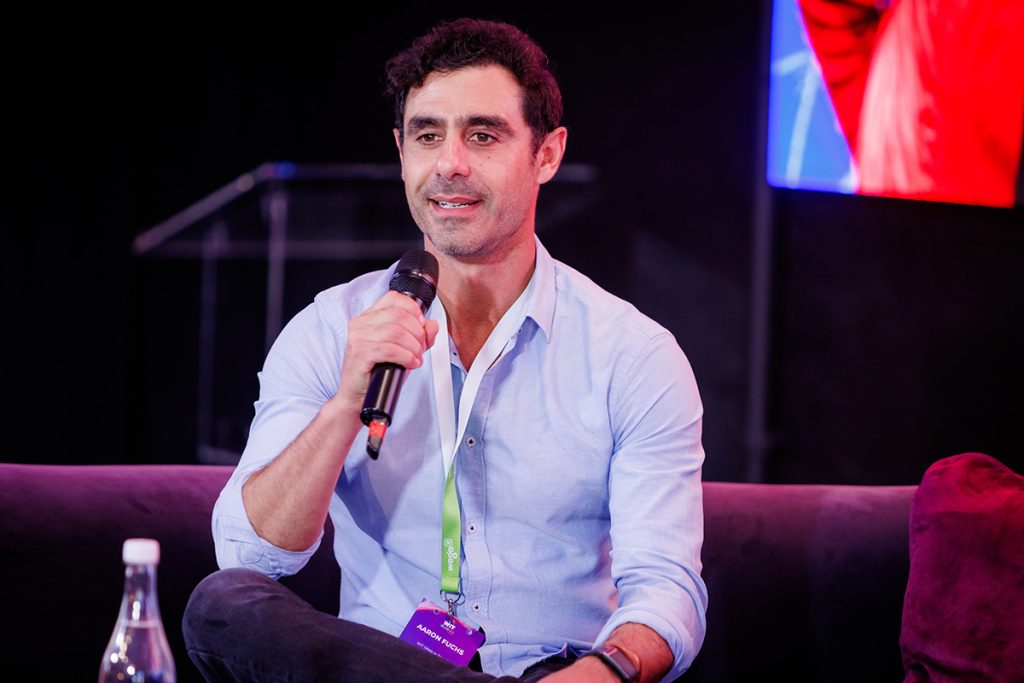
Aaron Fuchs grew up on a farm in South Africa and won a scholarship to Yale. After a brief stint on Wall Street at a hedge fund, he returned home struck by how much he had learned in six weeks of real-world finance relative to his entire college career.
That disconnect became the founding insight of iXperience, a company that combines intensive skills courses, work experience, and immersive travel into programmes for international students. Since then, roughly 5,000 students from institutions including Harvard, Princeton, and Stanford have come through Cape Town on iXperience programmes.
Said Fuchs, “There’s a crisis in education, but there’s an opportunity in travel. When you combine workforce readiness with global mobility, you get a new kind of model for learning.”
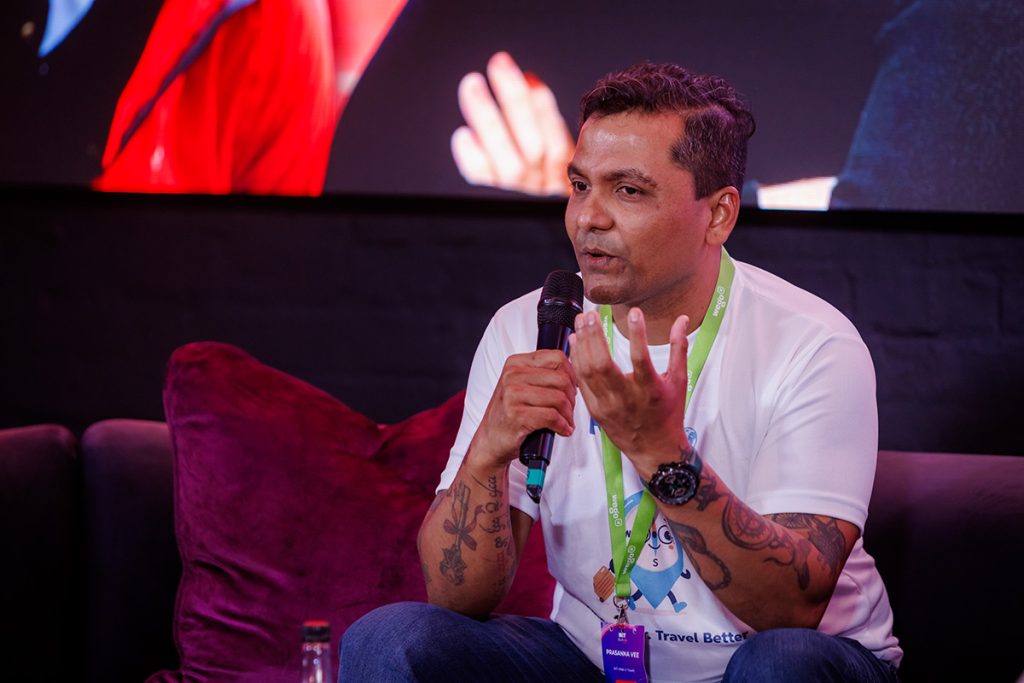
Prasanna Vee took the classic route from India to a tech career – a decade at Microsoft in Seattle – before a restless love of travel pulled him in a different direction. Having visited all 195 countries (195, he corrects anyone who counts Western Sahara separately), he spent the following decade working with travel startups across Taiwan, Denmark, Germany, Singapore, Malaysia, and India before landing in Uganda.
There he co-founded Tripesa, an AI-powered marketplace designed to digitise African tourism operators who are, as he puts it, “digitally invisible”. The company’s latest product, Romio, is an AI-powered custom travel marketplace built to connect those ground-level operators directly with travellers.
Alon Stern arrived at the travel industry through a global life that has taken him to nearly 100 countries, including Antarctica and Greenland. His company, Turnstay, solves a more structural problem: as a global merchant of record focused on travel, it enables African hotels and tour operators to accept card payments from Europe and the United States at dramatically lower rates – around 1.5% – by handling the compliance and financial infrastructure that most small operators simply cannot access.
AI and the shift in education towards soft skills
Asked to imagine the industry a decade and a half from now, all three founders returned to a common thread: AI will reshape the front end of the travel experience, but the most durable value will be created at the back end – in infrastructure, financial rails, and the irreplaceable human moment at the end of the supply chain.
For Fuchs, the 15-year horizon is partly an education story. Africa remains a dark horse in global student travel – more students study abroad in Italy than in the whole of Africa and Latin America combined.
Perception is the primary barrier. He describes speaking regularly to parents who want to refuse their child’s request to attend an iXperience programme, convinced that Africa is simply too dangerous.
Aaron Fuchs: “There’s a crisis in education, but there’s an opportunity in travel. When you combine workforce readiness with global mobility, you get a new kind of model for learning.”
Shifting that narrative, he argues, requires showing the infrastructure of cities like Cape Town, which in many respects outpaces comparable areas in the United States.
But the bigger future story, in Fuchs’s view, is about what education is for. The skills market has already been upended. Two years ago, iXperience’s most popular course was data science and AI.
Now it is among the least popular – students who enrolled in computer science degrees two years ago are anxious about career prospects in an AI-saturated job market and pivoting toward business programmes instead. The future of student travel, he argues, is soft skills: leadership, intercultural communication, creativity, and the ability to operate across global contexts.
AI in discoverability and operational efficiencies
Vee frames the AI opportunity in terms of planning and discoverability. Travellers coming to Africa for the first time are often paralysed by unfamiliarity – they do not know how to compare gorilla-trekking options across Uganda, Rwanda, and the DRC, or which option best balances cost, comfort, and conservation impact.
AI changes this. Smarter planning tools will allow travellers to navigate these decisions without needing to rely on expensive international agents who often take a substantial cut before the money reaches any African operator. The second shift Vee anticipates is in discoverability for operators – the AI-era equivalent of GEO, or Generative Engine Optimisation, could level a playing field currently dominated by the global OTAs.
Prasanna Vee identifies a fundamental mismatch between how investors typically model travel businesses and how travel actually works. Travel, he notes, is not like food delivery or streaming. People take one or two significant trips a year, not daily or weekly purchases.
He said, “Digitally invisible. That is what most of the operators actually providing the services in Africa are right now. The big platforms get the safari bookings, and most of the money stays outside Africa.”
Stern sees AI reshaping the industry in two distinct ways. The first is operational efficiency: AI agents replacing back-office functions in hotels – accounting, inventory management, communication – allowing smaller properties to compete without large teams. The cost of running a boutique hotel drops significantly when an AI agent can handle what once required a dedicated department.
The second shift is in how travellers research and decide. He envisions a world in which humans remain in the loop for the emotional, exploratory part of travel planning, chatting with AI agents that help them discover and decide, before handing off the administrative work of booking. The question, for him, is what the underlying infrastructure needs to look like to support that flow: safe, fast fund movement; real-time inventory; reliable information pipelines.
Investors, leakage, and the case for African tourism
The conversation turned, as most African startup conversations eventually do, to money –specifically why investors have been slow to back travel tech on the continent, and where African tourism revenues actually end up.
Vee identifies a fundamental mismatch between how investors typically model travel businesses and how travel actually works. Travel, he notes, is not like food delivery or streaming. People take one or two significant trips a year, not daily or weekly purchases. Standard VC metrics around growth rates and conversion funnels do not map cleanly onto a sector with inherently longer purchase cycles and very high average transaction values. Until investors develop fluency in travel-specific KPIs, they will continue to misread the sector’s potential.
Alon Stern sees AI reshaping the industry through operational efficiency and in how travellers research and decide. He envisions a world in which humans remain in the loop for the emotional, exploratory part of travel planning.
Stern observes that Africa’s VC landscape has historically been dominated by fintech, and for good reason. Almost every other sector’s digital infrastructure depends on the financial rails working first. As those rails mature, the argument goes, capital will flow upward into adjacent sectors including travel.
He adds a structural critique of African startup culture more broadly: too many founders have chased high valuations without first building sustainable, cash-generating businesses. His own perspective has shifted significantly. He now prioritises low operating costs, contracted recurring revenue, and demonstrable unit economics over headline growth. Investors, he says, will come for companies like that regardless of sector.
Fuchs makes the market-size argument bluntly: Africa’s tourism sector is worth approximately $186 billion across the continent. It is not a niche. The challenge is partly one of framing — travel tech in Africa has not yet been packaged for investors the way agritech or fintech have been, and founders addressing global problems that happen to be solved first in Africa may have more success than those pitching Africa-specific plays.
– Ben Peterson, Purple Elephant Ventures
The revenue leakage issue – how much of international tourist spending actually circulates within African economies – was also addressed.
The short answer, according to Peterson, is not much: in East Africa, 30% goes to international agents immediately, and the remainder that reaches safari operators often sits in offshore accounts. The operators actually driving the vehicles, guiding the walks, and cooking the meals see a thin sliver of what the end traveller paid.
Stern argues that is where AI-driven disintermediation could have the most transformative economic impact if it allows travellers to book more directly with the people providing the service.
The parts of travel that will always need a human
Onto the big question – if AI displaces so much, what remains?
Fuchs said he spent years wishing he had built a software company instead of an experience business – envying the lower operational complexity. That view has reversed. Friends running pure software companies now envy the defensibility of a business built on physical relationships, institutional partnerships, and compounding logistical infrastructure. The harder something is to replicate, the more durable it is.
For iXperience, that defensibility comes from the relationships with universities and employers that took years to build, and from the lived experience itself – a game drive or an immersive work programme is not something a language model can generate.
Vee maps the travel customer journey onto the AI disruption question: dream, plan, book, and experience. AI, he believes, will dominate the first two stages. The booking and the on-the-ground experience are more resistant.
He cites the observation that people genuinely enjoy scrolling through 100 hotel options – the planning is itself pleasurable, not merely a means to an end. And the experience itself – someone meeting you at the airport, loading you into a vehicle, pointing out a leopard in the grass — remains irreducibly human.
Stern repeated his hope – and prediction – that AI functions as a great disintermediator, eliminating layers of the value chain that aggregate demand. The person designing the bespoke itinerary deserves compensation. The booking platform that is simply capturing traffic from aggregated listings deserves less.
Whoever is, as he puts it, “changing your linen” and the hotel that employed them should receive the lion’s share of what the traveller paid.
Startup ideas that don’t exist yet but should
The panel closed with a challenge: name one startup idea that should exist but doesn’t. Three ideas emerged.
Prasanna Vee: Last-minute distressed room bidding
A mobile platform that allows hotels with unsold rooms to post real-time bid opportunities to nearby travellers. A room that will go empty tonight has zero value to the hotel; a traveller walking down the street might pay 40% of rack rate for it. The revenue management logic exists – the consumer-facing bid interface does not.
Aaron Fuchs: LocalPal, WhatsApp concierge for travellers
A scan-and-chat product that gives arriving travellers instant access to a curated local concierge via WhatsApp. “Tell me a coffee shop locals actually go to.” “Book me dinner tonight, nothing touristy.” Local operators get distribution; travellers get authenticity. The business model is a simple booking cut.
Alon Stern: Open inventory API for African hospitality
A universal, open-standard API through which any hotel or experience operator can publish real-time availability and accept bookings without intermediaries capturing the inventory and charging for access to it. The data belongs to the hotels. They just want people in the rooms.
Which one would you bet on?
What’s for sure is, these three entrepreneurs are making their own bets on taking Africa travel into the future.
Source link