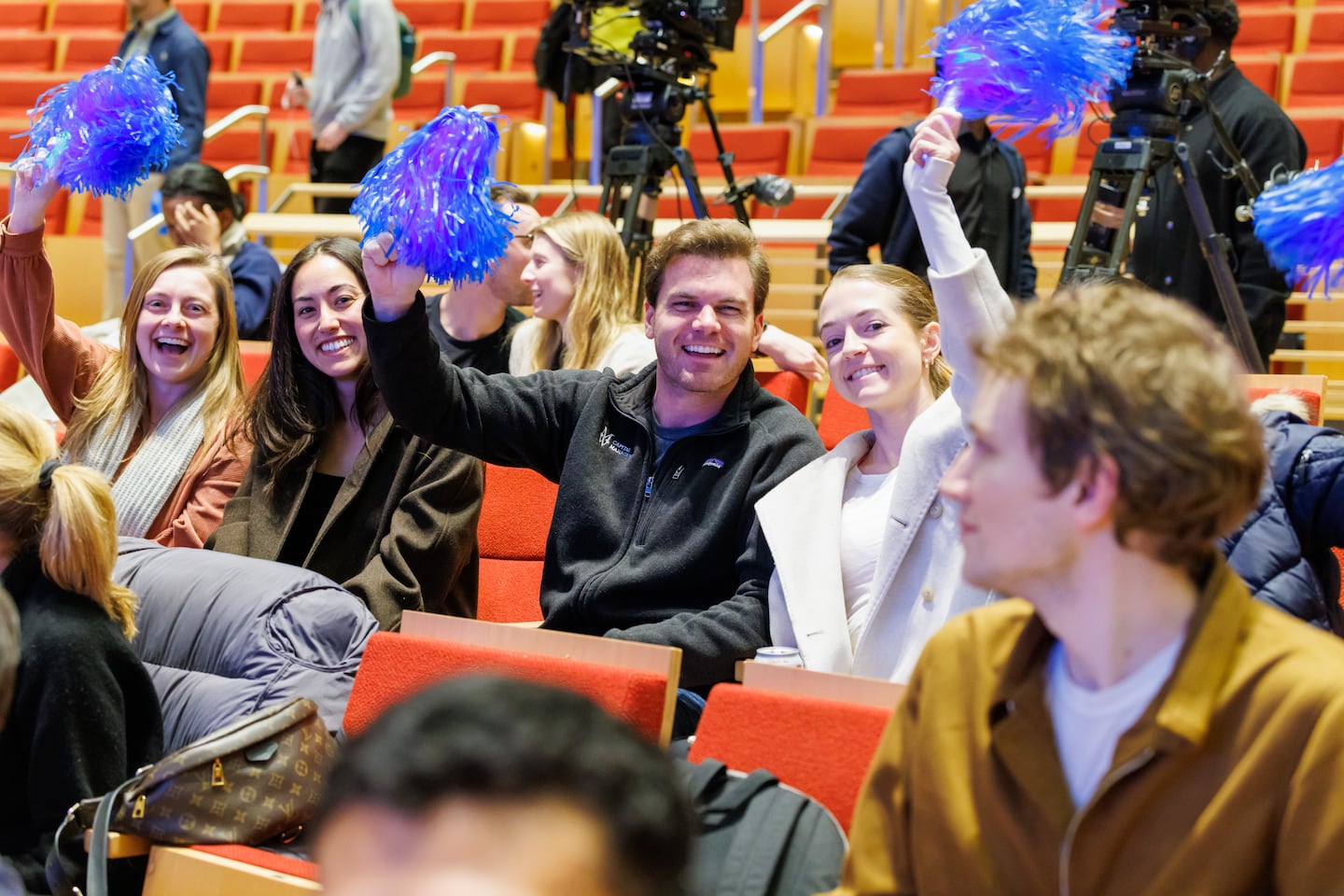



Usually a buttoned-down venue for hosting investment conferences or talks by star executives, the hall was primed for a more raucous affair that night, as hundreds of friends and family of the student founders came to cheer, equipped with pom-poms and handwritten signs more typical of a Beanpot hockey final.
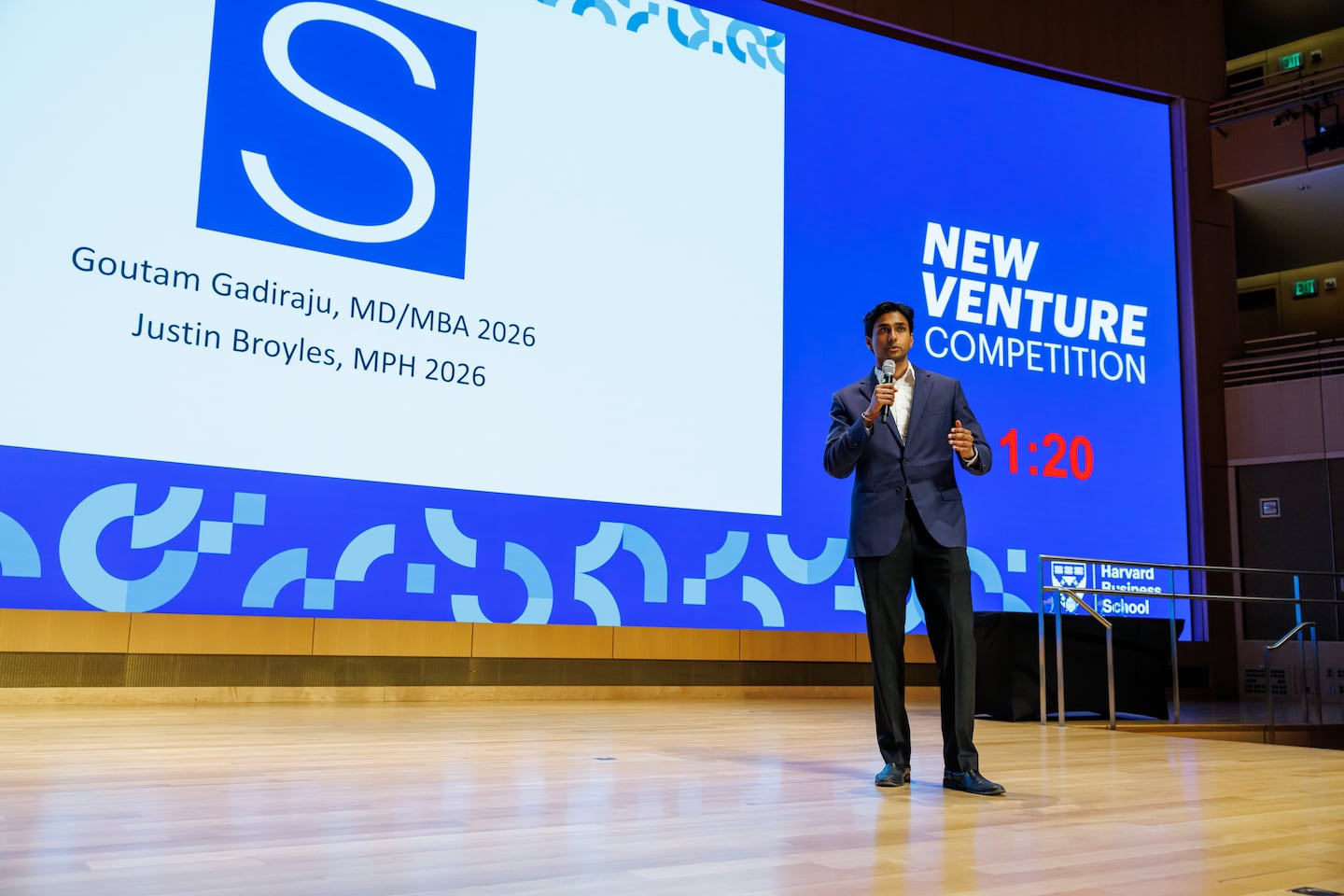
Eight out of an initial pool of 123 student-led startups came on stage to make their pitches, seeking prizes totaling more than $200,000 of seed capital to be awarded by a panel of judges including venture capital investors and experienced entrepreneurs.
“It’s the one time of the year where the students get to really celebrate their peers,” said Thara Pillai, director of the school’s Rock Center for Entrepreneurship that sponsors the competition. “They’re working so hard throughout the year, it’s a great way to bring the community together.”
The competition has been running for almost 30 years, amid a steady rise in the number of students interested in starting their own businesses. Last year, with 17 percent of grads founding a startup, appeared to be the highest since at least the late 1990s, according to research by HBS professor Josh Lerner. The data show some prior surges, in 2000 amid the internet bubble and in 2012 after the Great Recession, but not reaching the 2025 level.
The boom in artificial intelligence may be responsible for some of the recent surge, he said, as students see that AI software can do many of the functions of early-career jobs in consulting, finance, and tech.
“When you think about what analysts or even principals at many of these firms do, a lot of it is putting together slide decks, running numbers through spreadsheets, and so forth,” Lerner said. “You might regard that as pretty vulnerable to being automated with some of the tools coming down the pike.”
Many founders in the competition last month had become specialists in fields such as medicine, e-commerce, or engineering before entering business school. By going to HBS to learn how to build their startups — and build networks with classmates who might be able to fund those startups — they’re following the opposite path from famed Harvard dropouts Mark Zuckerberg and Bill Gates.
Goutam Gadiraju, 25, was in medical school at Harvard when he learned about some of the complications patients experience recovering from surgery. With one of his professors, he came up with an idea to replace surgical drains with a more flexible solution and started a business called Serosafe Surgical. To learn about the business side, he opted to enter Harvard’s joint-degree program for an MD and an MBA.
The medical device company won first place among for-profit startups at the competition. Meanwhile, Revolv, a startup aimed at turning organic waste into cheap animal feed and fertilizer in less developed countries, won the social enterprise category.
Both startups will receive $75,000.
Back in the late 1990s, the dot-com boom helped convince HBS to offer more programs related to startups, with a mandatory course on being an entrepreneurial manager added for all first-year students. In 2003, the school opened The Arthur Rock Center for Entrepreneurship on campus, named for the pioneering venture capital investor who graduated from HBS in 1951 and went on to back companies including Intel and Apple.
The upswing in entrepreneurship comes amid a broader trend in the US economy, with new business formation at record levels, according to the Census Bureau. More than half a million new businesses per month registered with the Internal Revenue Service in three out of the past seven months, a level only reached once before (in May 2021 at the height of the pandemic).
The rise has happened even as the overall funding environment for startups remains below the peak hit a few years ago.
And while most VC money the past few years has flowed to AI-related startups, most of the finalists at Harvard’s event had little connection to the technology. In addition to Serosafe, runner-up Lyv Health is working on medical lab testing and prescriptions. And Sensea, voted an audience favorite, is developing an underwater guidance system.
Harvard has run the contest since 1997, but lately has tweaked the event to focus less on the competitive aspects and more on mentoring and guidance. All entrants in the first round got to meet outside experts as judges and received at least 20 pieces of “actionable” feedback, everything from advice about their business model to what kind of employees they should be looking to hire next, Pillai said.
Jennifer Arnold, cofounder of Lyv Health, said she put all of the feedback into a huge Google Doc and tried to address it with her partner, Andrea Corleto. Though the startup won $25,000 as a runner-up, the feedback, such as being able to explain more clearly how much it cost the startup to acquire customers, was “the most valuable thing.”
“This idea is still evolving, we’re still making sure we’re adapting it to the best model,” she said. “Having all these really experienced, well-connected people take the time to give you advice and really detailed feedback, that’s invaluable.”
Lately, Boston tech companies and investors have been trying to convince more graduates of local schools to found companies here. But the pitch likely comes too late to keep Arnold.
“Boston has been fantastic,” she said. “But I do think we’ll probably land in either San Francisco or New York, just because of the concentration of capital and concentration of talent.”
🚫 Healey calls for action as AI nudes flood Mass. schools. Read more from education reporter Mariana Simões.
📱 Beacon Hill’s effort to restrict social media use by teens is clumsy and invasive, critics say. Read more from politics reporter Anjali Huynh and tech reporter Aaron Pressman.
💰 For the first time, startups in Texas raised more VC money than those in Massachusetts. Read more from tech reporter Aaron Pressman.
🤖 Work in a warehouse? This robot’s coming for your job. Read more from tech columnist Hiawatha Bray.
🩺 How reliable is medical advice from ChatGPT and other chatbots? Not very, says new Mass General Brigham study. Read more from health care reporter Jonathan Saltzman.
💵 Investment firm HarbourVest Partners in Boston raised $2.4 billion for its 13th venture capital and private equity fund.
☁️ Cloud storage company Wasabi Technologies in Boston raised a $250 million credit facility led by Bain Capital’s Private Credit Group.
🪖 Defense tech supplier The Elmet Group in Portland, Maine, filed to go public and raise about $100 million. Elmet plans to list on the Nasdaq and trade under the ticker symbol “ELMT.”
🧬 Life sciences AI infrastructure startup Alloy Therapeutics in Waltham raised $40 million in a deal that valued the company at $1 billion and included investors 8VC, JIC Venture Growth Investments, and Echo Capital.
🤝 Robotics and testing firm Teradyne in North Reading acquired semiconductor testing software firm TestInsight. Terms of the deal were not disclosed.
🔒 Cybersecurity company SpartanX in Boston raised an unspecified amount of funding in a deal led by Venture Guides.
🥼 Health care payments company Zelis in Boston hired Peter Durlach as chief strategy officer. Durlach previously was corporate vice president and chief strategy officer for health and life sciences at Microsoft.
🧪 Life sciences computing company d-wise in Boston hired Christine Oliver as president. Oliver previously was chief executive at Beaconcure.
💻 Software testing firm Applause in Boston hired Aatish Salvi as chief technology officer. Salvi previously worked at Hasbro, Teikametric, and Nanigans.
🙅♀️ Legislators in Maine passed the nation’s first statewide ban on large data centers, imposing a one-year moratorium on building the energy-intensive facilities.
👋 Apple chief executive Tim Cook is stepping down from the job that he inherited from the late Steve Jobs after 15 years. Apple’s head of hardware engineering, John Ternus, will take over as Cook shifts to executive chair of the board.
The Bezos Vs. Musk Space Race Is Heating Up (Wall Street Journal)
Tim Cook’s Impeccable Timing (Stratechery)
The F-35 Is a Masterpiece Built for the Wrong War (War on the Rocks)
👋 Thanks for reading. We’ll be will be back next Tuesday.
❓ Have a tip? Email Aaron at [email protected].
✍🏼 If someone sent you this newsletter, you can sign up for your own copy.
Aaron Pressman can be reached at [email protected]. Follow him @ampressman.
Source link