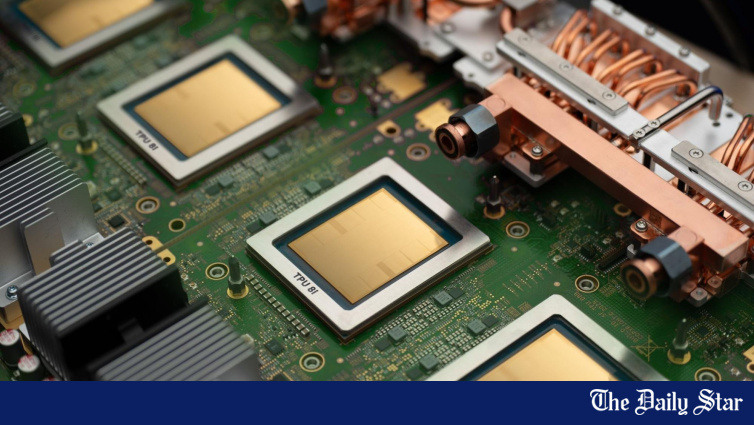
Google Cloud has unveiled two new artificial intelligence (AI) chips as part of its latest generation of tensor processing units (TPUs), signalling a deeper push into custom hardware while continuing to partner with Nvidia.
The company said on April 23 that its latest chips will be split into two categories: the TPU 8t, designed for training AI models, and the TPU 8i, intended for inference, the stage at which trained models process user queries and generate outputs. The approach mirrors a similar industry trend of optimising hardware for specific AI workloads.
In a recent blog, Google said the new chips offer significant performance gains over previous generations, including up to three times faster model training and improved cost efficiency. The company also highlighted the ability to link more than one million TPUs into a single cluster, potentially enabling large-scale computing tasks with lower energy consumption and reduced operational costs.
Despite the launch, Google is not moving away from Nvidia’s hardware. Like other major cloud providers, including Microsoft and Amazon, it is positioning its custom chips as a complement rather than a replacement. The company said it would continue to offer Nvidia’s latest processors, including its upcoming Vera Rubin architecture, within its cloud infrastructure.
The relationship between the two companies also extends to collaboration. Google said it is working with Nvidia to improve networking performance in data centres, including enhancements to Falcon, a software-based networking technology it developed and open-sourced through the Open Compute Project.
While Google Cloud is introducing new AI chips to lessen its reliance on Nvidia, the chipmaker continues to dominate the market, with a valuation approaching $5 trillion.