He said the framework favours legacy scale over EV‑specific capability, potentially undermining India’s long‑term electric mobility ambitions.
Mehta added that it is “hard to believe” policymakers would exclude startups at a time when electric‑first players have been instrumental in building India’s EV ecosystem. His remarks came after a senior government official said the PLI scheme is “not meant for startups but for global champions.”
I have had the opportunity to engage with several policy makers on the topic of Auto PLI excluding startups and I just can’t believe that they would think so!
It cannot be emphasised enough – current framing of Auto PLI needs to stay closely aligned with the moment India is in.… https://t.co/EcIM5Wbpal
— Tarun Mehta (@tarunsmehta) April 30, 2026
He said startups lack the capital and marketing muscle needed to compete at scale and therefore require policy support. While representations from startup OEMs have been received, he noted that there have been no discussions on introducing a separate PLI scheme for them.
Under existing norms, automobile OEMs must report at least ₹10,000 crore in global automotive manufacturing revenue and hold fixed assets worth ₹3,000 crore to qualify for the incentive—thresholds that effectively exclude most electric‑first manufacturers that started at a smaller scale.
Startups drove early EV investments, says Mehta
Mehta said India’s electric two‑wheeler ecosystem has taken shape over the past decade through the combined efforts of incumbents and electric‑first companies. He noted that several startups invested early in product development, software, power electronics and localisation—often without the backing of legacy scale—helping create what he described as a “vibrant and dynamic” EV market.
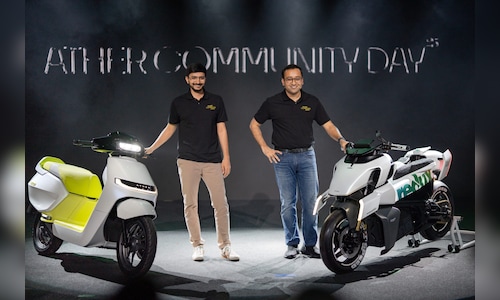
He added that many new‑age EV firms now lead not just in innovation but also in volumes and market share across segments. Citing Ather as an example, Mehta said the company has invested thousands of crores in research, development and manufacturing, employs more than 4,000 people directly, supports tens of thousands through its supply chain, and is investing ₹2,000 crore in a new greenfield manufacturing facility in Maharashtra.
13–16% cost disadvantage may shape EV market
At the heart of Mehta’s criticism is what he called a structural imbalance in the policy. He said the scheme puts emerging EV manufacturers at a “13–16% cost disadvantage” even as they continue to invest heavily in capability building. Defining industry champions by legacy scale rather than EV‑specific progress, he argued, could shape the market in ways that slow long‑term innovation.
A report by the Centre for Digital Economy Policy Research (C‑Dep) echoed this view, noting that innovation‑led OEMs investing in R&D, platform development, intellectual property and localisation remain excluded from PLI support if they fail to meet scale thresholds. This, the report said, sends a signal that scale is being prioritised over innovation. It added that operating at a “13–16% cost disadvantage” could discourage entry into technology‑intensive segments and hinder the pace of electrification.
What the PLI auto scheme is and who it benefits
The automobile and auto components PLI scheme, administered by the Ministry of Heavy Industries, aims to boost domestic manufacturing of advanced automotive technologies, including electric and hydrogen vehicles, while increasing localisation.
The programme has two components: the Champion OEM incentive scheme for battery electric and hydrogen fuel‑cell vehicles, and the Component Champion incentive scheme for advanced automotive parts. Incentives range from 13% to 18% for EV‑ and hydrogen‑related components and from 8% to 13% for other products. Eligible companies must also meet a minimum domestic value‑addition requirement of 50%.
According to government data, investments under the scheme have crossed ₹35,000 crore so far, resulting in the production of nearly 14 lakh electric vehicles and the creation of close to 49,000 jobs. Officials have said around 100 products are now being manufactured locally as a result of the incentive programme.
Of the 82 applicants under the scheme, 18 have been approved for incentives. Beneficiaries include large manufacturers such as Tata Motors, Mahindra & Mahindra, Maruti Suzuki, Bajaj Auto and Ola Electric. Nearly 70 vehicle models from Mahindra & Mahindra, Tata Motors and Bajaj Auto have qualified for subsidies under the scheme.
“Calibration, not overhaul”
Mehta said startups are already investing heavily in research, domestic value addition and indigenous development, and in some cases are ahead of the broader industry. He said DVA benchmarks are similar across PLI and non-PLI players, and it would be incorrect to assume startups lag in localisation.
He said what is needed is “calibration of PLI, not overhaul,” with more flexible eligibility aligned to localisation and R&D intensity. He added that if India aims to lead in electric mobility, policy must recognise where innovation and capability are being built.
Panel flags gaps, calls for flexibility
A parliamentary panel has also raised concerns about the scheme’s design and outcomes. The Department-related Standing Committee on Industry has recommended “calibrated flexibility or differentiated eligibility criteria” for startups and high-potential domestic players, particularly in the electric two-wheeler segment.
The panel noted that while cumulative investment of ₹39,081 crore is close to the projected five-year target of ₹42,500 crore, sales performance remains below expectations. It said job creation, at 61,241, is well short of the target of over 1.48 lakh jobs, and that ₹2,378 crore has been disbursed as incentives so far, representing a small portion of allocated funds.
C-Dep has suggested opening a limited window within the PLI framework for OEMs that already meet localisation benchmarks under PM E-DRIVE, and introducing explicit innovation criteria alongside financial thresholds. It said aligning eligibility across schemes would reduce fragmentation and improve policy coherence.