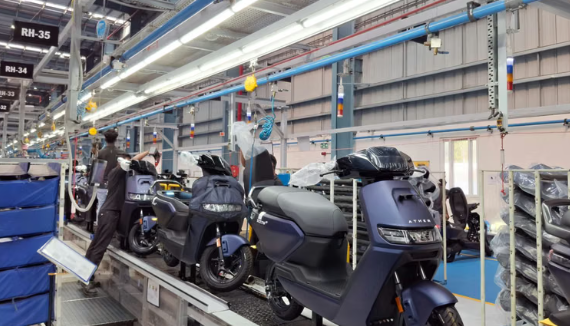



Two of India’s electric-first original equipment manufacturers (OEMs) have flagged the absence of a level playing field after the government made it clear that there is no proposal to include startups under the production-linked incentive (PLI) scheme for the auto sector.
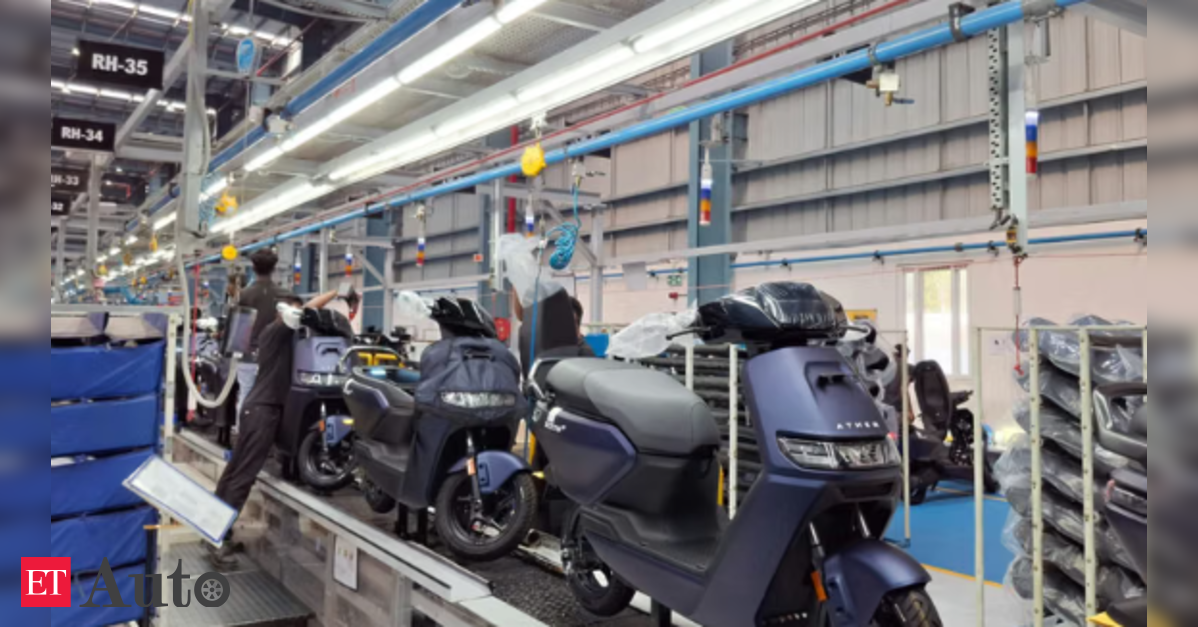
The scheme has a high turnover threshold for OEMs to qualify for subsidies, which are given to encourage local manufacturing. Since electric-first OEMs such as Ather Energy, Euler Motors and some others do not meet the eligibility criteria, they cannot get the benefits which are available to legacy OEMs such as TVS Motor Company, Bajaj Auto and also Ola Electric.
It places emerging EV manufacturers at a 13% to 16% cost disadvantage, at a stage where they are continuing to invest heavily in capability buildingTarun Mehta
“An EV policy architecture that defines champions primarily through legacy scale, not even scale within the EV industry, can create an unintended imbalance. It places emerging EV manufacturers at a 13 per cent to 16 per cent cost disadvantage, at a stage where they are continuing to invest heavily in capability building. Over time, this will influence how the market evolves, even as the goal is to build both scale and future-ready capability,” Ather Energy’s Co-Founder and CEO Tarun Mehta said on Thursday.Mehta’s comments have come after a senior government official said that the ongoing PLI for automobiles and auto components is not meant for startups.
“PLI schemes are not meant for startups but for global champions. Startups lack capital, marketing knowhow… They need hand-holding,” the official had said, adding that some representations by the interested startup OEMs had been received, but there were no discussions within the government on any new PLI scheme.
In its current structure, the auto PLI scheme risks prioritising past scale over future capabilitySaurav Kumar
Meanwhile, Saurav Kumar, Founder & CEO at Euler Motors, said that in its current structure, the auto PLI scheme risks prioritising past scale over future capability. “This creates a gap where several electric-first companies, which are investing deeply in innovation, localisation and new product categories, remain outside its ambit despite contributing meaningfully to the ecosystem,” said Kumar.
Comparing the electric vehicle industry to a train, Ather’s Mehta said, “If legacy businesses are the bogeys, startups and new-age companies are the engines. You cannot take the engine out of the equation and hope for the bogeys to move forward themselves. If India’s ambition is to lead in electric mobility, policy needs to recognise where innovation and capability are being built”.
Referring to the electrification of India’s commercial vehicle segment, Euler’s Kumar said that this was one of the most “underdiscussed parts of India’s EV transition”.
“I do not want to take away from what incumbents have done to build the industry…. However, going forward, policy should reward intent in the form of performance, innovation, people and investment, not just legacy/age,” he said.
The government’s reluctance to allow electric-first companies to avail the subsidies available to bigger OEMs under the PLI scheme has been criticised by a Department Related Standing Committee, comprising Members of Parliament.
In contrast, OEMs that meet scale thresholds receive cost advantages irrespective of innovation outputCentre for Digital Economy Policy Research
Even the Centre for Digital Economy Policy Research (C-Dep), a policy advocacy, has highlighted the exclusion of electric-first OEMs. It has pointed out that innovation-led OEMs that invested early in R&D, platform development, IP creation and localisation but had not reached scale at the time of the PLI scheme design remain outside the production-linked support.
“In contrast, OEMs that meet scale thresholds receive cost advantages irrespective of innovation output. This creates a signal that scale is prioritised over innovation capability in accessing policy support,” said C-Dep.
Speaking on the issue earlier, the government official quoted above had said that the existing PLI scheme cannot be tweaked to allow new entrants since it had been launched after approval of the Union Cabinet.
The PLI auto scheme has a Champion OEM incentive scheme for battery electric vehicles and hydrogen fuel cell vehicles across all segments. It also has the Component Champion incentive scheme for high-technology and high-value automotive components. For auto OEMs to qualify for incentives, the minimum global group revenue from automotive manufacturing must be at least ₹10,000 crore and the group’s fixed assets at least ₹3,000 crore.
Source link